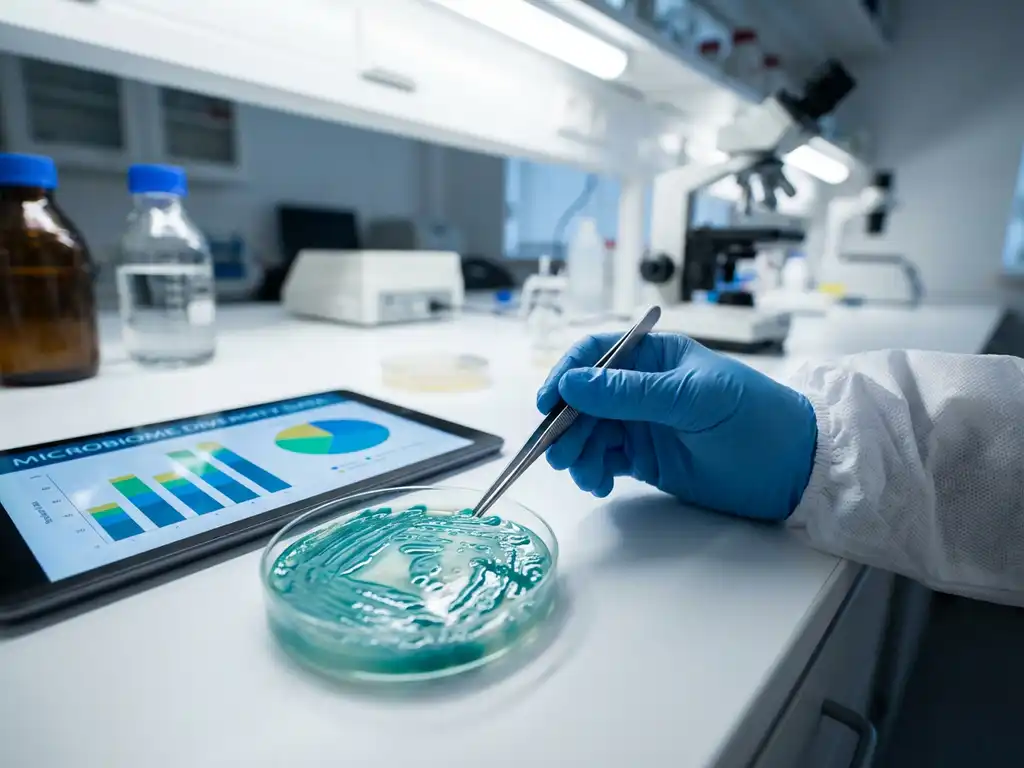
Companies across multiple industries require gut microbiome testing to develop products that interact with the human digestive system. Functional food manufacturers, pharmaceutical companies, biotechnology firms, nutraceutical producers, and animal nutrition companies all depend on reliable microbiome research to validate product efficacy, meet regulatory requirements, and reduce the risk of clinical trial failure. These organisations need predictive preclinical data to bridge the gap between laboratory findings and real-world outcomes.
What industries benefit most from gut microbiome testing services?
Five primary sectors rely heavily on gut microbiome testing: functional foods, pharmaceuticals, biotechnology, nutraceuticals, and animal health. These industries develop products that directly influence gut microbial communities and require robust scientific evidence for regulatory approval and commercial success.
Functional food companies create products with prebiotic fibres, probiotics, and other gut-modulating ingredients. They need mechanistic evidence to support health claims and demonstrate product differentiation in competitive markets. Pharmaceutical and biotech firms developing microbiome therapeutics require predictive models to reduce the high failure rates of expensive clinical trials.
Nutraceutical manufacturers face increasing regulatory scrutiny and consumer demand for scientifically backed supplements. Meanwhile, animal nutrition companies must optimise gut health formulations for pets and livestock, requiring species-specific microbiome research to improve digestibility and overall animal well-being.
Why do functional food companies need specialised microbiome testing?
Functional food companies require specialised testing to meet stringent regulatory requirements for health claims, satisfy consumer demand for evidence-based products, and demonstrate the mechanism of action of prebiotic and probiotic ingredients in their formulations.
Regulatory bodies such as EFSA and the FDA demand robust mode-of-action data before approving health claims. Traditional laboratory testing often fails to predict real-world effectiveness because it cannot replicate the complex, dynamic environment of the human gut. Companies need predictive models that can demonstrate how their ingredients will perform under physiologically relevant conditions.
Consumer awareness has increased dramatically, with buyers expecting scientific publications and evidence to support product claims. Companies must provide mechanistic insights showing exactly how their products modulate beneficial bacteria, produce short-chain fatty acids, or improve gut barrier function to justify premium pricing and build brand credibility.
What makes pharmaceutical and biotech companies seek microbiome research partners?
Pharmaceutical and biotech companies partner with microbiome research specialists to develop therapeutics, prepare for clinical trials, build regulatory dossiers, and access predictive preclinical models that significantly reduce the risk of costly trial failures.
The “Valley of Death” between preclinical research and clinical success represents a major challenge in microbiome therapeutics development. Traditional preclinical models often exhibit low biorelevance and fail to predict human responses, leading to clinical trial failure rates that can cost companies millions of pounds. Companies need validated, predictive models that can accurately forecast clinical outcomes.
Regulatory agencies require comprehensive mechanistic evidence demonstrating how microbiome therapeutics work at the molecular level. This includes understanding dose-response relationships, identifying responder versus non-responder populations, and establishing safety profiles. Companies must generate this evidence efficiently to support patent applications and regulatory submissions while managing development timelines and budgets.
How do animal nutrition companies use gut microbiome testing?
Animal nutrition companies use gut microbiome testing for digestibility studies, microbiome modulation research, and species-specific gut health optimisation across pet food formulations and livestock nutrition programmes.
Pet food manufacturers must demonstrate that their formulations support healthy gut microbiomes in cats and dogs, which have fundamentally different digestive systems from humans. They require species-specific testing protocols that account for variations in gut transit times, pH levels, and bile acid composition to develop effective products.
Livestock nutrition companies focus on improving feed conversion efficiency, reducing antibiotic dependence, and enhancing overall animal health through targeted microbiome interventions. They need rapid screening capabilities to test multiple formulations across different animal species, including poultry and swine, while understanding how dietary changes affect microbial communities and metabolite production in each species.
What should companies look for when choosing a microbiome testing partner?
Companies should prioritise partners that offer validated technology platforms with proven clinical predictivity, regulatory expertise, rapid turnaround times, and comprehensive reporting capabilities to support informed decision-making throughout product development cycles.
The most critical factor is predictive accuracy, validated through published studies demonstrating correlation between preclinical results and clinical trial outcomes. Partners must maintain the original microbial composition throughout testing and operate under physiologically relevant conditions, including appropriate pH, oxygen levels, and nutrient availability.
High-throughput capabilities enable testing across multiple donors (minimum 6–8 per cohort) to understand interindividual variability and identify responder versus non-responder profiles. This statistical power is essential for reliable results and reduces the risk of clinical trial failure. Additionally, partners should offer comprehensive services spanning early R&D screening through regulatory dossier preparation, with expert interpretation of complex multi-omics data.
How Cryptobiotix helps companies with gut microbiome testing
Cryptobiotix addresses these industry challenges through our proprietary SIFR® technology, which delivers validated, predictive insights that bridge the gap between preclinical data and clinical outcomes. Our ex vivo platform generates clinically relevant results within 1–2 days that mirror clinical outcomes that would otherwise require weeks of repeated intake.
Our services include:
- High-throughput screening across diverse human populations and disease states
- Validated clinical predictivity for taxonomy, metabolomics, and tolerability outcomes
- Comprehensive gastrointestinal simulation covering digestion, fermentation, and host-microbiome interactions
- Species-specific testing for cats, dogs, poultry, and swine applications
- Expert data interpretation with actionable insights for product development
Whether you’re developing functional foods, microbiome therapeutics, or animal nutrition products, our SIFR® technology provides the mechanistic evidence needed to secure intellectual property, build regulatory dossiers, and prepare for successful clinical trials. Contact us to discuss how we can accelerate and de-risk your product development journey.
Frequently Asked Questions
How long does it typically take to get results from gut microbiome testing?
With advanced ex vivo platforms like SIFR® technology, you can receive comprehensive results within 1-2 days, compared to traditional clinical studies that require weeks or months of repeated intake. This rapid turnaround enables faster decision-making during product development and significantly accelerates your time-to-market.
What's the minimum sample size needed for reliable microbiome testing results?
For statistically robust results, testing should include a minimum of 6-8 donors per cohort to account for interindividual variability in gut microbiomes. This sample size provides sufficient statistical power to identify responder versus non-responder profiles and reduces the risk of false positives that could lead to clinical trial failures.
How do I know if microbiome testing results will predict real-world clinical outcomes?
Look for testing platforms with published validation studies demonstrating correlation between preclinical results and actual clinical trial outcomes. The technology should maintain original microbial composition and operate under physiologically relevant conditions including appropriate pH, oxygen levels, and nutrient availability to ensure clinical predictivity.
Can the same microbiome testing approach be used for both human and animal applications?
No, different species require specialized testing protocols due to fundamental differences in digestive systems. For example, cats and dogs have different gut transit times, pH levels, and bile acid compositions compared to humans. Effective testing partners should offer species-specific protocols for your target application, whether human, pet, or livestock.
What types of data should I expect from comprehensive microbiome testing?
Comprehensive testing should provide multi-omics data including taxonomic analysis (which bacteria are present), metabolomics data (what compounds are produced), and tolerability outcomes. The best partners also provide expert interpretation of this complex data with actionable insights for product formulation, regulatory submissions, and clinical trial design.