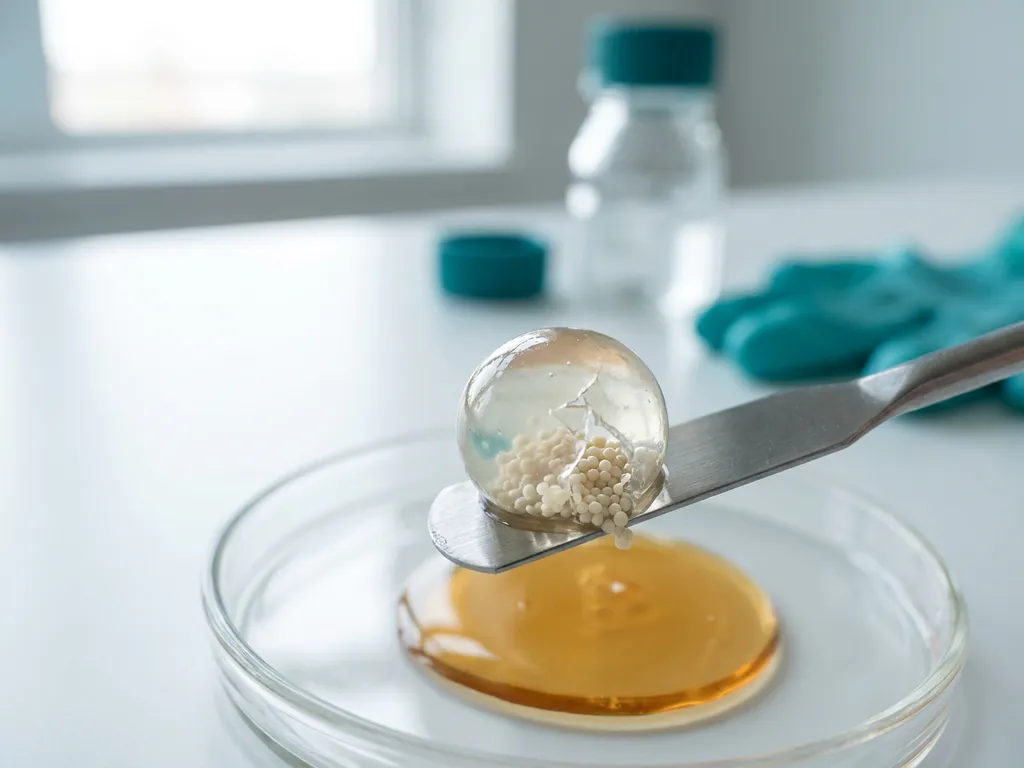
Encapsulation technologies affect probiotic survival in the gut by creating a physical and chemical barrier that reduces damage during processing, storage, and gastrointestinal transit. Well-designed probiotic encapsulation can improve gastrointestinal survival, enable controlled release, and increase the likelihood of meaningful colon delivery. The key questions are which stresses you need to protect against, how the capsule releases, and how to test viability in biorelevant digestion and fermentation conditions.
What is probiotic encapsulation and why is it used?
Probiotic encapsulation is the inclusion of live microorganisms within a protective carrier, while microencapsulation of probiotics typically refers to micron-scale particles or coatings. It is used to keep cells viable through manufacturing, shelf life, and GI transit, then release them where they can be active. For B2B developers, the goal is not “more CFU at any cost”, it is dose integrity and predictable performance.
Encapsulation is commonly used to:
- Reduce viability loss during heat, dehydration, and oxygen exposure in processing.
- Limit moisture-driven degradation during storage in powders, capsules, and foods.
- Buffer exposure to gastric acid and bile salts to support downstream colon delivery.
- Enable targeted release profiles, for example pH-triggered or time-dependent release.
How does the gastrointestinal tract reduce probiotic viability?
The GI tract reduces probiotic viability through sequential stressors that can inactivate cells before they reach the colon. The most damaging steps are low stomach pH, bile salts in the small intestine, and digestive enzymes, combined with mechanical shear and rapid environmental shifts. Sensitivity is strongly strain-specific, so survival assumptions rarely transfer between strains or formats.
Key stressors to consider in a survival hypothesis include:
- Acid stress: low pH can disrupt membranes and denature proteins.
- Bile salts: detergent-like effects can damage cell envelopes.
- Enzymes: proteases and lipases can degrade protective matrices and cell surfaces.
- Oxygen exposure: many strains are oxygen-sensitive during transit and handling.
- Osmotic stress: changes in ionic strength can impair cell function.
- Shear and mixing: physical forces can rupture weaker capsules or aggregates.
Which encapsulation technologies are most common for probiotics?
The most common encapsulation technologies for probiotics fall into polymer beads, lipid-based systems, drying-based matrices, and enteric or multilayer coatings. Each option trades off protection, release control, scalability, and cost. Selecting a platform usually starts with your processing constraints, required shelf life, and whether you need controlled release for colon delivery.
| Technology | Typical strengths | Common limitations |
|---|---|---|
| Alginate or alginate-chitosan beads | Gentle processing, good acid protection, tunable porosity | Variable release in bile, bead size can limit use in some formats |
| Lipid-based systems (liposomes, solid lipid particles) | Moisture and oxygen barrier, potential bile-responsive release | Formulation complexity, stability and scale-up constraints |
| Spray-drying with protective matrices | Industrial scalability, cost-effective powders | Heat and dehydration stress during processing, strain-dependent losses |
| Coacervation and emulsions | Good encapsulation efficiency, adaptable materials | Process sensitivity, potential solvent or surfactant constraints |
| Enteric coatings and multilayer systems | pH-triggered protection and delayed release | Coating integrity risks, added manufacturing steps |
How do encapsulation materials influence release and colon delivery?
Encapsulation materials influence release by controlling water ingress, diffusion, swelling, and matrix degradation, which together determine when cells are exposed and become metabolically active. For colon delivery, designs often rely on pH-responsive coatings that resist gastric conditions, or on enzyme and fermentation-triggered breakdown in the distal gut. Material choice also affects mucoadhesion, which can alter residence time and local concentration.
Practical design levers include:
- pH-triggered solubility: coatings that remain intact at low pH and dissolve at higher pH.
- Polyelectrolyte layering: alternating charged layers to reduce porosity and tune release.
- Fermentable matrices: inclusion of prebiotic substrates that can support post-release activity by providing local carbon sources.
- Diffusion control: adjusting cross-linking density to slow acid penetration and bile exposure.
How can you evaluate encapsulated probiotic survival and performance?
You can evaluate encapsulated probiotic survival by combining upper-GI digestion simulation with downstream colonic fermentation testing, then quantifying viable cells and functional outputs. A robust workflow separates “survival” from “activity”, because a formulation may protect CFU yet still fail to drive meaningful fermentation or interactions after release. Prioritise reproducibility through standardised protocols, controls, and consistent sampling times.
Common evaluation components include:
- Acid and bile challenge tests with defined exposure times and neutralisation steps.
- In vitro digestion models to assess capsule integrity and release kinetics.
- Simulated colonic fermentation to evaluate colon delivery, community interactions, and metabolite shifts.
- Viability assays: CFU plating, flow cytometry, and qPCR with viability dyes (to distinguish live from dead cells).
How to choose the right encapsulation strategy for your probiotic product?
Choose the right encapsulation strategy by matching the strain’s sensitivities and your product’s manufacturing realities to a release profile that supports colon delivery. Start with a clear target, for example survival through gastric acid, delayed release, or protection during spray-drying, then screen a small set of materials and processes before scaling. The best choice is the one that delivers consistent performance across batches and relevant microbiomes.
- Define the target site and performance readouts, viability, release timing, and functional activity.
- Map constraints, format, temperature, water activity, oxygen exposure, and shelf life.
- Shortlist 2 to 4 encapsulation approaches and run iterative screening on dose and process settings.
- Validate in digestion plus colonic fermentation, including inter-individual variability where relevant.
- Confirm regulatory and labelling feasibility for materials, claims, and manufacturing controls.
How Cryptobiotix helps with probiotic encapsulation and gastrointestinal survival
We help R&D teams generate decision-grade preclinical evidence on probiotic encapsulation, gastrointestinal survival, controlled release, and colon delivery, using validated ex vivo gut simulation to reduce translation risk and support development choices.
- Compare encapsulated versus non-encapsulated formats across digestion and colonic fermentation using SIFR® technology.
- Quantify survival, release behaviour, and downstream microbiome responses with mechanistic readouts aligned to scientific evidence.
- Support product-specific study design across sectors and matrices via our applications expertise.
If you want to de-risk an encapsulated probiotic concept before investing in expensive trials, contact us via our contact page to discuss your strain, format, and target release profile.
Key takeaways for R&D teams
Encapsulation can materially change probiotic survival, but outcomes depend on strain sensitivity, capsule chemistry, and release triggers. The most reliable development path is iterative screening followed by biorelevant digestion and colonic fermentation validation, using consistent viability methods and clear performance criteria.
FAQ: People also ask
- Does encapsulation guarantee probiotic survival?
No. Encapsulation reduces exposure to stressors, but survival still depends on strain robustness, processing conditions, and whether the capsule remains intact and releases as intended. - Is higher CFU after digestion always better?
Not necessarily. For B2B development, the goal is viable delivery plus functional activity after release, including compatibility with the resident microbiome and expected metabolite outputs. - What is the biggest failure mode in controlled release designs?
Mismatch between the trigger and the real GI environment, for example premature release in the stomach, or delayed release that reduces activity due to insufficient rehydration or nutrient access.