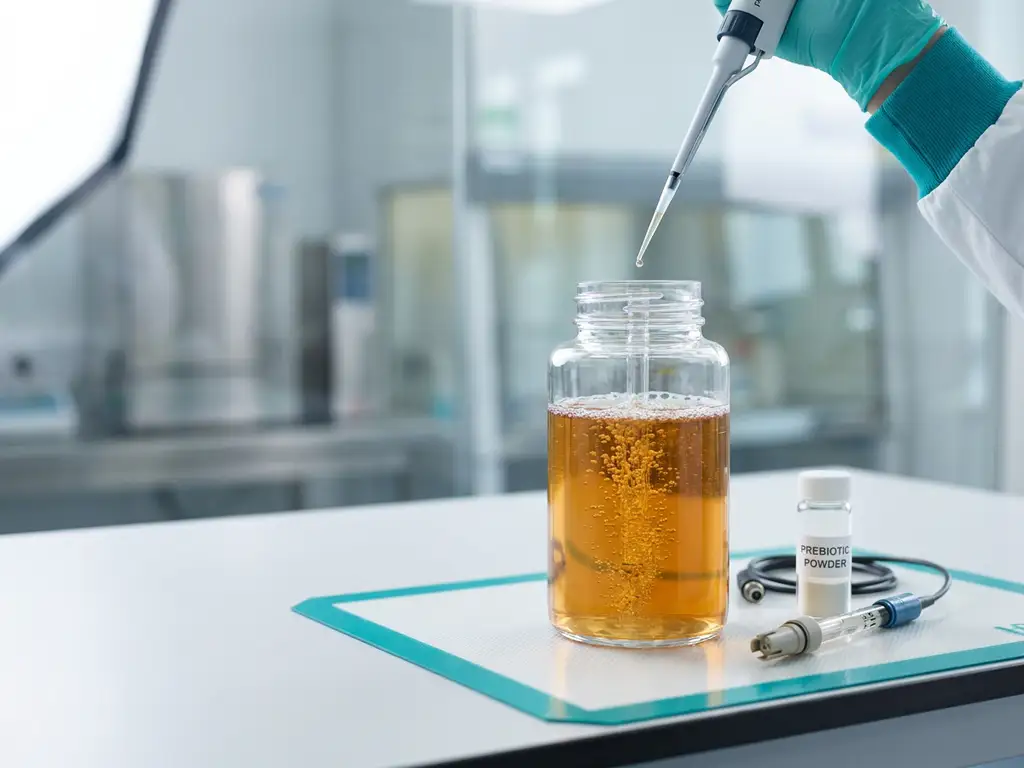
To test prebiotic fermentation using an ex vivo gut model, you incubate a defined dose of the prebiotic with a fresh, donor-derived colonic microbiota under anaerobic, pH-controlled conditions, then quantify fermentation outputs such as gas, pH shifts, short-chain fatty acids (SCFAs), and microbiome changes. The most useful setups also capture inter-individual variability across multiple donors and link metabolite profiles to the mechanism of action. Below are the key design, endpoint, control, and interpretation questions teams typically ask.
What are ex vivo gut models for testing prebiotic fermentation?
Ex vivo gut fermentation models are lab systems that keep a donor microbiota as close as possible to its original colonic ecosystem while exposing it to a test substrate. They simulate core colon conditions, including anaerobiosis, physiological temperature, controlled pH, and realistic retention time windows where non-digestible carbohydrates are fermented.
Common formats include:
- Batch (closed, short duration): ideal for rapid preclinical screening and mechanism-of-action signals.
- Semi-continuous (periodic feeding): extends observation while limiting drift.
- Continuous (chemostat-style): longer runs, but with a higher risk of adaptation and selection bias away from the original donor community.
They are used in prebiotic fermentation testing to rank candidates, compare formulations, explore dose-response, and assess variability across target cohorts before committing to expensive in vivo work.
How do you design an ex vivo fermentation study for a prebiotic?
A robust design starts with defining the decision you need to make, then selecting donors, dosing, and sampling that can answer it with minimal bias. For most B2B R&D teams, the priority is a design that preserves donor-specific microbiology while enabling statistical comparisons across conditions.
- Inoculum strategy: decide between fresh versus cryo-stabilised samples, and whether to pool (reduces variability) or keep donors separate (enables responder analysis).
- Donor selection: match the intended population (adult, elderly, disease-relevant, animal species) and include enough donors to capture variability.
- Substrate preparation: define purity, solubility, particle size, and whether a matrix is present.
- Dosing strategy: test a realistic concentration range and include at least one dose that supports clear ranking.
- Digestion pre-step: if the ingredient is in a food matrix, simulate upper-GI digestion first so the colon sees what would actually arrive.
- Anaerobic handling: minimise oxygen exposure from prep to sampling.
- Incubation and sampling: typical windows are 24–48 hours for colon fermentation signals, with timepoints that capture early acids (lactate/succinate) and later SCFAs.
- Replication: include technical replicates per donor-condition to separate biology from handling noise.
Which endpoints show whether a prebiotic is fermenting and modulating the microbiome?
A prebiotic is “fermenting” when you can show substrate utilisation and a shift in microbial metabolism, ideally alongside consistent compositional changes. The most decision-relevant endpoints combine gut microbiome fermentation activity with mechanistic markers that support claims and formulation choices.
- Gas and pH: gas pressure or volume, plus pH drop, indicate fermentation intensity and tolerability risk signals.
- SCFAs: acetate, propionate, and butyrate are the core short-chain fatty acids (SCFAs) used to interpret functional shifts.
- BCFAs: branched-chain fatty acids can indicate increased proteolytic fermentation, useful for profiling unwanted shifts.
- Lactate and succinate: early intermediates that can explain cross-feeding and the timing of SCFA emergence.
- Substrate disappearance: carbohydrate depletion or fingerprinting confirms the prebiotic is being consumed.
- Microbial composition: 16S rRNA profiling or metagenomics to link taxa shifts to metabolite changes.
- Functional outputs: targeted pathways, enzyme activity, or metabolite panels relevant to the intended mechanism.
- Metabolomics: broader profiling to detect off-target fermentation products and strengthen mode-of-action narratives.
What controls and quality checks are needed to interpret fermentation results?
Controls and QC determine whether you can attribute changes to the prebiotic rather than media, handling, or drift. A strong control set also helps demonstrate that your colon simulation model stayed stable enough to be considered truly ex vivo.
- Negative (blank) control: inoculum with no added substrate to track baseline drift and stability.
- Positive control: a known fermentable reference to confirm the system responds appropriately.
- Matrix control: if testing a formulated product, include the carrier without the active prebiotic.
- Technical controls: extraction blanks, sequencing controls, and instrument QC for analytics.
- Contamination checks: sterility controls and oxygen exposure indicators where relevant.
- Baseline normalisation: normalise to donor baseline and/or blank control to avoid misreading donor-to-donor differences as treatment effects.
- Acceptance criteria: predefined ranges for replicate variability, community stability in controls, and analytical precision.
How do you interpret ex vivo results and translate them to in vivo expectations?
Translation works best when you treat ex vivo outputs as early causal microbial events that precede longer-term host outcomes. Focus on directionality, dose-response, and consistency across donors, rather than expecting a one-to-one mapping to clinical endpoints.
- Dose-response: look for monotonic trends in SCFAs, gas, and key taxa to support formulation and dosing rationale.
- Inter-individual variability: identify responder and non-responder patterns, then relate them to baseline microbiome features.
- Mechanism triangulation: align composition shifts with metabolite changes (for example, lactate to butyrate cross-feeding patterns).
- Limitations: ex vivo models do not capture absorption, host clearance, diet variation, or behavioural compliance, so avoid over-claiming.
- Decision use: use results for go/no-go, ranking, cohort targeting, and to prioritise what to validate next (digestion coupling, host-interaction assays, or clinical protocol design).
How Cryptobiotix helps with testing prebiotic fermentation using ex vivo gut models?
We help R&D teams run decision-ready prebiotic fermentation testing using our validated ex vivo SIFR® platform, from rapid screening through deeper mechanistic characterisation.
- Study design support for donor strategy, dosing, sampling, and controls to reduce ambiguity in interpretation.
- High-throughput execution for comparing multiple substrates, doses, and cohorts in parallel using SIFR® technology.
- Modular workflows that can connect digestion, fermentation, and host-relevant readouts, aligned to your sector needs across our applications.
- Clear reporting that links SCFAs, gas, and microbiome shifts to mechanism, supported by our approach to scientific evidence.
If you want to scope a prebiotic fermentation study, contact us via the contact page to discuss timelines, cohorts, and endpoints.