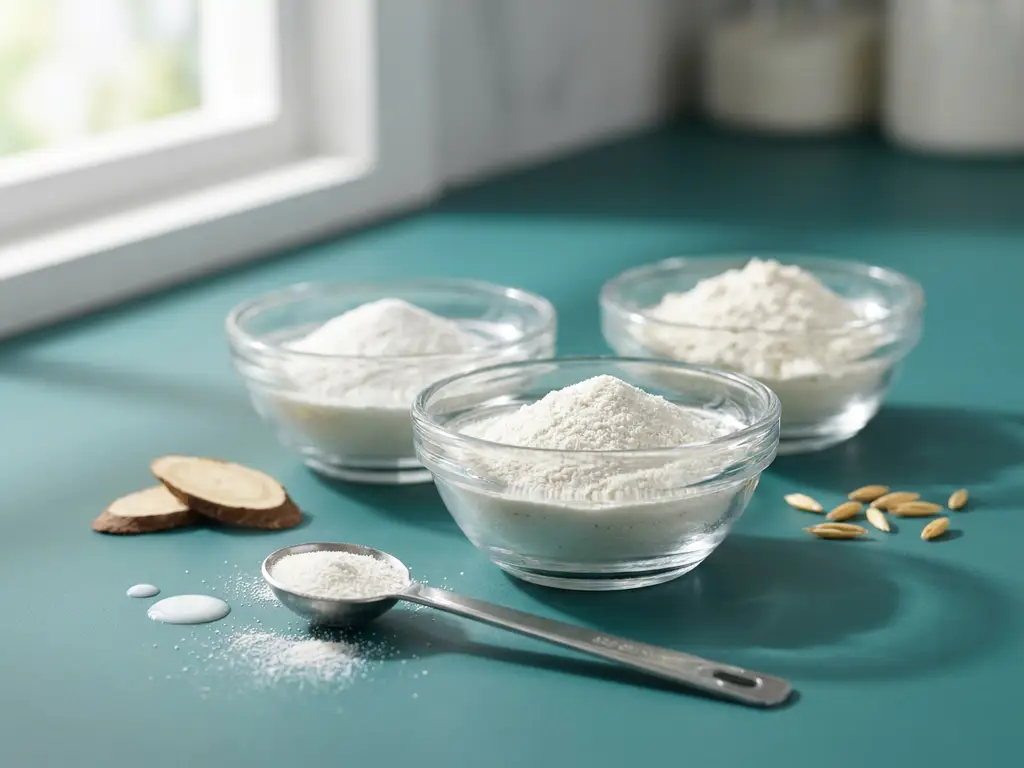
Inulin, FOS and GOS are all prebiotic fibres, but they differ in sugar building blocks, chain length, and how quickly they undergo gut microbiome fermentation. Inulin and FOS are fructans (fructose-based), while GOS is galactose-based. These differences affect which microbes use them, the short-chain fatty acids (SCFAs) produced, and practical factors like digestive tolerance and bloating.
What are inulin, FOS and GOS as prebiotics?
Inulin, fructo-oligosaccharides (FOS), and galacto-oligosaccharides (GOS) are non-digestible carbohydrates that reach the colon and are selectively used by gut microbes, which is the core definition of a prebiotic. They are fermentable fibres that shift microbial activity and metabolite output, including SCFAs.
Structurally, inulin and FOS are fructans, meaning chains of fructose (often with a terminal glucose). GOS is a mixture of galactose-containing oligosaccharides, typically built from lactose via enzymatic conversion. In product development, they are often positioned as functional fibres that can be screened for microbiome response and tolerability.
How are inulin, FOS and GOS different in structure and food sources?
The main difference between inulin, FOS and GOS is degree of polymerisation (chain length) and monomer type, which influences solubility, sweetness, and fermentation kinetics. Inulin is generally longer-chain, FOS is shorter-chain, and GOS is a galactose-based mixture with variable linkages.
| Prebiotic | Typical structure | Common label terms | Typical sources / production |
|---|---|---|---|
| Inulin | Longer fructan chains | Chicory root fibre, inulin | Extracted from chicory root, Jerusalem artichoke |
| FOS | Shorter fructan chains | Oligofructose, FOS | Produced from inulin hydrolysis or enzymatic synthesis from sucrose |
| GOS | Galactose-based oligosaccharide mix | GOS syrup, GOS powder | Enzymatically produced from lactose |
For R&D teams, these differences matter because they affect formulation (taste, viscosity, stability) and the feasible dose range needed to see measurable microbiome outputs.
How do inulin, FOS and GOS ferment in the gut and what microbes use them?
All three ferment primarily in the colon, where microbes convert them into SCFAs (such as acetate, propionate, and butyrate) plus gases. FOS and GOS are typically fermented faster than longer-chain inulin, so they can drive earlier metabolic shifts and, depending on context, more rapid gas generation.
Microbially, they are well known for bifidogenic effects, meaning stimulation of Bifidobacterium species, while also supporting broader networks through cross-feeding, where one microbe’s products become another’s substrates. In practice, the fermentation profile is shaped by baseline community composition, which is why inter-individual variability is a central consideration when interpreting gut microbiome fermentation data.
What benefits are associated with inulin, FOS and GOS?
Inulin, FOS and GOS are associated with outcomes linked to microbial fermentation and SCFA production, but effects are dose- and microbiome-dependent. In a product context, benefits are usually framed as functional endpoints that need mechanistic support rather than assumed equivalence across fibres.
- Stool regularity, via increased microbial biomass and fermentation-derived effects on colonic physiology.
- Mineral absorption, often discussed in relation to fermentation-driven changes in the colonic environment.
- Immune modulation, typically positioned as downstream of microbial metabolites and host–microbiome interactions.
- Metabolic markers, where SCFAs and related metabolites are used as mechanistic indicators.
For B2B teams building dossiers, the key is linking the ingredient to measurable microbial and metabolic changes that plausibly support the intended claim, while acknowledging responder and non-responder patterns.
Which is better for tolerance: inulin, FOS or GOS?
No single option is always “best”, and tolerance depends on fermentation speed, dose, and the starting microbiome. Faster-fermenting fibres (often FOS and some GOS preparations) can be more associated with digestive symptoms and bloating at higher or rapidly escalated doses, while longer-chain inulin may shift fermentation timing but can still produce gas.
From a development standpoint, tolerance management is usually approached through:
- Dose-response testing to identify a functional window with acceptable gas output.
- Gradual titration strategy in study design to reduce abrupt fermentation load.
- Blends (mixing chain lengths or combining fibres) to shape kinetics and sensory properties.
- Matrix considerations (format and co-ingredients) that can influence delivery and fermentation dynamics.
Also note the FODMAP context: inulin and FOS are commonly categorised as fructans, and GOS is also a FODMAP class, which is relevant when designing products for sensitive subpopulations.
How to choose between inulin, FOS and GOS for a product or diet?
Choosing inulin vs FOS vs GOS is mainly a question of target population, desired mechanistic readouts, and formulation constraints. For B2B R&D, the most reliable approach is to define the biological question first, then select the fibre type and testing strategy that can answer it with minimal ambiguity.
- Define the target cohort, including expected variability and whether stratification is needed.
- Specify the primary readouts, for example SCFAs, bifidogenic response, or gas as a tolerability proxy.
- Check dose feasibility against format, serving size, and sensory limits.
- Confirm labelling and regulatory positioning (terminology, fibre claims, ingredient identity).
- Validate with fit-for-purpose preclinical testing across multiple donors to capture responder patterns.
If you are designing a study intended to support regulatory or IP decisions, align early with internal regulatory affairs and a qualified scientific partner to avoid generating data that cannot be translated into a dossier.
How Cryptobiotix helps with inulin, FOS and GOS prebiotic research
We help R&D and regulatory teams generate decision-grade evidence on prebiotic fibres, including inulin, FOS and GOS, by testing gut microbiome fermentation under biorelevant, controlled conditions using our SIFR technology.
- Compare inulin, FOS and GOS head-to-head across multiple donors to quantify inter-individual variability.
- Measure functional outputs such as short-chain fatty acids (SCFAs) and gas as a tolerability-relevant signal.
- Support mechanism-of-action narratives suitable for R&D down-selection, IP, and regulatory planning, backed by our scientific evidence.
- Extend testing across sectors and populations via our applications framework.
To discuss your ingredient, target cohort, and the fastest study design to de-risk next steps, contact us.