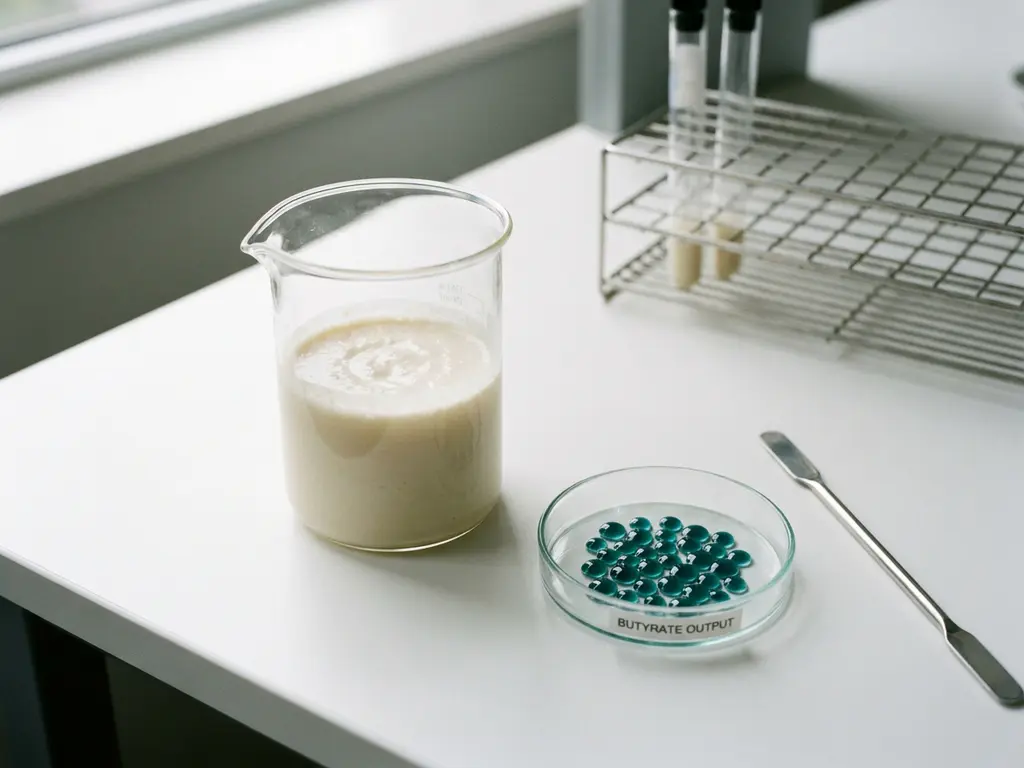
Butyrate production tells you whether a prebiotic ingredient is being fermented into a high-value short-chain fatty acid (SCFA) profile that is consistent with targeted microbiome modulation. In practice, it is a fast, mechanistic readout of prebiotic ingredient quality, especially when interpreted alongside dose response, donor variability, and other metabolites.
High butyrate production is meaningful for R&D only when you can attribute it to the ingredient, confirm it is reproducible across relevant microbiomes, and rule out artefacts from poor gut microbiome fermentation methods. The sections below break down what butyrate can and cannot tell you, and how to test it reliably before committing to expensive trials.
What is butyrate and why is it used to assess prebiotic quality?
Butyrate is a short-chain fatty acid (SCFA) produced when gut microbes ferment non-digestible carbohydrates and other fermentable substrates in the colon. It is used to assess prebiotic ingredient quality because it provides a direct, quantifiable signal that the ingredient drives a specific microbial metabolic output, not just a change in taxonomy.
For product developers, butyrate production is attractive because it links three practical needs in prebiotic efficacy testing: mechanistic evidence, dose sensitivity, and comparability across formulations. Unlike broad measures such as total gas or total SCFAs, butyrate focuses attention on a defined end product of gut microbiome fermentation that often depends on cross-feeding between microbial groups.
That said, butyrate is not a universal proxy for success. Some ingredients primarily increase acetate or propionate, and some shift community function without a large net change in butyrate. Treat butyrate as a high-signal marker, not the only marker.
How does a prebiotic ingredient increase butyrate production in the gut?
A prebiotic ingredient increases butyrate production by supplying fermentable substrate that selected microbes convert into intermediary metabolites, which butyrate producers then transform into butyrate through cross-feeding. This means butyrate rises when the ingredient supports both the right primary degraders and the downstream butyrogenic pathways within a realistic colonic environment.
Mechanistically, three patterns show up repeatedly in gut microbiome fermentation data:
- Direct butyrogenesis: the ingredient is accessible to butyrate-producing taxa, increasing butyrate without requiring extensive intermediate steps.
- Cross-feeding via acetate or lactate: the ingredient boosts acetate or lactate first, then butyrate increases as secondary fermenters convert those intermediates.
- Community-level shifts: the ingredient changes pH, redox balance, or substrate competition in ways that favour butyrate pathways over alternative end products.
Because these routes depend on the starting microbiome, inter-individual variability is expected. That variability is not noise: it is often the earliest indicator of responder and non-responder patterns you will later see in humans.
What does high butyrate production actually tell you about a prebiotic ingredient?
High butyrate production tells you that the prebiotic ingredient is fermentable by the target microbiome and that fermentation is being channelled into a desirable SCFA endpoint rather than only biomass or non-specific acidification. It also suggests the ingredient supports functional interactions, including cross-feeding, that are central to real-world microbiome responses.
In decision-making terms, strong butyrate production can support:
- Ingredient ranking: prioritising candidates with clearer functional outputs in prebiotic efficacy testing.
- Formulation choices: selecting matrices or combinations that preserve fermentability and shift SCFA balance.
- Dose selection logic: identifying the lowest dose that produces a measurable functional change.
However, high butyrate alone does not prove clinical benefit, nor does it guarantee tolerability or consistency across populations. It is a mechanistic signal that needs context: which donors responded, what else changed in the metabolome, and whether the result holds under controlled, standardised conditions.
What other markers should you evaluate alongside butyrate?
Alongside butyrate, you should evaluate the full short-chain fatty acids (SCFAs) profile, gas production, and microbiome compositional stability to interpret prebiotic ingredient quality correctly. These markers clarify whether butyrate is part of a balanced fermentation response, whether the ingredient may raise tolerability risks, and whether effects generalise across donors and cohorts.
For most R&D programmes, a practical marker set includes:
- Acetate and propionate: to understand carbon flow and whether butyrate increases via cross-feeding or at the expense of other pathways.
- Total SCFAs and kinetics: to distinguish a true functional shift from a simple increase in overall fermentation intensity.
- Gas production: as a quantitative proxy for fermentation pressure and a relevant tolerability biomarker in preclinical settings.
- Community composition and diversity: to confirm the microbiome remains biorelevant and to connect function to plausible microbial drivers.
- Inter-individual variability: responder and non-responder patterns across at least 6 to 8 donors per cohort for statistically meaningful interpretation.
This combined view prevents common misreads, such as celebrating a butyrate increase that only occurs in a narrow donor subset, or missing a strong functional response because butyrate was not the dominant SCFA shift.
How can you test butyrate production reliably before running a clinical trial?
You can test butyrate production reliably before a clinical trial by using a validated, standardised ex vivo gut microbiome fermentation approach with appropriate controls, sufficient donor numbers, and reproducible analytics for SCFAs. The goal is to generate mechanistic evidence quickly while capturing inter-individual variability and avoiding in vitro bias that distorts fermentation outcomes.
A robust preclinical workflow for butyrate production typically includes:
- Define the decision question: screening, dose response, formulation comparison, or cohort specificity.
- Select a relevant donor panel: use at least 6 to 8 donors per cohort to quantify variability and identify responder profiles.
- Run proper controls: include no-substrate controls to confirm microbiome stability and to attribute changes to the ingredient.
- Measure function and structure: quantify SCFAs (including butyrate) and track microbiome composition to link outputs to plausible mechanisms.
- Assess tolerability proxies: include gas production and fermentation dynamics to flag potential issues early.
Be cautious with methods that rely on long adaptation periods or poorly controlled media, as they can select for fast growers and drift away from the original donor microbiome, making butyrate production results harder to translate into clinical expectations.
How does Cryptobiotix help with butyrate-based prebiotic ingredient evaluation?
We help teams evaluate butyrate production and broader short-chain fatty acids (SCFAs) outputs with a validated, automated ex vivo gut microbiome fermentation platform designed to generate predictive, decision-ready evidence within 24 to 48 hours of fermentation. This supports prebiotic efficacy testing that is faster, more reproducible, and more informative for de-risking clinical trials.
- SIFR technology to quantify butyrate production, SCFA balance, and cross-feeding under biorelevant conditions
- Scientific evidence to support confidence in predictivity and standardisation for R&D decision-making
- Industry applications across food and nutrition, pharma and biotech, and animal health with cohort-appropriate microbiomes
- Study designs that capture inter-individual variability, enabling responder and non-responder insights before clinical investment
If you want to benchmark prebiotic ingredient quality using butyrate production and complementary markers, contact us via our contact page to discuss your ingredient, target cohort, and decision timeline.
Frequently Asked Questions
What butyrate increase is “meaningful” in an ex vivo fermentation study?
Define “meaningful” against your decision goal and your assay’s baseline variability. In practice, look for (1) a statistically robust increase versus a no-substrate control, (2) a clear dose–response (or a defined plateau), and (3) reproducibility across a relevant donor panel rather than a single outlier donor. Report both absolute change (e.g., mM) and the shift in SCFA proportions to avoid overinterpreting small absolute differences.
How do you distinguish true ingredient-driven butyrate from method artefacts?
Use tight controls and standardisation: include no-substrate and positive-control fermentations, keep inoculum handling and anaerobiosis consistent, and verify that pH and buffering are comparable across conditions. Check whether butyrate rises alongside plausible intermediates (acetate/lactate) and whether community composition remains biorelevant. If results depend on long pre-adaptation, unusual media, or show large drift in taxa, treat the butyrate signal as higher risk for poor translation.
What donor panel should you choose if you’re developing for a specific consumer group?
Match donors to the intended cohort (e.g., healthy adults, metabolic syndrome, IBS-prone, older adults) because baseline fermentation capacity and responder rates differ. Aim for at least 6–8 donors per cohort, and consider running two cohorts if you expect strong segmentation. Predefine what counts as a “responder” (e.g., minimum butyrate delta at a given dose) to make the output decision-ready.
Can an ingredient be a good prebiotic even if butyrate doesn’t increase?
Yes. Some substrates preferentially increase acetate or propionate, or shift microbial function without a large net butyrate change (e.g., by changing kinetics or reducing proteolytic metabolites). Evaluate the full SCFA profile, fermentation kinetics, and tolerability proxies (gas), and align the functional readout with your product claim and target biology rather than forcing butyrate as the only success metric.
How should you translate ex vivo butyrate data into a starting human dose?
Use ex vivo results to rank candidates and identify a lowest effective concentration, then convert that into a practical daily intake range considering expected colonic delivery, serving format, and tolerability. Start with the lowest dose that produced a consistent functional shift across donors, then plan a step-up regimen in humans (or a short dose-escalation pilot) to confirm GI tolerance and refine the effective dose window.
What are practical next steps after you identify a strong butyrate-producing ingredient?
Confirm robustness with a repeat run (new fermentation batch and, ideally, an independent donor set), then test formulation variables that can blunt fermentability (processing, sweeteners, polyols, proteins, fats). If the signal holds, move to a small, well-controlled clinical pilot focused on feasibility: adherence, GI tolerance, and a biomarker panel aligned to your mechanism (stool SCFAs, targeted metabolites, and symptom/tolerability tracking).