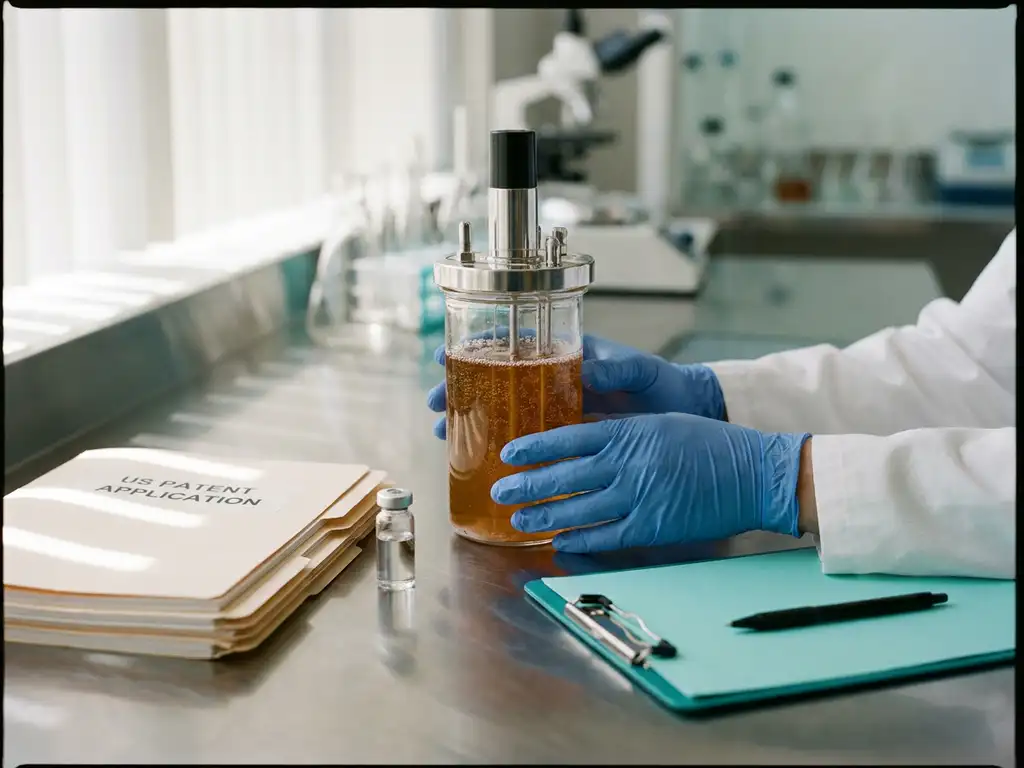
Yes, ex vivo gut fermentation data can be used directly in a patent application for a new ingredient as experimental evidence to support new ingredient patentability, especially for demonstrating a technical effect, plausibility, and enablement. It is rarely the only evidence needed, but it can be a strong part of the data package when the study is well controlled and reproducible.
The key is to present ex vivo gut fermentation data as microbiome model evidence that links the ingredient to measurable, credible outcomes such as specific metabolite shifts, dose response, and responder variability. Patent offices typically scrutinise whether the effect is believable across the claim scope and whether the invention is sufficiently disclosed.
The questions below break down where ex vivo data helps most, where it can fall short, and how to design a preclinical fermentation study that is genuinely patent-ready.
Can ex vivo gut fermentation data support a patent for a new ingredient?
Ex vivo gut fermentation data can support a patent for a new ingredient by providing experimental proof that the ingredient produces a measurable technical effect in a controlled gut microbiome setting. In a patent application, this type of microbiome model evidence can strengthen plausibility, help distinguish the invention from prior art, and support broader claim scope when the results are consistent and well controlled.
For R&D teams, the value is practical: ex vivo gut fermentation data can show what changes (for example, specific metabolites, community shifts, gas output as a tolerability proxy) and under which conditions (dose, matrix, donor cohort). That combination often helps patent counsel argue that the invention is more than an idea and has a demonstrable technical contribution.
In many ingredient patents, ex vivo results sit alongside chemistry, manufacturing details, and sometimes additional biological assays. The ex vivo layer is most persuasive when it is positioned as a mechanistic bridge between ingredient design and expected real world performance, without overstating clinical claims.
What patent requirements do ex vivo fermentation results help satisfy?
Ex vivo fermentation results most directly help with patent requirements related to plausibility and sufficiency of disclosure by showing that the new ingredient reliably causes a technical effect in a relevant microbiome model. They can also support inventive step by demonstrating an unexpected effect versus known ingredients or formulations, provided the comparison is fair and the endpoints are meaningful.
In practice, ex vivo gut fermentation data can strengthen several common pressure points in prosecution:
- Plausibility by linking the ingredient to a concrete effect such as metabolite production, substrate utilisation patterns, or consistent community-level shifts.
- Enablement and sufficiency by documenting conditions that allow a skilled person to reproduce the effect, including dose, incubation time, controls, and analytical methods.
- Inventive step by showing an effect that is not obvious from prior art, especially when benchmarked against close comparators.
- Claim support by mapping data to the breadth of the claims, for example across multiple donors to justify generalisation.
For new ingredient patentability, the most persuasive datasets usually combine a clear primary endpoint with supporting secondary endpoints that explain the mechanism of action, rather than relying on a single readout.
What are the limitations of using ex vivo gut data directly in a patent?
The main limitation is that ex vivo gut data is not clinical evidence, so patent examiners may challenge whether the demonstrated effect translates to the full scope of the claims or to all intended populations. Ex vivo gut fermentation data can also be weakened by poor controls, too few donors, or endpoints that look like general observations rather than a specific technical effect.
Common issues that reduce the legal and scientific weight of a preclinical fermentation study include:
- Overbroad claims that cover many ingredient variants while the data only tests one narrow embodiment.
- Insufficient inter-individual coverage where results come from one to three microbiomes, making generalisation hard to defend.
- Selection bias if the microbiome community drifts far from the starting state, undermining the argument that the system reflects an ex vivo ecosystem.
- Weak comparators where the prior art is not tested under matched conditions, leaving inventive step arguments exposed.
- Endpoints without a clear technical narrative such as reporting many taxa changes without connecting them to a defined functional output.
A good rule for patent strategy is to treat microbiome model evidence as proof of a technical effect under defined conditions, not as a substitute for every other element of disclosure and claim support.
How should ex vivo fermentation experiments be designed for patent-ready evidence?
To generate patent-ready ex vivo gut fermentation data, design the experiment to be reproducible, controlled, and clearly tied to the claimed invention and its technical effect. The study should include appropriate negative controls, relevant comparators, multiple donors to capture variability, and a pre-specified analysis plan that demonstrates dose response and consistency across microbiomes.
For teams preparing a patent application, the following design choices typically make the difference between “interesting data” and defensible evidence:
- Align the model to the claim by testing the exact ingredient form, dose range, and matrix that the claims will cover.
- Use robust controls including no-substrate controls and, where relevant, a benchmark ingredient to support inventive step arguments.
- Include enough donors to address inter-individual variability and to support statements about responder and non-responder behaviour.
- Prioritise functional endpoints such as metabolomics and fermentation outputs, then use taxonomy as a supporting mechanism rather than the only proof.
- Show a clear dose response or at minimum a consistent directionality across doses that maps to the technical effect.
- Document methods for reproducibility including sample handling, incubation conditions, analytical pipelines, and acceptance criteria.
When the patent narrative is “immediate microbial modulation leads to progressive outcomes”, short time windows can still be persuasive if the endpoints capture the initial causal microbial event and the controls demonstrate stability and biorelevance.
How Cryptobiotix helps with using ex vivo gut fermentation data in a patent application for a new ingredient
We help teams turn ex vivo gut fermentation data into patent application-ready evidence by generating reproducible, controlled microbiome model evidence that supports new ingredient patentability and aligns with how patent claims are examined. Our approach focuses on rapid, biorelevant readouts within 24 to 48 hours, while capturing inter-individual variability and the mechanism of action.
- SIFR technology designed to maintain ex vivo microbiome stability with appropriate controls and high-throughput automation
- Study designs that include sufficient donor numbers to support responder and non-responder insights and claim breadth
- Multi-omics outputs that connect taxonomy to functional effects, strengthening the technical effect narrative
- Population and sector fit via our industry applications across food, biotech, pharma, and animal health
- Clear reporting packages that support IP discussions alongside your patent counsel, backed by our scientific evidence approach
If you are preparing a patent application for a new ingredient and want to de-risk your evidence package with robust ex vivo gut fermentation data, contact us via our contact page.
Frequently Asked Questions
How many donors should I include to make ex vivo fermentation results more defensible in prosecution?
Aim for a donor panel that reflects the breadth of your intended claim (e.g., different baseline microbiome profiles). As a practical starting point, use enough donors to show the effect is not an outlier (often 6–12+) and report both responders and non-responders. If claims target a specific population (e.g., elderly, IBS), match donors accordingly and justify inclusion/exclusion criteria.
What should I use as comparators to strengthen inventive step arguments?
Use (1) a no-substrate/vehicle control to show the system is stable, and (2) the closest prior-art ingredient(s) or formulation(s) tested under identical conditions (same dose, matrix, incubation, analytics). Predefine the primary endpoint and statistical approach so the comparison reads as a fair head-to-head rather than a post hoc selection.
How do I translate ex vivo endpoints into claim language without overreaching into clinical territory?
Draft claims around the demonstrated technical effect in the model (e.g., “increases butyrate production,” “reduces proteolytic fermentation markers,” “shifts SCFA profile”) and specify the tested ingredient form, dose range, and conditions where appropriate. Keep clinical outcomes in the description as hypotheses or downstream expectations unless you have in vivo/clinical support.
What level of method detail should be included in the patent to support enablement and reproducibility?
Include enough detail for a skilled person to reproduce the effect: ingredient characterisation (composition, purity, DP/structure where relevant), preparation and matrix, donor handling and pooling strategy, anaerobic conditions, incubation timepoints, acceptance criteria for microbiome stability, analytical methods (metabolomics/SCFA, gas, sequencing), and how endpoints are calculated. Add ranges and alternatives only if you can justify them with data or sound rationale.
How can I handle variability and still argue the effect applies across the claim scope?
Plan for variability upfront: stratify donors by baseline features, report distribution of responses, and define what counts as a meaningful effect (e.g., threshold change vs control). If only a subset responds, consider claims directed to a defined responder profile, a specific dose window, or a combination with a co-ingredient that broadens response.
When should I add in vivo or clinical data, and what is the minimum that helps?
Add in vivo/clinical support when you want broader health-related claims, when examiners challenge translation, or when the effect is subtle. A minimal step can be a small in vivo study or human pilot that confirms the direction of key biomarkers (e.g., stool SCFAs, tolerability, target metabolite) and matches the ex vivo mechanism. Even limited confirmation can reduce plausibility objections.
How should I time the patent filing relative to generating ex vivo data and publications?
Coordinate early with patent counsel: file before any public disclosure (abstracts, posters, preprints, marketing). If data is still being generated, consider a first filing with core embodiments and methods, then follow with a second filing (or add data for prosecution) as results mature. Keep lab notebooks, raw data, and protocols organised to support later declarations if needed.