


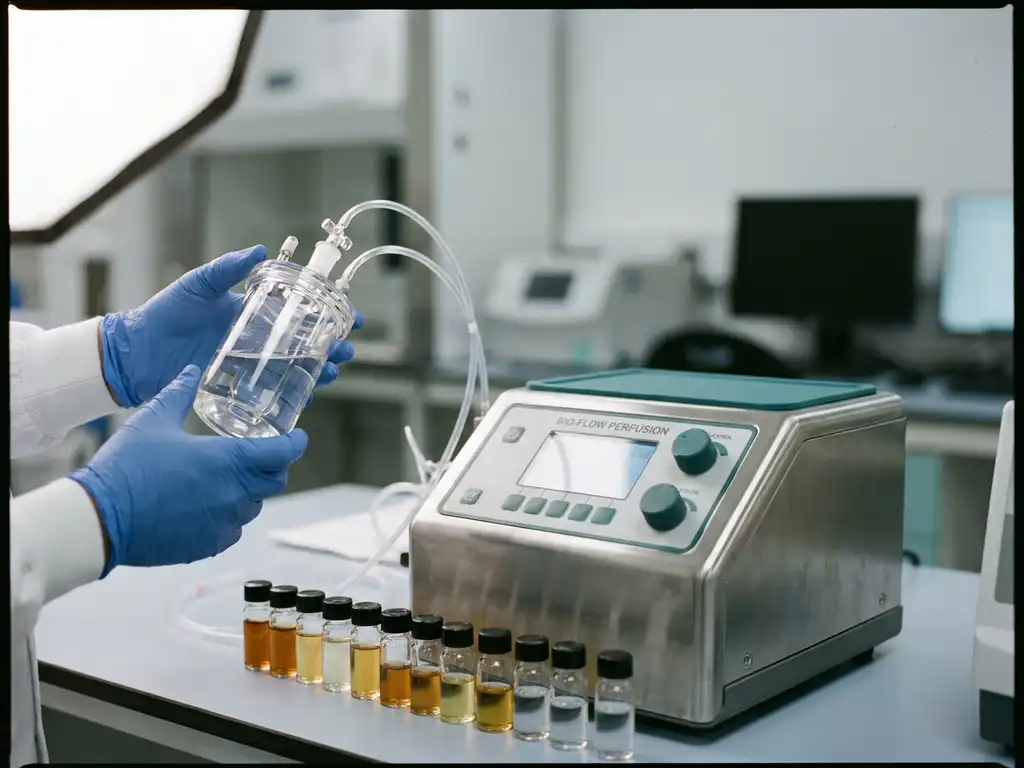
Yes, an ex vivo gut model can help predict inter-individual variability before a feeding study by testing the same ingredient or formulation across multiple donor microbiomes under controlled, biorelevant conditions. This reveals likely responder and non-responder patterns in gut microbiome fermentation within 24 to 48 hours, rather than weeks.
The prediction is strongest when the model preserves the original community structure and function, includes enough donors to represent population spread, and measures both composition and metabolites linked to the mechanism of action. It is not a replacement for a human trial, but it is a powerful form of preclinical microbiome testing to de-risk decisions.
The questions below break down what ex vivo models can and cannot predict, and how to design them for credible feeding study prediction.
What are ex vivo gut models and what can they predict?
An ex vivo gut model is a controlled laboratory system that incubates a living gut microbial community taken directly from donors, aiming to maintain it close to its original state while testing an intervention. It can predict directional changes in gut microbiome fermentation, including metabolite shifts, community changes, and tolerability proxies that often underpin clinical outcomes.
In practical R&D terms, ex vivo models are most useful for questions that sit between basic screening and expensive human work. They can show whether a substrate is fermented, what metabolic routes are activated, and whether effects look consistent or donor-dependent.
- Mechanism signals such as short-chain fatty acid patterns and other fermentation metabolites
- Microbiome composition shifts that indicate which taxa benefit or decline
- Dose-response directionality across realistic concentration ranges
- Tolerability-related fermentation outputs such as gas production in closed systems
Ex vivo outputs are most actionable when they are interpreted as causal microbial events that can drive longer-term host outcomes, rather than as a direct substitute for clinical endpoints.
How can ex vivo models help anticipate responder and non-responder variability?
Ex vivo models anticipate responder and non-responder variability by running the same intervention across multiple individual donor microbiomes and quantifying how widely the fermentation and community responses spread. This directly targets inter-individual variability and turns it into measurable distributions, helping teams define likely responder profiles before committing to a feeding study.
Responder patterns often emerge from baseline differences, for example initial carbohydrate utilisation capacity, presence or absence of key degraders, and cross-feeding networks that convert primary fermentation products into downstream metabolites.
- Stratify by baseline state using starting composition and functional readouts to explain why responses diverge
- Identify thresholds where some donors shift strongly while others remain unchanged
- Separate true non-response from a different metabolic route, for example different end products rather than no fermentation
- Quantify variability to inform inclusion criteria and powering assumptions for later work
For feeding study prediction, the key is not only the average effect but the shape of the response across individuals.
What are the key limitations when using ex vivo data to predict real-world consumer outcomes?
The key limitation is that ex vivo data captures microbial causality under controlled conditions, not the full complexity of real-world exposure and host physiology. Ex vivo systems do not replicate behaviour, adherence, diet variability, or whole-body pharmacokinetics, so feeding study prediction should focus on microbial mechanism, likely variability, and tolerability proxies rather than clinical endpoints.
Several practical constraints can also weaken translation if teams do not plan for them upfront.
- Host factors such as immune signalling, gut motility, and absorption are only partially represented unless coupled to host-relevant assays
- Matrix effects from complex foods may require an upstream digestion step to reflect what reaches the colon
- Donor coverage that is too narrow can underestimate population spread and overstate confidence
- Implementation bias from poorly designed fermentation media or uncontrolled conditions can distort which microbes dominate
A good rule is to treat ex vivo as a decision tool for mechanism and risk, then confirm with human data when the business case is clear.
How should you design an ex vivo study to de-risk a feeding study?
Design an ex vivo study to de-risk a feeding study by matching the question to the model, using enough donors to capture variability, and building in controls that prove stability and causality. The most decision-useful preclinical microbiome testing combines composition and metabolite readouts, tests realistic doses, and reports both average effects and donor-level dispersion.
A robust design typically includes the elements below.
- Define the decision such as go/no-go, dose selection, formulation choice, or cohort targeting
- Select an appropriate donor cohort and include at least 6 to 8 donors to support responder analysis
- Include proper controls including a no-substrate control to confirm microbiome stability without the intervention
- Choose endpoints tied to mechanism such as fermentation metabolites, taxonomy shifts, and tolerability proxies
- Test multiple doses and formats to see whether variability narrows or widens with exposure level
- Plan analysis for variability including clustering, responder definitions, and links to baseline features
If the product is delivered in a digestible matrix, align the workflow with a digestion step so the fermentation phase reflects what actually reaches the colon.
How do ex vivo gut models compare with in vitro, animal models, and pilot feeding studies?
Ex vivo gut models sit between simple in vitro assays and human studies by keeping a complex donor microbiome intact while enabling controlled, parallel testing. Compared with many in vitro approaches, an ex vivo gut model can better capture cross-feeding and donor-to-donor spread. Compared with animal models, it avoids species-specific microbiome differences that often fail to translate to humans.
The trade-offs become clearer when you compare what each approach is best for.
- Simple in vitro assays are fast and cheap but often test too few microbiomes and can introduce strong in vitro bias
- Ex vivo fermentation supports higher throughput, mechanistic clarity, and explicit measurement of inter-individual variability
- Animal models can answer whole-organism questions but may mislead for microbiome-driven effects due to taxonomic and physiological differences, and animal testing is not required in this field
- Pilot feeding studies provide real-world human data but are slower and far more expensive, making them a poor first filter for formulations and dose ranges
In 2026, many teams use ex vivo work as the final preclinical gate before committing euros to a pilot, especially when variability risk is a core concern.
How does Cryptobiotix help with predicting consumer response variability before a feeding study?
We help teams predict response variability before a feeding study by using our validated SIFR technology to run high-throughput, donor-rich ex vivo fermentation with mechanistic and variability-focused analytics. This approach supports faster feeding study prediction by revealing responder patterns, dose response, and tolerability-relevant signals within 24 to 48 hours of fermentation.
- Validated ex vivo simulation using SIFR technology designed to preserve microbiome structure and function
- Donor-level variability with statistically meaningful cohort designs to separate responders from non-responders
- Actionable outputs that connect taxonomy and metabolites to mechanism, supported by our scientific evidence
- Cross-sector experience across food, pharma, biotech, and animal health via our industry applications
If you want to de-risk your next study and quantify variability early, share your target cohort and product format via our contact page.
Frequently Asked Questions
How many donors do you need to make responder/non-responder insights credible?
Aim for at least 8–12 donors for early responder mapping, and increase to 15–30 when you need tighter estimates of population spread or plan to segment by baseline traits (e.g., enterotype, habitual diet, health status). If you expect high variability, prioritize more donors over more technical replicates.
What should you measure beyond 16S/shotgun sequencing to make results decision-useful?
Pair community profiling with functional readouts that match your product’s mechanism: targeted SCFAs (acetate, propionate, butyrate), branched-chain fatty acids, lactate/succinate, bile acid transformations (when relevant), pH, and gas/pressure in closed systems. Add untargeted metabolomics when you need to discover unexpected pathways or differentiate “no effect” from “different route.”
How do you translate an ex vivo dose to a realistic human intake?
Back-calculate from the estimated amount reaching the colon: start with the intended daily serving, apply an in vitro digestion step (or literature-based digestibility), then scale to colonic volume and residence time used in the model. Test a small range around the expected colonic concentration (e.g., 0.5×, 1×, 2×) to see whether variability narrows or widens with dose.
Can ex vivo models evaluate complex food matrices or finished products, not just isolated fibers?
Yes, but include a standardized digestion step first so the fermentation phase reflects what actually arrives in the colon. For emulsions, polyphenol-rich foods, or protein-containing products, consider measuring matrix-driven effects (e.g., bile interactions, protein fermentation markers) and compare the finished product against its key actives to separate matrix from ingredient effects.
How do you define a “responder” in a way that will hold up in a later feeding study?
Predefine responder criteria using (1) a mechanistic endpoint, (2) a minimum effect size above control, and (3) consistency across related readouts. For example, classify responders by a butyrate increase above a set threshold plus a shift in known butyrogenic taxa or pathways. Validate the definition with sensitivity analyses and avoid post-hoc thresholds that inflate apparent response rates.
What are common pitfalls that make ex vivo results hard to translate, and how can you avoid them?
Key pitfalls include unstable baseline communities, oxygen exposure during handling, non-physiological media, and insufficient negative/positive controls. Mitigate by standardizing sample collection and storage, using anaerobic workflows, verifying stability in no-substrate controls, including a known fermentable reference, and documenting QC metrics (pH drift, biomass, replicate variability) before interpreting biology.
What’s the best next step after an ex vivo study if you see strong donor-dependent effects?
Use the ex vivo data to design a smarter pilot: enrich or stratify the cohort based on baseline features linked to response, choose a dose that balances effect and tolerability proxies, and pre-register primary mechanistic endpoints. If the goal is commercialization, plan a confirmatory human study that tests the identified responder hypothesis rather than averaging it away.
