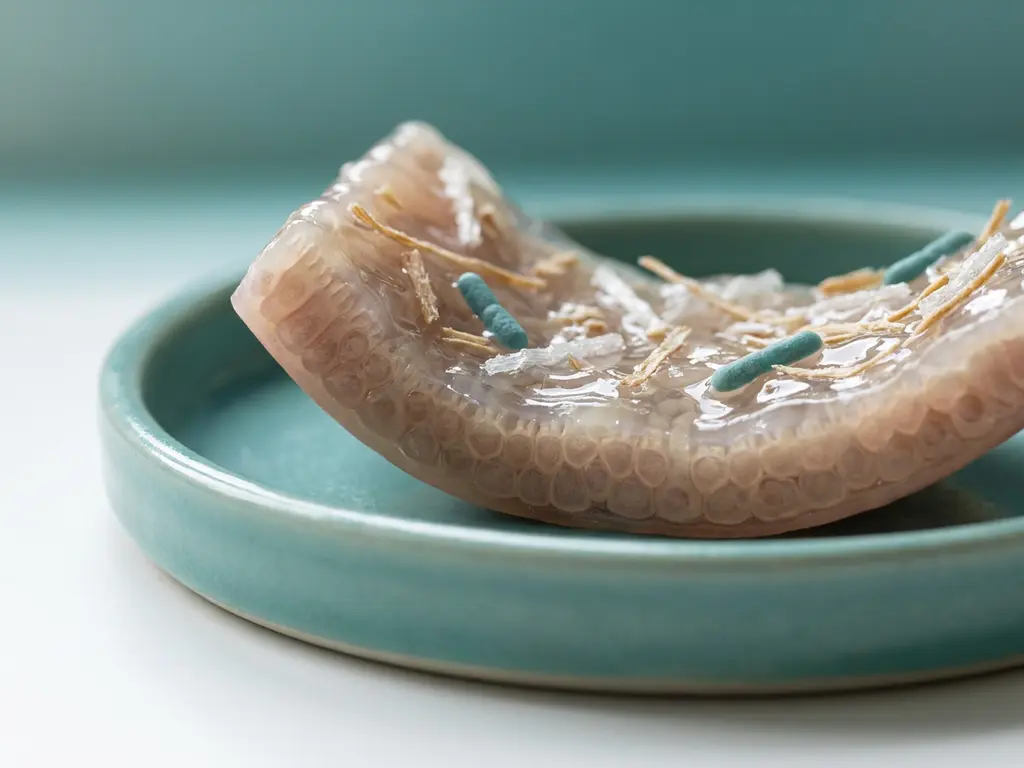
Prebiotics support the gut barrier by feeding selected gut microbes that convert non-digestible carbohydrates into short-chain fatty acids (SCFAs), especially butyrate. These metabolites can influence mucus layer support, tight junctions, and immune signalling, which are central to controlling intestinal permeability. For R&D teams, the key questions are which prebiotics drive which fermentation profiles, how quickly effects emerge, and how to balance barrier-relevant signals with tolerability.
What is the gut barrier and why does it matter?
The gut barrier is a multi-layer system that separates the intestinal lumen from underlying tissue while still enabling nutrient uptake. It matters because it regulates intestinal permeability, limits pathogen translocation, and shapes immune signalling that can influence local and systemic biology.
Functionally, it is often described as four interacting components:
- Mucus layer, a physical and biochemical shield that also provides habitat and substrates for microbes.
- Epithelial cells, the single-cell layer responsible for absorption and controlled transport.
- Tight junctions, protein complexes that “seal” spaces between epithelial cells, controlling paracellular passage.
- Immune layer, including innate and adaptive cells that sample luminal signals and calibrate inflammation.
In product development, “gut barrier support” typically refers to measurable shifts in barrier integrity markers, inflammatory tone, and microbially derived metabolites linked to epithelial energy and junction regulation.
How do prebiotics support the gut barrier?
Prebiotic gut barrier effects are mainly indirect. Prebiotics are selectively fermented by members of the microbiota, shifting community function towards metabolites that can reinforce barrier physiology, particularly short-chain fatty acids (SCFAs) such as butyrate.
Key mechanisms R&D teams commonly evaluate include:
- Selective fermentation that enriches beneficial guilds (for example, bifidogenic responses) and enables cross-feeding to butyrate producers.
- Butyrate production, relevant because colonocytes can use butyrate as an energy source, and it is often linked with tight junction modulation and anti-inflammatory signalling.
- Mucus layer support, via microbial metabolism that can influence mucin dynamics and the ecological balance near the epithelium.
- Tight junctions regulation through metabolite signalling pathways that affect junction assembly and epithelial stress responses.
- Competitive exclusion, where fermentation-driven pH and nutrient shifts can reduce opportunities for opportunistic taxa.
Practically, mechanism-of-action work benefits from pairing microbial composition with metabolomics, because barrier-relevant outcomes are often function-led rather than taxonomy-led.
Which prebiotics are most studied for gut barrier support?
The most studied prebiotics for barrier-relevant outcomes are well-characterised fibres and oligosaccharides with reproducible fermentation behaviour. They differ in fermentation rate, dominant metabolites, and the microbial groups they tend to stimulate, which is why “prebiotic” is not a single mechanism.
| Prebiotic type | Typical fermentation profile (general) | Common food sources |
|---|---|---|
| Inulin | Often rapidly fermented, commonly bifidogenic, can support cross-feeding to butyrate | Chicory root, onions, garlic, Jerusalem artichoke |
| FOS | Fast fermentation, frequently bifidogenic, may increase gas depending on dose and matrix | Chicory, some fruits and vegetables, added ingredients |
| GOS | Typically bifidogenic, can promote acetate and support downstream butyrate via cross-feeding | Dairy-derived ingredients, added oligosaccharides |
| Resistant starch | Slower fermentation, often associated with butyrogenic potential in suitable microbiomes | Cooled cooked potatoes/rice, green bananas, legumes |
| Beta-glucans | Fermentable fraction varies by structure, can support SCFA production and immune signalling | Oats, barley, some mushrooms |
| Pectin | Often supports acetate and broader saccharolytic fermentation, structure-dependent | Apples, citrus peel |
For formulation teams, the “best studied” option is usually the one with the most predictable structure, purity, and batch-to-batch consistency for your target cohort.
How long does it take for prebiotics to improve gut barrier function?
Microbial responses to prebiotics can occur within hours, but barrier-related outcomes are usually progressive and depend on repeated exposure, the baseline microbiome, and the endpoint being measured. In preclinical settings, early signals often appear as shifts in SCFAs and other metabolites, while epithelial readouts may require integrated host-relevant assays.
Timelines vary because:
- Inter-individual variability changes fermentation kinetics and SCFA yields, creating responder and non-responder patterns.
- Dose and matrix influence where and how fast substrates are fermented, affecting both efficacy signals and gas production.
- Outcome definition matters, stool SCFAs, permeability-associated biomarkers, and cell-based integrity measures reflect different biology.
For decision-making, align your timeline to the mechanism you need to evidence, for example, metabolite shifts versus tight junction-associated functional assays.
What are common side effects of prebiotics and how can they be minimized?
The most common prebiotic side effects in development and testing are increased gas, bloating, and altered bowel habits, driven by fermentation rate and osmotic effects. These are not just consumer issues, they affect compliance in trials, product positioning, and the interpretation of gut barrier endpoints when inflammation or stress responses are involved.
Ways teams typically minimise tolerability risk include:
- Gradual titration in study designs, rather than jumping to the intended target dose.
- Split dosing to reduce peak substrate availability and rapid gas accumulation.
- Ingredient selection by kinetics, choosing slower-fermenting fibres when rapid fermentation is problematic.
- Hydration and matrix control in protocols to reduce confounding from formulation effects.
Seek medical oversight in clinical planning when enrolling participants with IBS, suspected SIBO, IBD, or immunocompromised status, because tolerability and risk profiles can differ materially and may require additional safeguards.
How Cryptobiotix helps with prebiotics supporting the gut barrier?
We help R&D teams generate decision-grade evidence on how prebiotics support the gut barrier by linking fermentation behaviour to barrier-relevant functional readouts using our SIFR® technology and modular GI simulation approach.
- Screen prebiotics, blends, and doses for SCFA profiles, including butyrate, and tolerability-relevant gas signals.
- Quantify inter-individual variability across appropriate donor cohorts to identify responder patterns early.
- Build mechanism-of-action packages that connect microbial shifts to gut barrier integrity endpoints.
- Support sector-specific development pathways across applications in food, biotech, pharma, and animal health.
- Provide supporting documentation via our scientific evidence resources for internal decision-making and external dossiers.
If you want to de-risk a prebiotic gut barrier programme with fast, mechanistic preclinical evidence, contact us via the contact page to discuss your target cohort, endpoints, and study design.
Key takeaways for R&D teams
- Barrier support is multi-factorial, mucus layer support, tight junctions, and immune signalling all matter.
- Prebiotics act through fermentation, SCFAs, and community function, not a single “good bacteria” effect.
- Plan for variability, measure metabolites and functional endpoints, and treat tolerability as a core development parameter.
FAQ
- Do all prebiotics increase butyrate?
No. Many increase acetate or other metabolites first, and butyrate often depends on cross-feeding and the presence of specific butyrate-producing microbes. - Is intestinal permeability the same as “leaky gut”?
In scientific and regulatory contexts, intestinal permeability refers to measurable transport across the barrier. “Leaky gut” is a non-specific term and is not an endpoint definition. - What endpoints are most useful for prebiotic gut barrier projects?
Common options include SCFA profiles, inflammatory markers, and cell-based barrier integrity readouts, selected based on the intended claim and mechanism-of-action hypothesis.