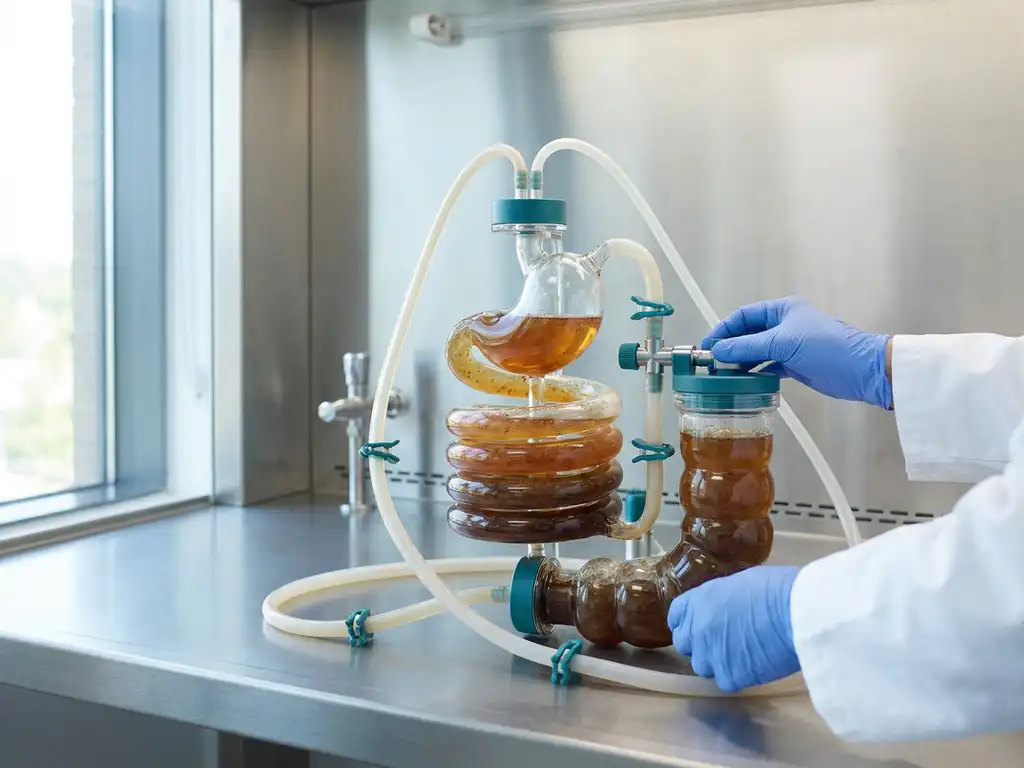
To simulate the entire GI tract in a single preclinical study, you link in vitro digestion and fermentation into one workflow so the output of each compartment becomes the input for the next. This full-GI approach models oral, gastric, small-intestinal and colonic phases, then optionally adds host readouts for host–microbiome interactions. The goal is consistent conditions, harmonised endpoints and decision-ready data on mechanism, dose and variability.
What does it mean to simulate the entire GI tract in one preclinical study?
Simulating the entire GI tract in one preclinical study means reproducing the key physiological steps from mouth to colon, using connected modules rather than isolated tests. A “single study” implies one experimental design, one set of inputs, and aligned sampling points across compartments, so results remain comparable and traceable.
Most full-GI simulation setups cover:
- Oral phase: mixing, salivary enzymes, short residence time.
- Gastric phase: acidic pH, pepsin activity, mechanical stress.
- Small intestine: bile and pancreatic enzymes, neutralisation, dilution, transit.
- Colon: anaerobic fermentation by a complex microbiota, metabolite production.
How can one workflow combine digestion, colonic fermentation, and host–microbiome interactions?
One workflow combines digestion, colonic fermentation, and host–microbiome interactions by processing the same test material through sequential steps, then applying the colonic outputs to host-relevant assays. This preserves causality, so you can link what survives digestion to what microbes ferment, and what metabolites may drive host responses.
- Upper-GI digestion: set pH profiles, enzymes, bile salts, mixing and transit times to generate a realistic digesta fraction.
- Transfer to colon: inoculate digesta into an anaerobic ex vivo gut microbiome model with controlled temperature, a pH control strategy and a nutrient background.
- Host layer (optional): expose fermented supernatants to cell-based systems to read out barrier, inflammation or endocrine-relevant markers.
Operationally, the biggest quality drivers are oxygen management (strict anaerobiosis), standardised controls, and consistent sample handling so that “process noise” does not mask biological effects.
What endpoints should you measure to make a full-GI simulation useful?
A full-GI simulation is most useful when endpoints connect formulation, microbial function and host relevance. Measure outputs that explain mechanism of action, enable ranking across candidates, and support translation into clinical or regulatory plans.
- Bioaccessibility: what fraction of actives or nutrients becomes available after digestion.
- Microbial metabolites: SCFAs and broader metabolomics to capture functional shifts and cross-feeding.
- Gas and pressure: practical tolerability proxies and fermentation intensity signals.
- Microbial composition and function: community profiling plus functional readouts where possible.
- Host readouts: barrier integrity markers and inflammation-relevant signals in host–microbiome interactions.
Design for dose–response and inter-individual variability by testing multiple concentrations and using enough independent donors per cohort to identify responder and non-responder patterns.
What are the main limitations of full-GI simulation models and how do you mitigate them?
Full-GI simulation models cannot reproduce the whole organism, and they do not capture systemic absorption, full immune complexity, neuroendocrine feedback, or true peristalsis. They also simplify spatial structure and long-term adaptation. These boundaries can mislead if results are interpreted as direct clinical efficacy.
Mitigate limitations by:
- Using validated models with clear performance criteria and appropriate controls (including no-substrate controls).
- Selecting donors and cohorts that match the target population, then replicating across individuals.
- Running sensitivity checks on key parameters (pH, bile, transit assumptions) to test robustness.
- Separating claims: use ex vivo data for plausibility and mechanism, not for clinical endpoints.
How do you choose the right full-GI model for your product or research question?
Choose the right GI tract simulation by matching the model’s strengths to your decision point: early screening, mechanism confirmation, formulation comparison, or regulatory support. The “best” preclinical gut model is the one that answers your question with sufficient predictivity, throughput and interpretability within your timelines and budget.
| Choice point | What to prioritise |
|---|---|
| Screen many formulations | Throughput, standardisation, clear ranking endpoints |
| Mechanism and translation | Ex vivo biorelevance, multi-omics, donor variability |
| Upper-GI sensitive actives | Realistic digestion conditions and bioaccessibility |
| Regulatory dossier support | Reproducibility, controls, transparent interpretation |
Also decide between static vs dynamic digestion, batch vs continuous fermentation, and ex vivo vs animal approaches, based on whether you need speed and donor fidelity, or long-run adaptation questions.
How Cryptobiotix helps with simulating the entire GI tract in a single preclinical study?
We help teams run GI tract simulation as one connected, decision-focused workflow, combining digestion, an ex vivo gut microbiome model, and optional host–microbiome interactions using our modular SIFR technology. Depending on your stage and question, we align study design, donor strategy and endpoints so you can move from screening to mechanism with consistent logic.
- Modular full-GI pipeline, from upper-GI digestion to colonic fermentation and host readouts.
- Study designs that capture inter-individual variability with appropriate donor replication.
- Mechanistic reporting suitable for R&D decisions and regulatory-facing narratives, supported by our scientific evidence.
- Coverage across sectors and species-relevant questions via our applications focus.
If you want to discuss a full-GI study design for your ingredient, formulation, or therapeutic concept, contact us via the contact page.
FAQ
- How long does a full-GI simulation take?
Upper-GI digestion is typically run over hours, while colonic fermentation commonly runs over one to two days for decision-making endpoints, depending on the model and sampling plan. - Do you need repeated dosing in preclinical GI tract simulation?
Not always. Many questions about immediate microbial modulation, dose–response and mechanism can be answered with single-exposure designs, as long as the model preserves donor microbiome characteristics and uses appropriate controls. - Is ex vivo data useful for regulatory submissions?
Yes, as supporting evidence. High-quality ex vivo results can strengthen biological plausibility and mechanism-of-action arguments, while clinical data remain the basis for efficacy claims.