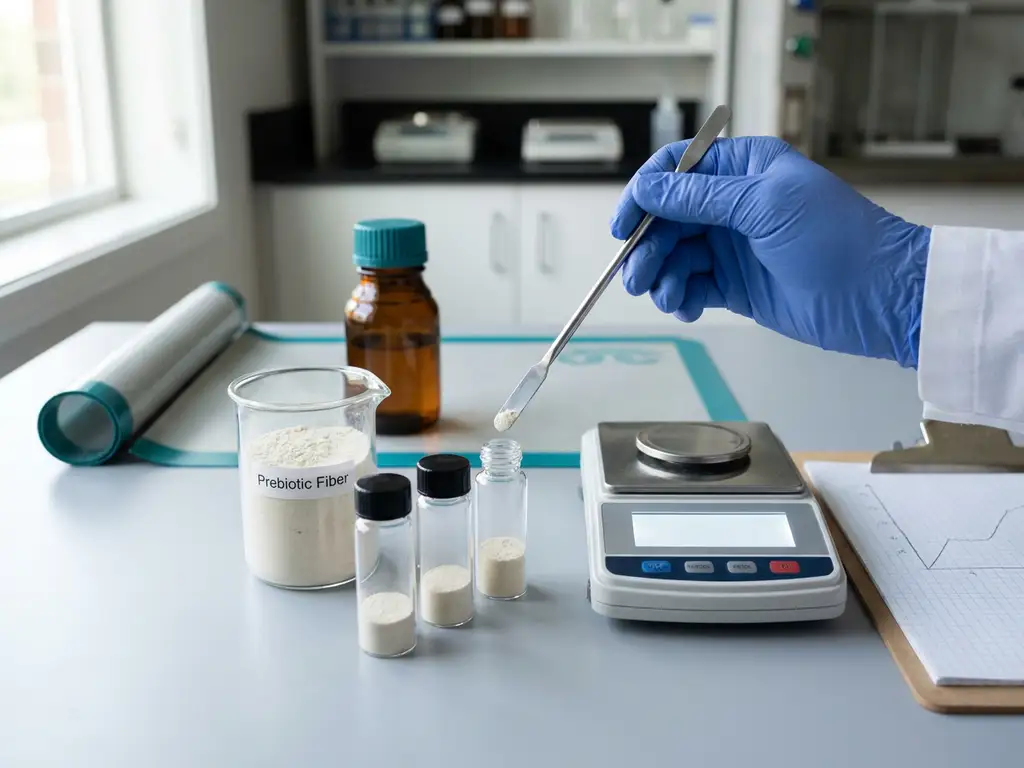
To test dose-response for a prebiotic ingredient, run a structured prebiotic dose-response testing plan across multiple dose levels and measure both efficacy and tolerability signals in the same workflow. The goal is to identify the minimal effective dose, the point of diminishing returns, and any tolerance limits. Below are the key questions teams ask about endpoints, prebiotic dosing study design, model choice, and how to interpret results for R&D and regulatory-ready decision-making.
What is a dose-response test for a prebiotic ingredient?
A dose-response test measures how a prebiotic’s biological effects change as the dose increases, across defined endpoints such as microbial activity and tolerability proxies. In prebiotics, responses are often non-linear because fermentation depends on substrate availability, microbial competition, and cross-feeding, so you may see thresholds, plateaus, or even inverted U-shaped curves.
It helps to separate two outcome types: efficacy (desired microbiome and metabolic shifts) and tolerance (excess gas, rapid acidification, or other fermentation burdens). Common terms include:
- Minimal effective dose: lowest dose with a consistent, meaningful endpoint shift.
- NOAEL: highest dose with no observed adverse effect, often framed via tolerability-related readouts in preclinical work.
- Ceiling effect: higher doses add little benefit but may increase fermentation load.
Which endpoints should you measure to prove a prebiotic dose-response?
The best endpoints link dose to a plausible mechanism of action and remain interpretable for product development and regulatory dossiers. For most programmes, combine community structure with function, because function often changes before taxonomy. A strong package includes SCFA and microbiome endpoints plus tolerability proxies.
- Microbiome composition: targeted taxa shifts (for example, bifidogenic effects), diversity, and responder patterns across individuals.
- Functional outputs: SCFAs (acetate, propionate, butyrate), lactate, branched-chain fatty acids, and broader metabolomics for pathway-level evidence.
- Gas and fermentation pressure: total gas, kinetics, and profiles as practical tolerability indicators.
- Physicochemical markers: pH changes and buffering demand, which can explain non-linear behaviour.
- Host-relevant biomarkers (when coupled to host models): barrier integrity readouts and immune signalling proxies.
Choose endpoints that can be traced from dose, to microbial metabolism, to a defensible claim rationale, even if the final claim is assessed clinically.
How do you design a dose-response study for prebiotics (doses, controls, duration)?
A practical prebiotic dosing study design uses multiple, well-spaced doses, appropriate controls, and a duration that captures primary fermentation dynamics without introducing avoidable bias. In early screening, 3 to 6 dose arms often balance resolution and throughput, with spacing that can detect thresholds and plateaus.
- Controls: include a no-substrate or placebo control, and consider a positive control if you need benchmarking.
- Dose selection: start below expected activity, include a mid-range, and test a high dose that may reveal ceiling effects or tolerance constraints.
- Duration: align sampling to fermentation kinetics, early timepoints for rapid metabolism, later timepoints for cross-feeding products like butyrate.
- Diet and matrix: standardise background substrate exposure, and account for delivery format (powder, capsule, food matrix) using digestion steps when relevant.
- Human trials: use randomisation and blinding, manage run-in and compliance, and size the study to detect dose separation rather than only placebo separation.
What models can you use to test prebiotic dose-response (in vitro, ex vivo, animal, human)?
You can test dose-response in in vitro, ex vivo, animal, and human models, but they answer different questions. The best approach is staged: use higher-throughput systems to narrow doses and formulations, then confirm in models with stronger physiological relevance. For gut microbiome work, animal models are often poorly translatable due to species-specific microbiomes and gut physiology.
| Model | Best for | Main limitation |
|---|---|---|
| Simple in vitro fermentation | Fast ranking of substrates | Higher in vitro bias, limited donor coverage |
| Ex vivo gut model | Mechanistic, donor-specific dose-response with better biorelevance | Still a proxy, needs careful controls and donor strategy |
| Animal | Systemic endpoints in a whole organism | Microbiome and physiology differences reduce predictivity |
| Human | Clinical confirmation and claim substantiation | Cost, time, and risk if the dose is not well-chosen |
To address inter-individual variability, include multiple donors or participants and plan for responder and non-responder analysis rather than relying on an “average” microbiome.
How do you analyse and interpret prebiotic dose-response data?
Analyse dose-response by fitting curves that match the biology, then translating them into decisions such as dose selection for clinical work or formulation optimisation. Common approaches include Emax models (plateauing effects), EC50-type metrics (dose for half-maximal response), and benchmark dose concepts for tolerability-related thresholds.
- Curve fitting: test linear vs saturating models, avoid forcing linearity when plateaus are expected.
- Multiple endpoints: predefine primary endpoints to reduce false positives, adjust for multiple comparisons in omics-heavy datasets.
- Responder analysis: segment by baseline microbiome features, then report dose effects within strata.
- Confounders: control for matrix effects, background carbohydrate availability, and batch effects in sequencing and metabolomics.
- Reproducibility: report controls, raw processing steps, and decision rules so results are auditable.
How Cryptobiotix helps with dose-response testing for a prebiotic ingredient?
We help teams run dose-response programmes that connect mechanistic evidence to practical R&D decisions, using our validated SIFR® technology platform and a service workflow designed for speed, donor-level insight, and actionable reporting.
- Designing prebiotic dose-response testing matrices with appropriate controls, dose spacing, and donor strategy.
- Running a high-throughput gut microbiome fermentation assay with closed bioreactors that support gas readouts alongside SCFAs and multi-omics.
- Linking SCFA and microbiome endpoints to mechanism, including cross-feeding patterns and inter-individual variability.
- Supporting application-specific programmes across sectors described on our applications page.
- Providing validation context and technical rationale via our scientific evidence resources.
If you want to define the minimal effective dose, tolerance boundary, and responder profile for your ingredient, contact us via our contact page to discuss your study design and timelines.
Word count (main content): 666