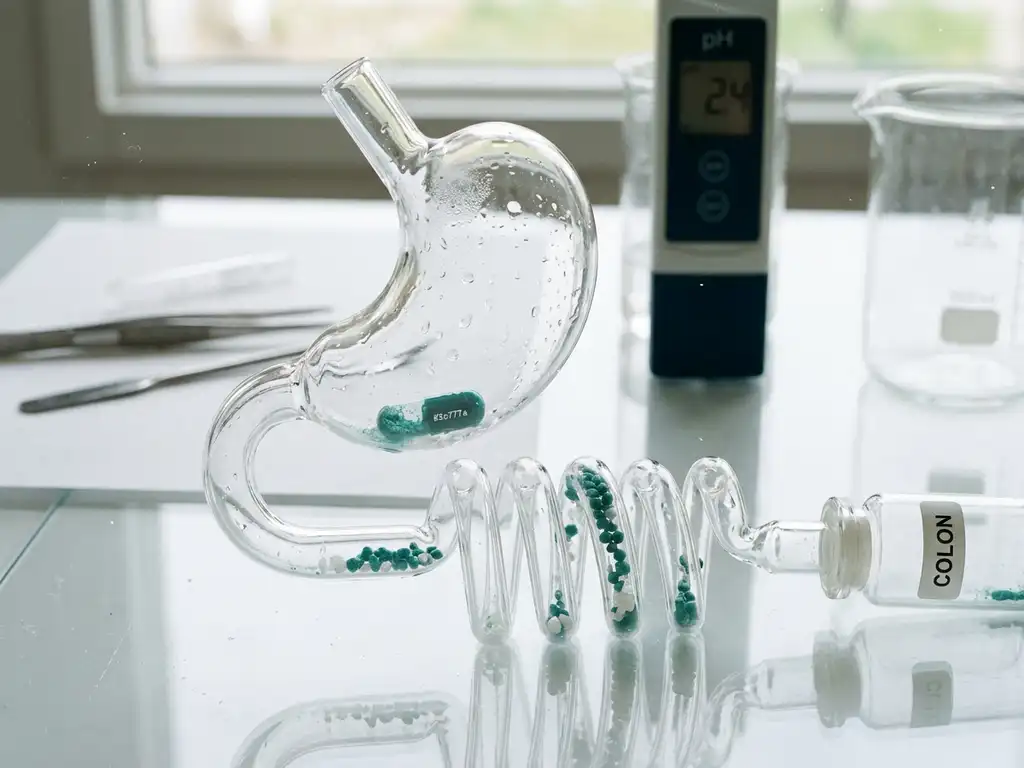
A novel fibre ingredient “survives” the upper GI tract when it resists breakdown during oral, gastric, and small intestinal digestion, so that a meaningful fraction reaches the colon in a form gut microbes can ferment. You test this by combining an upper GI digestion model with post-digestion analytics and follow-on colonic fermentation testing to confirm fermentability.
For R&D teams, the key is separating two questions: whether the fibre shows fibre ingredient stability through digestion, and whether the digested residue still drives the intended microbial metabolism. The most robust workflows use standardised in vitro gastrointestinal simulation up front, then validate fermentation outcomes in a biorelevant colon phase.
The sections below break down what “survival” means, how to test it, which readouts matter, and how to choose between in vitro, ex vivo, and in vivo approaches.
What does it mean for a fiber ingredient to survive the upper GI tract?
A fibre ingredient survives the upper GI tract when it remains largely non-digestible during mouth, stomach, and small intestine conditions, avoiding enzymatic hydrolysis and solubilisation into absorbable sugars. In practice, “survival” means the ingredient reaches the colon with its key structural features intact enough to support predictable microbial fermentation.
Upper GI survival is not always all or nothing. Many novel fibres partially change during digestion, for example through pH-driven swelling, bile interactions, or limited depolymerisation. For preclinical decision making, define survival in terms of measurable attributes that link to function, such as molecular weight distribution, degree of polymerisation, or preservation of specific linkages.
It also helps to set a clear acceptance criterion before testing, such as “at least X percent of carbohydrate remains non-digestible after simulated small intestinal digestion” or “no meaningful release of free monosaccharides,” then align the analytics to that criterion.
How do you test upper GI survival with in vitro digestion models?
You test upper GI survival by running the ingredient through a standardised upper GI digestion model that mimics oral, gastric, and small intestinal phases using biorelevant pH shifts, enzymes, bile salts, and transit times. After digestion, you separate the digestible fraction from the non-digestible residue and quantify structural and compositional changes.
A practical workflow for in vitro gastrointestinal simulation typically includes:
- Define the matrix (ingredient alone versus in a finished product) because proteins, fats, and minerals can change digestion outcomes.
- Run sequential phases (oral, gastric, intestinal) with controlled pH and enzyme activities.
- Stop the reaction at the end of the small intestinal phase to prevent continued hydrolysis.
- Fractionate into soluble and insoluble components, and optionally dialyse to remove low molecular weight sugars.
- Benchmark with controls such as a clearly digestible carbohydrate and a known non-digestible fibre to validate the run.
For B2B R&D, standardisation matters as much as realism. Tight control of enzyme activity, pH, and mixing reduces variability and makes formulation comparisons meaningful.
Which analytical readouts show whether the fiber remains intact after digestion?
The best readouts for fibre ingredient stability after digestion quantify both how much carbohydrate remains non-digestible and what changed structurally. In most programmes, this means combining mass balance-style measurements with molecular characterisation, so you can link digestion-driven changes to downstream fermentation performance.
- Released mono- and disaccharides to detect unwanted hydrolysis into absorbable sugars.
- Molecular weight distribution to see depolymerisation or fragmentation.
- Degree of polymerisation and oligosaccharide profiling to track shifts in chain length.
- Solubility and viscosity changes which can indicate structural disruption or gel formation.
- Specific linkage or substitution patterns when functionality depends on branching or chemical modifications.
- Recovery of non-digestible residue (soluble and insoluble) to support a clear survival claim.
Choose readouts based on the ingredient’s hypothesised mechanism. For example, if the value proposition depends on slow, distal fermentation, molecular weight and fermentation kinetics become more informative than a single end point “remaining fibre” number.
How do you confirm the digested fiber is still fermentable in the colon?
You confirm fermentability by taking the post-digestion residue and running colonic fermentation testing under anaerobic, colon-like conditions with a representative gut microbiota. A fermentable fibre will drive measurable microbial activity, typically seen as substrate utilisation, metabolite production, and community shifts consistent with carbohydrate fermentation.
Key outputs to confirm the digested fibre still performs include:
- Short-chain fatty acids and other fermentation metabolites to quantify functional conversion.
- Gas production as a proxy for fermentation intensity and potential tolerability risk signals.
- Microbial composition changes to understand which taxa respond and whether effects vary by donor.
- Fermentation kinetics to distinguish rapid proximal fermentation from slower, more sustained utilisation.
Because inter-individual variability can be large, testing across multiple donors helps you identify responder and non-responder patterns before you invest in expensive downstream studies.
What are the differences between in vitro, ex vivo, and in vivo approaches for GI survival testing?
In vitro models simulate digestion or fermentation using controlled lab reagents and conditions, ex vivo models use intact microbial communities outside the body under biorelevant conditions, and in vivo studies measure outcomes in living subjects. For GI survival testing, in vitro digestion is best for mechanistic breakdown risk, ex vivo gut models are best for predictive fermentation responses, and in vivo is best for integrated physiology but is slower and costlier.
- In vitro digestion excels at isolating upper GI breakdown mechanisms and comparing formulations quickly, but it does not capture microbiome-driven metabolism.
- Ex vivo gut model approaches preserve complex microbial ecosystems to measure fermentation, metabolite profiles, and variability across individuals with higher biorelevance than simplified cultures.
- In vivo captures absorption, motility, and host responses, but introduces confounders and typically requires more time, budget, and operational complexity.
In 2026, many organisations prioritise non-animal approaches for early decision making, using in vitro plus ex vivo evidence to de-risk later-stage clinical planning and strengthen mechanistic narratives for regulatory dossiers.
How can Cryptobiotix help test whether a novel fiber reaches the colon?
We help confirm whether a novel fibre reaches the colon by coupling standardised upper GI digestion with a validated ex vivo gut microbiome workflow that measures fermentation outcomes across multiple human donors. This approach links fibre ingredient stability after digestion to real-world-relevant microbial metabolism, enabling faster, more confident R&D decisions.
- Run digestion plus fermentation as one pipeline to connect an upper GI digestion model to downstream colonic fermentation testing.
- Test across donor panels to quantify inter-individual variability and identify responder profiles early.
- Generate mechanism-focused readouts including metabolites, microbial shifts, and gas production under controlled conditions.
- Support multiple sectors through our industry applications experience, from food and nutrition to pharma and animal health.
- Build evidence packages aligned with R&D and regulatory needs, backed by our scientific evidence and our SIFR technology platform.
If you want to de-risk whether your fibre truly reaches the colon with functionality intact, share your ingredient format, target population, and key claims via our contact page and we will propose a fit-for-purpose testing plan.
Frequently Asked Questions
How should we set a realistic “pass/fail” threshold for upper GI survival?
Start from the intended claim (e.g., “reaches the colon,” “low glycaemic impact,” or “distal fermentation”) and translate it into 1–2 measurable criteria. Common approaches include setting a maximum allowable release of free mono-/disaccharides and a minimum recovery of non-digestible carbohydrate after the small-intestinal phase. Use a known digestible carbohydrate and a known resistant fibre as anchors, then refine thresholds based on repeatability and product-to-product differences you need to detect.
Should we test the fibre as a neat ingredient or inside the final product matrix?
Do both when decisions are high-stakes. Screen the neat ingredient first to understand intrinsic stability, then confirm in the finished matrix because proteins, lipids, minerals, and processing (heat, shear, pH) can change solubility, enzyme access, and apparent “survival.” If you can only choose one, test the format that will be commercialised (dose, particle size, and processing history included).
How many microbiome donors are enough for fermentation testing, and how do we choose them?
Use a small panel (often 5–10 donors) for early-stage direction and expand if you see strong responder/non-responder splits. Select donors that match the target consumer population (e.g., healthy adults vs. metabolic risk; antibiotic history; habitual fibre intake) and predefine exclusion criteria that could confound results. Report donor-to-donor variability explicitly rather than relying on a single “average” profile.
What should we use as comparators in digestion + fermentation studies?
Include at least one negative control (readily digestible carbohydrate) and one positive control (well-characterised fermentable fibre) to validate both phases. Add a “category comparator” that reflects what your customers already use (e.g., inulin, resistant dextrin, GOS) to position performance. Keep dose and carbohydrate equivalents consistent so differences reflect biology, not loading.
How do we interpret gas and SCFA results for both efficacy and tolerability?
Look at kinetics, not just totals. Rapid early gas with steep SCFA spikes can signal proximal fermentation and potential GI discomfort at higher doses, while slower, sustained SCFA production can support more distal activity. Compare gas per gram of substrate and SCFA profiles (acetate/propionate/butyrate balance) across donors, and use dose-ranging or dilution series to identify a practical dose window.
What are the most common pitfalls that make “survival” results hard to trust?
Frequent issues include inconsistent enzyme activity, poor pH control, incomplete reaction quenching, and losses during fractionation/dialysis that break mass balance. Another pitfall is measuring only one endpoint (e.g., “% remaining”) without confirming structural changes that explain fermentation behaviour. Build in run acceptance criteria, recovery checks, and replicate runs to separate real ingredient effects from method noise.
What are sensible next steps after promising in vitro/ex vivo results?
Move toward a claim-aligned evidence plan: (1) confirm robustness across batches and processing conditions, (2) run dose-response and matrix compatibility checks, (3) map mechanisms to endpoints relevant for your claim (e.g., SCFA patterns, specific taxa, or metabolic outputs), and (4) design a targeted human study with appropriate biomarkers and tolerability monitoring. Document methods and controls early so the package is audit-ready for partners and regulators.