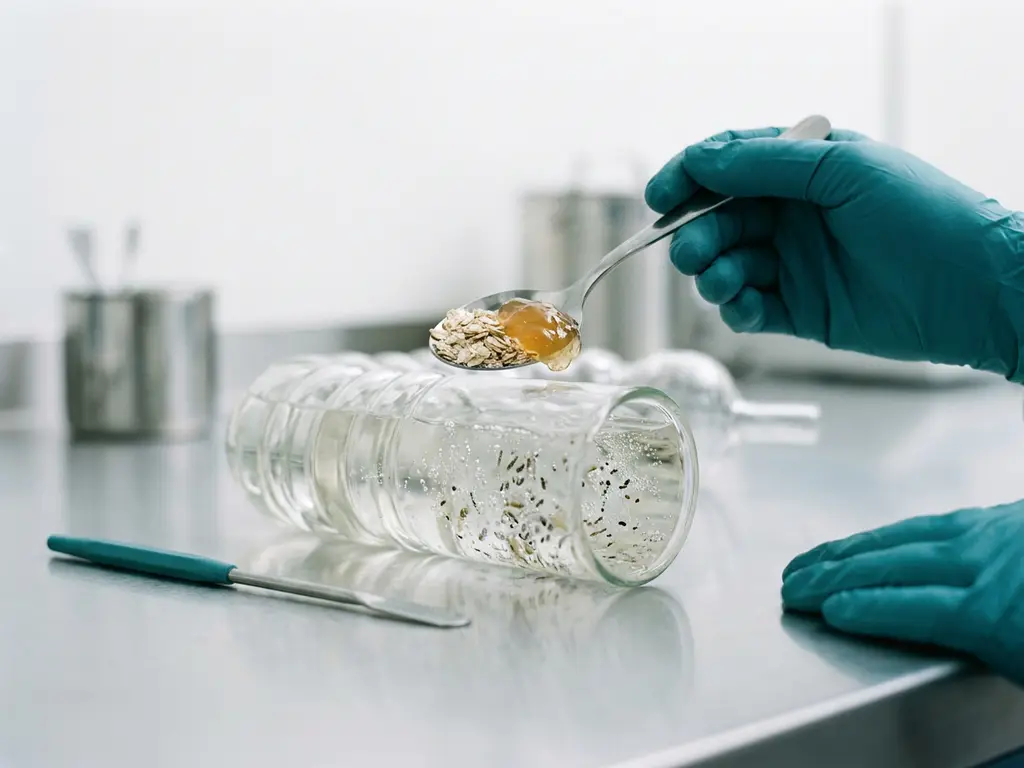
The food matrix affects the colonic fermentation behaviour of a functional ingredient by controlling when the ingredient becomes available to the gut microbiome, how quickly microbes can access it, and which metabolic pathways dominate. This shifts both the fermentation location within the colon and the balance of outputs such as short-chain fatty acids and gas.
In practice, the same ingredient can look highly fermentable in a simple test but behave very differently once embedded in a real formulation, because processing, structure, and co-nutrients change microbial access and cross-feeding.
The sections below answer the key formulation and study questions that determine predictability and translation into later-stage development decisions.
What is the food matrix and why does it matter for colonic fermentation?
The food matrix is the full physical and chemical environment that surrounds a functional ingredient in a product, including macronutrients, microstructure, processing effects, and interactions between components. It matters for colonic fermentation because the matrix governs ingredient release, microbial accessibility, and which members of the gut microbiome can utilise it first.
For R&D teams, “matrix” is not marketing language. It is a mechanistic variable that can change fermentation kinetics and metabolite profiles even when the ingredient dose stays constant.
- Physical structure can trap substrates and slow microbial access.
- Chemical interactions can reduce solubility or bind the ingredient to proteins or minerals.
- Co-substrates can redirect metabolism through cross-feeding, changing short-chain fatty acids patterns.
- Processing can pre-degrade polymers or create resistant fractions, shifting where fermentation happens.
How does the food matrix change where and how fast a functional ingredient ferments in the colon?
The food matrix changes where and how fast a functional ingredient ferments by altering substrate release rate, particle size, viscosity, and the fraction that survives upper GI digestion to reach the colon. Faster release tends to drive earlier, more proximal colonic fermentation, while slower release can extend fermentation distally and change short-chain fatty acids and gas dynamics.
Think of the colon as a time and space gradient. Microbes compete for what becomes available first. If the matrix makes the ingredient readily accessible, fast fermenters may dominate early, increasing rapid acidification and gas. If the matrix delays access, fermentation can become more gradual, often changing the acetate, propionate, and butyrate balance.
Key mechanisms that shift kinetics and location include:
- Encapsulation and entrapment in fat-protein networks or plant cell walls, delaying availability.
- Viscosity and gel formation that slows diffusion of enzymes and microbes to the substrate.
- Co-delivered simple carbohydrates that get consumed first, postponing fermentation of the target ingredient.
- Processing-driven depolymerisation that increases solubility and speeds fermentation.
Because the gut microbiome differs strongly between individuals, the same matrix can also amplify responder versus non-responder patterns, which matters for de-risking later-stage trials.
Which matrix factors most influence microbial metabolism and metabolite outputs?
The matrix factors that most influence microbial metabolism are substrate accessibility, co-substrate composition, and processing-induced chemistry, because they determine which microbes engage first and what pathways they use. These factors directly shape metabolite outputs, including the type and timing of short-chain fatty acids, branched-chain metabolites from protein fermentation, and gas production during colonic fermentation.
From a preclinical perspective, the most decision-relevant outputs are not only “more fermentation”, but what kind of fermentation and under which conditions.
- Microstructure and particle size influence surface area and diffusion, affecting fermentation rate and peak intensity.
- Solubility and water binding determine whether the ingredient behaves like a rapidly fermented substrate or a slow-release one.
- Protein and fat context can shift metabolism towards proteolytic routes if fermentable carbohydrate availability is limited.
- Polyphenols, minerals, and emulsifiers can modulate microbial activity through binding, inhibition, or altered community interactions.
- Thermal and mechanical processing can create resistant fractions or pre-break complex carbohydrates, changing the balance of acetate, propionate, and butyrate.
When teams interpret results, it helps to track both short-chain fatty acids and gas together. A matrix that drives rapid fermentation may look positive on SCFAs but raise tolerability risk signals through higher gas pressure.
What are practical formulation and study design tips to predict fermentation behavior?
To predict fermentation behaviour, treat the food matrix as a test variable, not a background detail, and evaluate the functional ingredient in the most representative formulation state possible. Study designs that capture inter-individual variability in the gut microbiome and measure both short-chain fatty acids and gas provide a more decision-ready view of colonic fermentation.
- Test the ingredient in context by comparing neat ingredient versus final formulation, not just one or the other.
- Control upper GI delivery by using a digestion step when the matrix is digestible, so the colonic phase receives realistic residues.
- Use adequate donor numbers to capture responder and non-responder behaviour, rather than relying on one to three microbiomes.
- Include proper controls such as no-substrate controls and matrix-only controls to separate ingredient effects from background fermentation.
- Measure kinetics by sampling across 24 to 48 hours to see early shifts that drive later outcomes.
- Track multi-endpoint outputs including SCFAs, lactate, branched-chain metabolites, and gas pressure as a proxy for tolerability.
- Stress test dose and format by screening multiple doses and processing states to identify robust performance windows.
For teams building regulatory dossiers, these practices also strengthen mode of action narratives because they connect formulation choices to measurable microbial mechanisms.
How Cryptobiotix helps with understanding how the food matrix affects colonic fermentation of functional ingredients?
Cryptobiotix helps teams understand how the food matrix shapes colonic fermentation of a functional ingredient by generating fast, mechanistic, ex vivo data that preserves real-world gut microbiome behaviour and captures inter-individual variability. We use the validated SIFR technology pipeline to test formulation-relevant conditions and quantify outputs such as short-chain fatty acids and gas.
- Matrix-realistic workflows that can couple full GI digestion with colonic fermentation to reflect true substrate delivery
- High-throughput designs to compare multiple formulations, doses, and processing states in parallel
- Multi-donor cohorts to identify responder versus non-responder patterns before expensive trials
- Actionable reporting linking metabolite shifts to mechanism of action and development decisions
- Cross-sector experience across industry applications supported by our scientific evidence
If you want to de-risk formulation choices and build a clearer mechanism of action story, contact us via our contact page to discuss your ingredient, matrix, and target cohort.
Frequently Asked Questions
How can I tell whether a fermentation result is driven by the ingredient or by the matrix itself?
Run a minimal control set: (1) ingredient-only (neat), (2) matrix-only (same formulation without the ingredient), and (3) ingredient-in-matrix (final product). Compare kinetics and endpoints across all three. If the matrix-only condition shifts SCFAs or gas substantially, you’ll need to interpret the ingredient effect as an interaction rather than a standalone property.
What’s the best way to compare two product formats (e.g., beverage vs bar) using the same functional ingredient?
Standardise the delivered colonic substrate as much as possible by applying the same in vitro digestion step to both formats, then ferment the post-digestion residues under identical conditions. Report results per “dose reaching the colon” (residue basis) rather than per label dose, and include time-course data to capture differences in release and accessibility.
Which analytical readouts are most useful when SCFAs look similar but tolerability differs between formulations?
Add complementary markers that capture rapid fermentation and proteolysis: gas volume/pressure (or total gas), lactate and succinate (transient intermediates), branched-chain fatty acids (isobutyrate/isovalerate), and pH over time. Similar total SCFAs can hide very different peak rates, intermediate accumulation, and gas dynamics that drive bloating risk.
How should I choose donor microbiomes to make results more decision-ready for development?
Use a multi-donor panel that reflects your target population (e.g., healthy adults, older adults, IBS-prone, or high-protein consumers) and pre-screen donors for baseline fermentation capacity if possible. Analyse results both as cohort averages and as responder/non-responder distributions so you can estimate the likelihood of variable consumer outcomes.
What processing changes are most likely to ‘flip’ fermentation behaviour during scale-up?
Watch for steps that alter polymer size and accessibility: high-shear mixing, extrusion, baking/thermal load, pH shifts, and storage that changes retrogradation or gel structure. When any of these change, re-test at least one pilot-scale sample because small shifts in solubility or microstructure can move fermentation earlier and increase gas peaks.
If my goal is more distal fermentation, what formulation levers can I try without changing the ingredient?
Increase physical protection and slow release: larger particle size, stronger gel/viscosity systems, inclusion within intact plant structures, or encapsulation approaches that survive upper GI digestion. Also reduce rapidly available co-carbs that get consumed first and can accelerate proximal fermentation; then verify with time-course sampling to confirm a distal shift rather than just lower overall fermentation.
How do I translate ex vivo fermentation findings into a next-step plan for human studies?
Use ex vivo data to define a ‘safe and effective’ window: pick 1–2 doses and 1–2 formats that balance SCFA profiles with acceptable gas kinetics, then pre-specify clinical endpoints aligned to the mechanism (e.g., stool frequency/consistency, breath hydrogen, symptom diaries, targeted metabolites). Consider stratifying or at least recording baseline microbiome features to interpret responder patterns observed ex vivo.