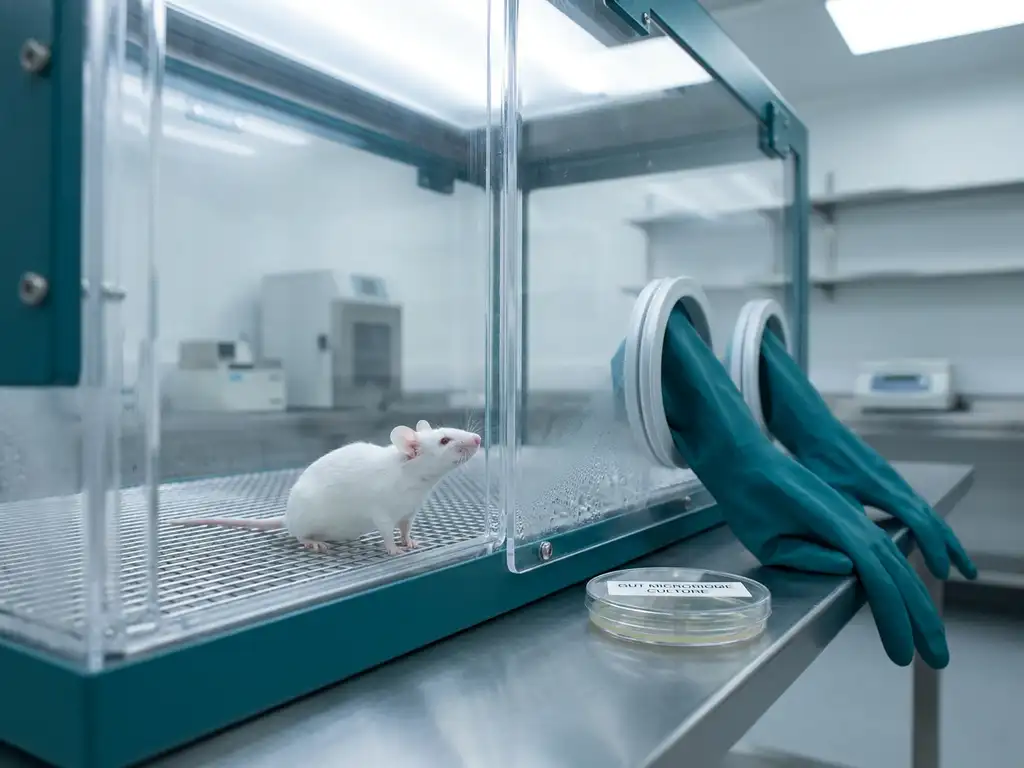
Germ-free mice limitations matter because removing microbes changes the host itself, not just the microbiome. Germ-free and gnotobiotic mouse models are powerful for testing causality in host–microbiome interactions, but they can distort immune development, physiology, and colonisation dynamics. Reproducibility is also sensitive to housing, diet sterilisation, and contamination control. Below are the main constraints and practical alternatives within modern microbiome research models.
What are germ-free mouse models and why are they used?
Germ-free mice are raised with no detectable microorganisms, while gnotobiotic mice are germ-free animals colonised with a known, defined microbiota. They are used to test whether a microbe, community, or metabolite is sufficient to drive a phenotype, and to separate host genetics from microbial effects in a controlled gnotobiotic mouse model.
They are typically generated via sterile derivation (for example, aseptic embryo transfer) and maintained in isolators or high-barrier systems with sterilised food, water, and bedding. In microbiome research models, they enable questions such as:
- Is a phenotype microbiome-dependent or host-intrinsic?
- Which taxa or functions are causal rather than correlative?
- How does a defined consortium alter immune signalling or metabolism?
Why do germ-free mice have atypical immune and physiological development?
Germ-free mice develop differently because microbial signals are required for normal immune maturation and physiological setpoints. The absence of microbial exposure reshapes gut morphology, mucosal immune architecture, metabolic programming, and neuroendocrine signalling, so the baseline “host context” is not equivalent to a conventionally colonised animal.
Common confounders include underdeveloped gut-associated lymphoid tissue, altered epithelial turnover and mucus properties, and differences in bile acid pools and energy harvest. These shifts can make an intervention look stronger or weaker than it would in a host with a mature, microbially trained immune system. A practical way to reduce misinterpretation is to define whether your readout is meant to reflect (1) colonisation effects, (2) immune education, or (3) product-driven modulation on an already established microbiota, as these are not interchangeable.
How do housing, diet, and contamination risks limit reproducibility?
Reproducibility is limited because germ-free work depends on strict barrier conditions that vary across facilities. Small differences in isolator design, husbandry, bedding, water treatment, and sterilisation methods can change stress, nutrition, and exposure history, all of which influence microbiome establishment and host responses.
Diet is a frequent hidden variable: sterilisation (autoclaving or irradiation) can change nutrient availability and generate breakdown products that affect gut physiology. Contamination risk is another constraint, as even low-level introduction of microbes can rapidly invalidate “germ-free” status and create drift over time. To improve cross-lab comparability, teams often standardise:
- Barrier level and monitoring frequency (culture and molecular checks)
- Diet composition and sterilisation method, documented per batch
- Colonisation protocols (inoculum preparation, timing, and route)
What are the translational limitations when extrapolating to humans?
Translationally relevant microbiome questions are hard to answer with germ-free mice because the model combines species differences with artificial colonisation. Mouse and human physiology differ in gut transit, bile acid composition, immune tone, and diet patterns, so identical microbial functions can lead to different host outcomes.
Gnotobiotic colonisation also simplifies real-world exposure. Humans acquire microbes gradually, with continuous environmental inputs, complex diets, and prior immune training. In contrast, germ-free mice often receive a single inoculation, which can create non-human colonisation dynamics and community structures. As a result, effects seen in a germ-free setting may not predict human outcomes, especially for interventions where responder versus non-responder behaviour depends on pre-existing community context.
What alternatives or complementary models can reduce these limitations?
You can reduce germ-free mice limitations by combining models that separate microbial causality from human relevance. No single system answers every question, so selection should follow the decision you need to make (screening, mechanism, stratification, or translation).
| Model | Best for | Main caveat |
|---|---|---|
| Humanised mice | Testing human donor communities in vivo | Colonisation remains mouse-context dependent |
| Defined consortia | Causal mapping of functions to taxa | May miss community complexity and redundancy |
| Antibiotic depletion | Partial reset with intact development | Off-target host effects and incomplete depletion |
| Ex vivo gut models | Human-relevant fermentation and metabolite readouts | Limited systemic host physiology |
| Organoids and cell models | Barrier and immune signalling with microbial metabolites | Reduced ecosystem-level interactions |
| Multi-omics integration | Linking taxa to function and mechanism | Requires careful experimental design and controls |
For B2B R&D, a common approach is: ex vivo screening across multiple donors to capture variability, then targeted in vivo or cell-based work to validate specific mechanisms.
How Cryptobiotix helps with limitations of germ-free mouse models for microbiome research?
We help teams move beyond germ-free mice limitations by generating fast, human-relevant evidence on microbiome modulation and host–microbiome interactions using SIFR® technology, a validated ex vivo gut simulation platform designed for decision-making in preclinical development.
- Run parallel testing across multiple human donors to address inter-individual variability and support responder profiling.
- Generate mechanistic outputs (taxonomy and metabolite shifts) that are easier to translate into product claims and regulatory narratives.
- Option to connect fermentation outputs to host-relevant readouts via coupled cell models for host–microbiome interactions.
- Access practical study pathways across sectors via our applications pages and review our scientific evidence for model validation principles.
If you want to replace or complement germ-free mouse work with a higher-throughput, human-focused preclinical plan, contact us here: contact.