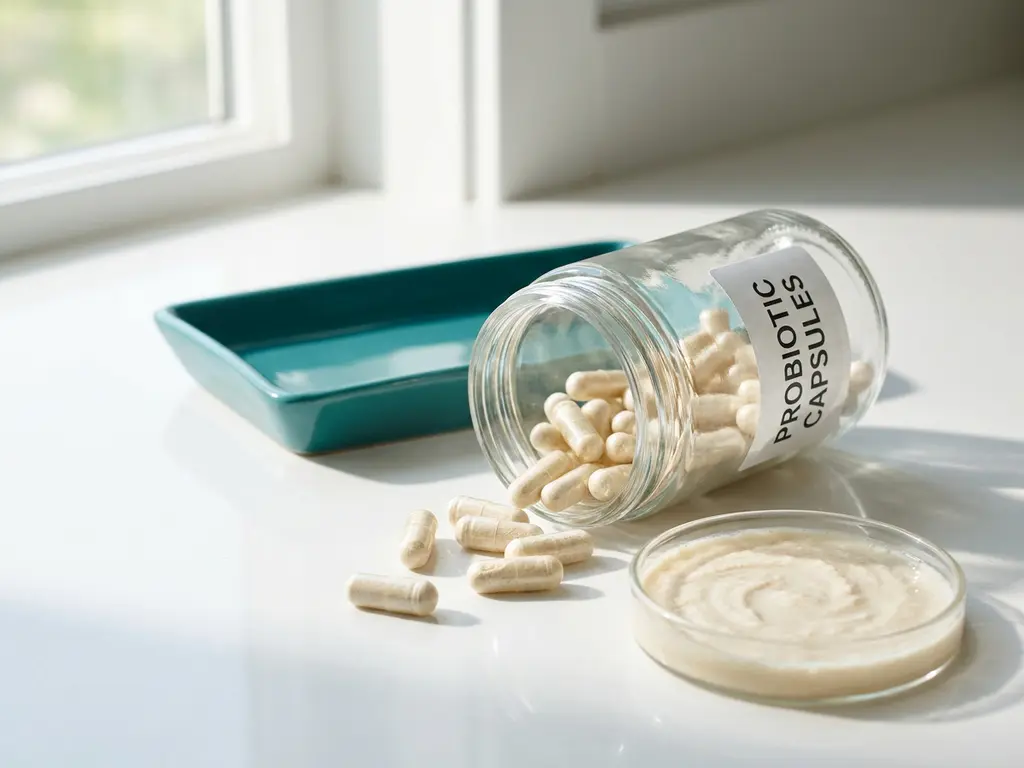
Probiotics are live microorganisms that, when delivered in adequate amounts, can influence the probiotics and gut microbiome relationship by temporarily adding functional capacity to the intestinal ecosystem. In practice, they tend to act through competition with other microbes, metabolite production, and “cross-feeding” that shifts outputs such as short-chain fatty acids (SCFAs). For R&D teams, the key questions are which strains do what, how consistent the effects are across people, and how to generate mechanistic evidence efficiently.
What do probiotics do in the gut microbiome
Probiotics mainly work through transient colonisation and functional interaction, rather than permanently “taking over” the gut. They can support gut bacteria balance by competing for nutrients and adhesion sites (competitive exclusion), producing metabolites (for example, organic acids), and enabling cross-feeding where one microbe’s outputs become another’s inputs. These mechanisms can shift microbiome diversity and resilience, especially after disturbances.
From a preclinical perspective, it helps to separate “presence” from “impact”. A strain may be detectable only briefly, yet still change fermentation patterns, pH microenvironments, and the availability of substrates for resident microbes. When this happens across multiple donor microbiomes, it suggests a more robust, product-relevant mechanism rather than a donor-specific artefact.
- Competitive exclusion: limits opportunities for less desirable taxa to expand.
- Metabolite production: changes local chemistry and microbial behaviour.
- Cross-feeding: can increase SCFAs via multi-step community metabolism.
How do probiotics affect digestion, the gut barrier, and immunity
Probiotics can influence digestion and host interfaces by altering enzymatic activities and microbial metabolism. Some strains contribute to lactose processing or bile acid transformations, which can change downstream fermentation. They may also affect epithelial barrier function by supporting tight junction signalling and mucus-associated interactions, and they can modulate immune communication through microbial-associated molecular patterns and metabolite-driven pathways.
These effects are strain-specific and often person-dependent because baseline microbiome composition, diet matrix, and bile acid pools differ between individuals. In R&D terms, this means you should test across multiple donors and track both structure (taxonomy) and function (metabolites, gas, and barrier or immune readouts where relevant) to avoid over-interpreting a single endpoint.
Which probiotic strains help with which gut goals
Different probiotic genera are associated with different functional “goals”, but performance depends on the exact strain identifier and formulation context. At a high level, Lactobacillus and Bifidobacterium strains are often selected for carbohydrate fermentation profiles and SCFA-linked outputs, while Saccharomyces boulardii is often selected for robustness and interaction with microbial ecology during perturbations. For product teams, match strains to measurable endpoints, not marketing categories.
| Strain group (examples) | Common R&D goal | What to measure preclinically |
|---|---|---|
| Lactobacillus spp. | Fermentation shifts, cross-feeding potential | Organic acids, SCFAs, community composition |
| Bifidobacterium spp. | Support saccharolytic metabolism | Acetate and downstream butyrate patterns, bifidogenic effects |
| Saccharomyces boulardii | Stability during ecosystem disturbance | Community resilience markers, metabolite stability, gas |
What are prebiotics and synbiotics, and how do they differ from probiotics
Probiotics are live microbes added to a system, prebiotics are substrates (often fibres or oligosaccharides) that are selectively used by resident microbes, and synbiotics combine both to target complementary functions. Prebiotics typically work by feeding existing communities, often increasing SCFAs and sometimes supporting microbiome diversity, while probiotics add specific metabolic activities or ecological interactions.
Synbiotics make sense when there is a plausible mechanistic link, for example, when a probiotic produces intermediates that resident microbes convert into butyrate, or when a prebiotic improves the persistence or activity of the added strain. Preclinical screening should check for additive versus synergistic effects, and whether the effect holds across donor variability.
How to choose and use a probiotic safely
For B2B teams selecting probiotic candidates, safety and quality start with the label and technical file: you need an unambiguous strain ID, a defined viable count at the end of shelf life, and clear storage conditions. Also confirm the delivery format and matrix effects, since oxygen, moisture, and acidity can change viability and functional performance. Risk assessment should consider the intended population and use context.
- Strain identification: genus, species, and strain code, not just “Lactobacillus”.
- CFU specification: defined at end of shelf life, with stability data.
- Storage and handling: temperature, humidity, and packaging requirements.
- Side effects and contraindications: include internal guidance for immunocompromised or critically ill populations, and align with clinical governance.
- Escalation: involve a qualified clinician for any clinical positioning or vulnerable cohorts.
How Cryptobiotix helps with probiotics in the gut microbiome
We help R&D teams generate decision-grade evidence on probiotics and gut microbiome performance using a validated ex vivo gastrointestinal simulation approach, so you can prioritise strains, de-risk formulations, and build mechanistic narratives that stand up to technical review.
- Assess probiotic benefits in the gut via functional readouts such as SCFAs, gas, and community shifts, including cross-feeding effects.
- Quantify inter-individual variability by testing across multiple donor microbiomes, supporting responder and non-responder insights.
- Connect digestion, fermentation, and host-relevant endpoints through a modular workflow aligned to product type and target cohort, see our applications.
- Use our SIFR technology to move from screening to deeper mechanistic characterisation with structured reporting.
- Review our approach to validation and outputs in scientific evidence.
If you want to evaluate a probiotic, synbiotic, or formulation concept with a clear preclinical plan, contact us to discuss your research question and timelines.