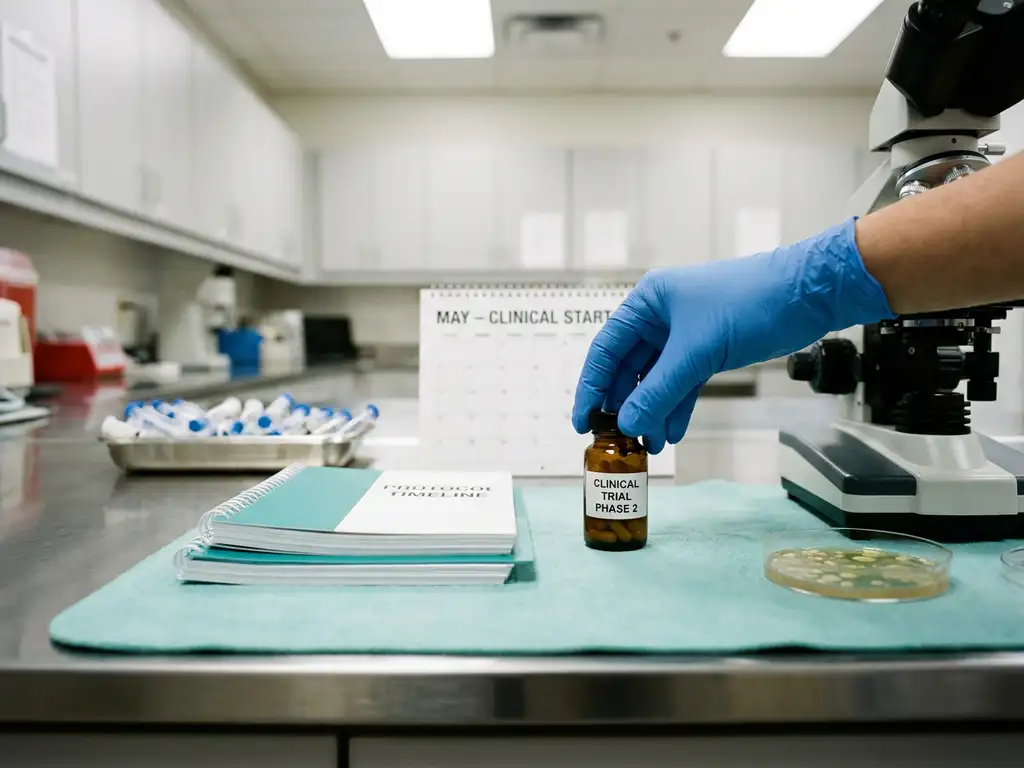
A realistic clinical development timeline for a gut microbiome product from preclinical work to a defensible health claim typically spans 2 to 5 years, depending on product type, target population, endpoints, and the regulatory pathway for microbiome products in the intended markets. The fastest programmes compress early R&D by generating predictive mechanistic evidence before committing to expensive human trials.
For B2B teams, the main timeline risk is not running trials; it is running the wrong trial design or dose because preclinical evidence did not translate. The most reliable plans build a clear mechanism of action, quantify inter-individual variability, and align endpoints with claim strategy early.
The sections below break down the stages, typical durations, clinical trial phases, and the practical levers that speed up or slow down delivery to claim substantiation.
What are the main stages in a gut microbiome product development timeline?
A gut microbiome clinical development timeline usually moves through five stages: product definition, preclinical mechanism and screening, clinical feasibility and dose finding, pivotal clinical substantiation, and claim and dossier preparation. Each stage should reduce uncertainty about mechanism, responder profiles, and endpoints so later microbiome clinical trial phases are faster and less likely to fail.
In practice, most programmes iterate between stages because formulation, dose, and target cohort often change once early microbiome readouts appear. A robust timeline also plans for analytics and quality decisions that are easy to underestimate, such as assay selection, sample handling, and statistical plans for microbiome variability.
- Stage 1: Define product, intended use, target population, and claim ambition
- Stage 2: Preclinical evidence generation for mechanism, dose response, and variability
- Stage 3: First-in-human feasibility and biomarker confirmation
- Stage 4: Confirmatory substantiation trial(s) aligned to claim language
- Stage 5: Health claim substantiation microbiome dossier, regulatory, and commercial readiness
How long does preclinical development take for microbiome-targeted products?
Preclinical development for microbiome-targeted products typically takes 3 to 12 months for a well-run programme, depending on how many formulations, doses, and donor cohorts are tested and how deep the mechanistic package needs to be. The goal is to generate predictive evidence that informs clinical design, not to run long, open-ended experiments.
Time expands when teams rely on low-throughput approaches that test only a few microbiomes, or when they postpone key decisions such as target population selection and endpoint strategy. Time compresses when preclinical work is designed to mirror the intended clinical regimen and captures early causal microbial shifts that drive longer-term outcomes.
- Fast track: Lead screening and ranking across many conditions, then focused validation for the best candidates
- Mechanistic track: Taxonomy plus functional readouts such as metabolite shifts, gas production as a tolerability proxy, and host interaction assays where relevant
- Variability track: Testing multiple donors per cohort to identify responders and non-responders before trial recruitment
For teams planning a microbiome product preclinical to clinical transition, preclinical is also where you can align digestion and fermentation assumptions with the real GI journey. That alignment reduces the risk of choosing a dose that looks promising in a simplified setup but fails once translated to humans.
What does a realistic clinical trial timeline look like from first-in-human to claim substantiation?
A realistic clinical timeline from first-in-human to health claim substantiation microbiome evidence is usually 12 to 36 months. This includes protocol design, ethics and contracting, recruitment, intervention, sample analysis, and reporting. The duration depends heavily on recruitment speed, endpoint complexity, and whether one strong substantiation trial is sufficient or multiple studies are needed.
Unlike small molecule development, many microbiome-acting products aim to demonstrate a measurable benefit in a defined population with a clear mechanism and consistent microbiome response. That still requires disciplined planning because microbiome endpoints add operational steps such as stool logistics, sequencing or metabolomics pipelines, and pre-specified analysis plans.
- Study design and set up: 3 to 6 months for protocol, vendors, ethics, contracting, and site initiation
- First-in-human feasibility: 3 to 9 months depending on recruitment and intervention length
- Confirmatory substantiation: 6 to 18 months depending on endpoints, seasonality, and cohort availability
- Analysis and dossier-ready reporting: 2 to 6 months depending on omics depth and QA requirements
To keep microbiome clinical trial phases on track, teams should define in advance what success looks like for both clinical endpoints and microbiome readouts, and how those map to claim language and the regulatory pathway for microbiome products in each target region.
What are the biggest factors that speed up or slow down microbiome product timelines?
The biggest timeline drivers are cohort definition, model predictivity, recruitment feasibility, endpoint selection, and data operations. Programmes speed up when preclinical evidence is predictive, high-throughput, and designed to quantify inter-individual variability. They slow down when teams discover late that the effect is cohort-specific, dose-dependent, or not robust across microbiomes.
Several factors repeatedly determine whether a microbiome product preclinical to clinical plan stays realistic.
- Inter-individual variability: If you do not map responders and non-responders early, you often redesign inclusion criteria mid-programme
- Endpoint strategy: Complex endpoints and exploratory omics can add months unless pre-specified and operationally tested
- Operational logistics: Sample collection, stabilisation, shipping, and lab throughput can become the critical path
- Regulatory alignment: Claim ambition that is not aligned to available evidence can trigger additional studies
- Formulation changes: Late changes reset comparability and may require repeating parts of the evidence package
A practical way to protect the gut microbiome clinical development timeline is to treat preclinical and clinical as one continuous evidence strategy, with clear decision gates for dose, cohort, and mechanism before committing to larger trials.
How does Cryptobiotix help with a realistic clinical development timeline for gut microbiome products?
We help teams build a realistic gut microbiome clinical development timeline by generating predictive, decision-ready preclinical evidence that translates into clearer clinical hypotheses, better-powered designs, and fewer late-stage surprises. Our validated ex vivo approach is built to capture immediate microbial modulation within 24 to 48 hours while supporting deeper mechanism and variability analysis.
- Faster preclinical decisions: High-throughput screening and focused validation to prioritise formulations and doses earlier
- Mechanism and variability: Multi-omics insights across multiple donors to support responder profiling and dose-response logic
- Biorelevant GI simulation: Modular workflows that can cover digestion, colonic fermentation, and host microbe interaction questions
- Operational acceleration: Access to characterised microbiome material via biobanking to reduce sourcing delays
Explore our SIFR technology, see scientific evidence, review industry applications, or start a timeline scoping discussion via our contact page.
Frequently Asked Questions
What evidence is usually needed to support a defensible health claim for a microbiome product?
Plan for a package, not a single readout: (1) a clinically meaningful primary endpoint in the intended population, (2) a plausible mechanism of action supported by microbiome/functional data, (3) dose justification, and (4) reproducibility (ideally in a confirmatory study or clearly justified single pivotal trial). Align the evidence standard to the claim type and market early to avoid adding studies later.
How do you choose between a single pivotal substantiation trial vs. multiple studies?
Use one well-powered pivotal trial when the endpoint is objective, the population is tightly defined, and preclinical/feasibility data show a consistent responder signal. Consider multiple studies when effects are modest, endpoints are subjective, seasonality or diet strongly influences outcomes, or you need replication across sites/regions. Decide upfront based on claim ambition and risk tolerance.
What sample size and powering pitfalls are common in microbiome clinical trials?
The biggest pitfalls are powering on exploratory microbiome features, underestimating inter-individual variability, and ignoring expected dropout from stool collection burden. Power the study on the clinical primary endpoint, pre-specify a limited set of key microbiome/functional secondary endpoints, and inflate sample size for variability and missing samples. Run a feasibility study to estimate variance and adherence.
What operational steps should be locked down early to prevent stool logistics from becoming the critical path?
Before recruitment, finalise the collection kit, stabilisation method, shipping conditions, chain-of-custody, and lab throughput timelines. Pilot the full workflow (site → participant → courier → lab) and define acceptance criteria for samples. Pre-book sequencing/metabolomics capacity and freeze the bioinformatics pipeline and versioning plan to avoid reprocessing delays.
How should diet, probiotics, antibiotics, and other confounders be handled in study design?
Define clear washout rules (especially for antibiotics and probiotics), standardise key dietary constraints around sampling windows, and capture diet with a practical tool (short FFQ or 24-hour recalls). Stratify or adjust for major confounders in the statistical plan, and pre-specify how protocol deviations will be handled to protect interpretability.
When do formulation or manufacturing changes trigger the need to repeat studies?
If a change can alter viability, delivered dose, release profile, or key actives (e.g., strain ratio, excipients, encapsulation, processing), you may need bridging data to show comparability. Lock the formulation before pivotal trials when possible; if changes are unavoidable, plan a comparability strategy (analytical + small clinical/biomarker bridge) so you don’t reset the entire evidence package.
What are practical next steps to scope a 2–5 year development plan for your specific product?
Start with a one-page Target Product Profile (population, use case, claim, dose form), then map endpoints to claim language and region. Run a preclinical plan that ranks formulations/doses across multiple donors, followed by a feasibility study that tests adherence, variance, and biomarker directionality. Use those outputs to lock the pivotal design, vendors, and a dossier-ready reporting plan with clear decision gates.