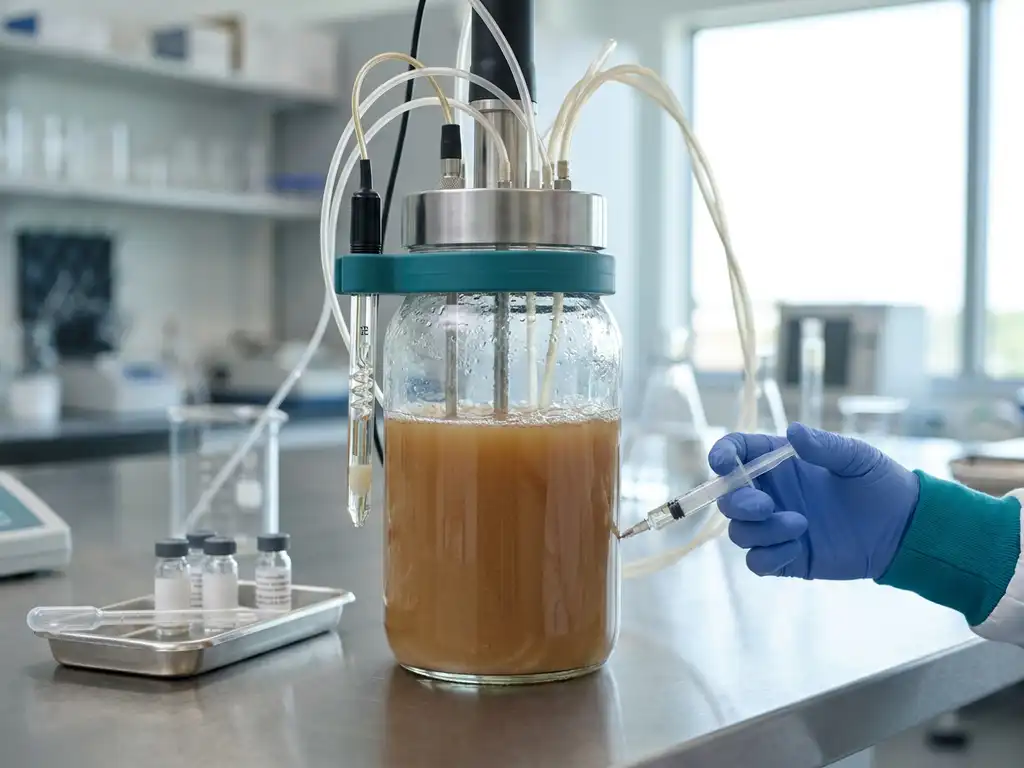
Colonic fermentation is the microbial breakdown of undigested food components in the large intestine, producing short-chain fatty acids (SCFAs), gases, and other metabolites that influence gut function and systemic physiology. In the lab, gut microbiome simulation recreates these anaerobic, pH-controlled conditions using faecal inocula and defined media, then tracks metabolites and community shifts over time. Below are the key questions R&D teams ask when selecting an in vitro colon model or ex vivo fermentation assay.
What is colonic fermentation
Colonic fermentation is the anaerobic metabolism of substrates that escape upper gastrointestinal digestion, carried out by the gut microbiota in the colon. It mainly generates SCFAs (acetate, propionate, butyrate), gases (CO2, H2, sometimes methane), and intermediate metabolites such as lactate.
It occurs primarily in the proximal to transverse colon, where substrate availability is highest and microbial density is greatest. Key microbial players include saccharolytic taxa that degrade complex carbohydrates, plus cross-feeders that convert intermediates (for example, lactate) into butyrate or propionate. Main substrates include:
- Dietary fibres (inulin-type fructans, pectins, beta-glucans)
- Resistant starch and other slowly fermentable carbohydrates
- Proteins and amino acids (especially when carbohydrate is limited), which can yield branched-chain fatty acids and other nitrogenous metabolites
Why does colonic fermentation matter for health and product development
Colonic fermentation matters because microbial metabolites act as measurable mechanistic links between an ingredient and downstream host responses. For product development, SCFA profiles, gas, and proteolytic markers help teams predict whether a formulation is likely to support gut barrier function, immune signalling, and metabolic pathways in a biologically plausible way.
In B2B R&D, fermentation outcomes are used to:
- Screen fibres, prebiotics, synbiotics, and APIs for mode-of-action signals before investing in expensive trials
- Compare dose responses and formulation effects (matrix, processing, release profile)
- Assess tolerability risk using gas production as an early proxy
- Build mechanistic packages that support IP, partner due diligence, and regulatory dossiers
How is colonic fermentation simulated in the lab
Colonic fermentation is simulated by incubating a gut-derived microbial community with a test substrate under anaerobic, temperature-controlled conditions, then sampling metabolites and microbiome composition over time. Common approaches include batch fermentation, continuous fermentation, and ex vivo systems designed to preserve donor-like community structure while improving throughput and reproducibility.
Common model formats
| Approach | Typical use | Key controls to get right |
|---|---|---|
| Batch fermentation | Fast ranking of substrates and formulations | Anaerobiosis, media suitability, pH buffering, negative controls |
| Continuous models | Longer-term adaptation questions | Retention time, steady-state definition, selection bias management |
| Ex vivo fermentation assay | Mechanistic readouts with higher biorelevance | Donor stability, standardisation, robust analytics, replication across donors |
Core setup steps (what drives data quality)
- Inoculum sourcing: typically fresh faecal material, or qualified cryo-stabilised material when logistics require repeatability.
- Anaerobic handling: oxygen exposure can suppress strict anaerobes and skew outputs.
- pH control: fermentation acids lower pH, which can change community behaviour if not buffered or controlled.
- Retention time and sampling plan: align timepoints to the question, for example, early causal shifts versus later cross-feeding products.
- Endpoints: define primary endpoints (SCFAs, gas, taxa, functional markers) before running the study.
What measurements are used to assess fermentation outcomes
Fermentation outcomes are assessed by combining metabolite quantification with microbiome profiling, then interpreting both in the context of controls and donor variability. The most common primary readouts are short-chain fatty acids (SCFAs), lactate, branched-chain fatty acids, gas, and pH, supported by sequencing and functional analytics.
- Metabolites: acetate, propionate, butyrate, lactate, succinate, branched-chain fatty acids (isobutyrate, isovalerate).
- Gas and pressure: total gas, gas kinetics, or pressure build-up in closed systems as a tolerability-relevant signal.
- pH: both a readout and a confounder, interpret alongside buffering strategy.
- Microbial composition: 16S or metagenomics, ideally paired with approaches that avoid purely relative-abundance bias.
- Functional readouts: targeted or untargeted metabolomics (for example, indole derivatives), and optional host-facing assays using fermented supernatants on cell models.
What are the limitations of lab simulations and how can they be reduced
Lab simulations cannot fully reproduce the living colon, so limitations include missing host factors, simplified oxygen and mucus gradients, and strong dependence on donor microbiome composition and diet context. These issues can be reduced through standardised protocols, appropriate controls, donor panels, and validation against clinically relevant signals rather than relying on single-donor outcomes.
- Inter-individual variability: mitigate with multi-donor cohorts, responder analysis, and replicate designs.
- Loss of host biology: mitigate by coupling fermentation outputs to barrier or immune cell assays when mechanism requires host context.
- In vitro bias: mitigate by preserving donor-like community structure, using suitable media, and including no-substrate controls.
- Diet and matrix effects: mitigate by simulating digestion upstream for complex foods, then fermenting the relevant fraction.
How Cryptobiotix helps with colonic fermentation simulation
We help R&D teams generate decision-grade data from colonic fermentation using our validated SIFR technology, designed for high-throughput gut microbiome simulation with a strong focus on biorelevance, reproducibility, and actionable interpretation. Depending on your development stage, we support:
- Rapid screening of ingredients, doses, and combinations across multiple donors
- Mechanism-of-action packages, including SCFAs, gas, microbiome shifts, and optional host-relevant readouts
- Population and indication-specific study designs aligned to your applications
- Clear scientific substantiation routes, backed by our scientific evidence page
If you want to discuss an ex vivo fermentation assay or an in vitro colon model strategy for your product, contact us via this form.
Related questions teams often ask next
- Which donor panel size is needed to detect responder and non-responder patterns?
- How do you choose between SCFA optimisation and gas minimisation endpoints?
- When should digestion be simulated before colonic fermentation for complex matrices?