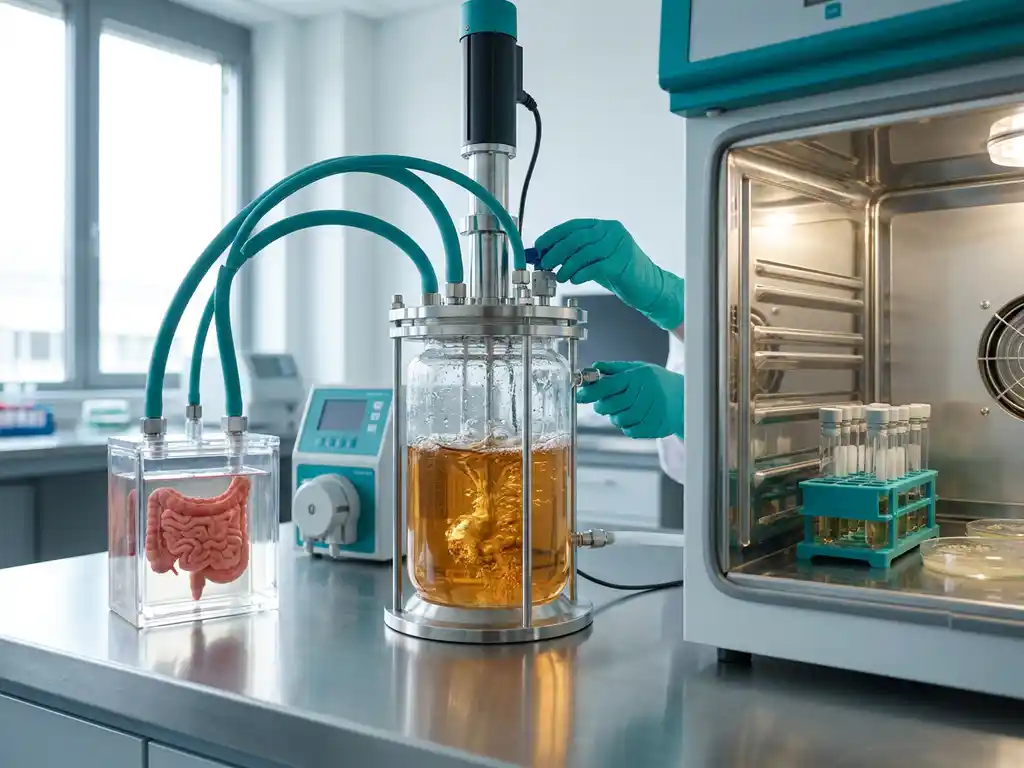
Ex vivo gut fermentation is a form of preclinical microbiome testing that measures how a complex, donor-derived gut community ferments a test product outside the body under controlled, gut-like conditions. It differs from many in vitro gut model setups by aiming to preserve the original microbiome structure and function, improving biological realism and decision confidence. Below are the practical questions R&D teams ask most, from workflows and readouts to when each approach fits product development.
What is ex vivo gut fermentation?
Ex vivo gut fermentation is the incubation of a complex gut microbiome community, typically sourced from a donor sample, in a controlled system outside the body while keeping the community as close as possible to its original state. The goal is to observe how a product changes microbial activity and composition under biorelevant conditions.
Typical inputs include a test substance (ingredient, formulation, API, or feed additive), a defined fermentation medium, and a donor-derived inoculum. Typical outputs include metabolites (for example, short-chain fatty acids), gas production, and shifts in microbial taxa and functional pathways. It can answer questions such as:
- Does the product change gut microbiome fermentation patterns (metabolites, gas, pH trends)?
- Which taxa are stimulated or suppressed, and are cross-feeding effects plausible?
- Is there evidence of dose response and inter-individual variability?
How does ex vivo gut fermentation work in practice?
In practice, ex vivo fermentation follows a standard workflow: select donor samples, prepare a microbiome inoculum, run fermentation under gut-like conditions, dose the test product, then sample over time for multi-layer readouts. A well-designed workflow prioritises negative controls and conditions that maintain donor-specific community features.
- Donor strategy: define cohort criteria, then select multiple donors to capture variability (responder and non-responder patterns).
- Inoculum preparation: process samples to preserve anaerobic microbes and minimise handling bias.
- Simulated conditions: set temperature, pH control, anaerobiosis, and nutrient background to match the target gut region.
- Dosing and sampling: apply product at defined concentrations, sample at relevant timepoints (often within 24 to 48 hours).
- Readouts: metabolites, gas pressure, community composition (taxa), and functional endpoints, optionally including downstream host-relevant assays using cell-based systems.
What is in vitro gut fermentation, and what are its main limitations?
An in vitro gut model is any laboratory fermentation approach used to study microbial metabolism outside the body, ranging from simple monocultures to mixed-community batch systems and longer-term continuous setups. These models can be useful for early hypothesis testing, but their value depends heavily on how well they preserve ecological complexity and avoid selection bias.
Main limitations include:
- Ecological drift: communities can adapt to the system rather than reflect the starting donor microbiome.
- Over-simplification: monocultures or low-diversity consortia miss cross-feeding and competitive dynamics.
- Stability and translation: poor media choices, oxygen exposure, or long adaptation phases can produce outputs that do not reflect real gut behaviour.
- Low population coverage: too few donors can hide inter-individual variability that later drives clinical or feeding-trial risk.
What are the key differences between ex vivo and in vitro gut fermentation?
The key difference is intent and execution: ex vivo approaches aim to keep the donor microbiome close to its original structure and function, while many in vitro approaches prioritise controllability or long runtime, sometimes at the cost of biological realism. For R&D, the practical impact shows up in predictivity, reproducibility, and how confidently you can generalise results across individuals.
| Factor | Ex vivo gut fermentation | In vitro gut model (typical) |
|---|---|---|
| Biological realism | Designed to preserve complex donor communities | Ranges from simple to complex, often with higher selection bias |
| Throughput | Can be high with automation and parallelisation | Often lower for complex systems, higher for simple screens |
| Reproducibility | Strong when protocols and controls are standardised | Variable, sensitive to operator handling and adaptation effects |
| Cost and time | Fast turnaround for actionable microbiome shifts | Can be fast (simple) or slow (continuous, adapted) |
| Best use cases | Mechanism, dose response, donor variability, translation-focused decisions | Early feasibility, single-strain questions, rough ranking with caution |
When should ex vivo or in vitro models be used for R&D decisions?
Use ex vivo when you need decision-grade evidence about how real, complex microbiomes respond, especially when inter-individual variability and translation risk matter. Use simpler in vitro approaches when you need fast, low-cost directional signals, for example, to eliminate non-starters before investing in deeper work.
- Early screening: in vitro can help rank many concepts quickly, but confirm with ex vivo before major spend.
- Mechanistic validation: ex vivo is better suited to link taxa shifts with metabolite changes and plausible cross-feeding.
- Dose response: ex vivo supports more realistic concentration testing with appropriate controls.
- Responder variability: ex vivo designs can include multiple donors to identify stratification signals.
- Regulatory-supporting packages: ex vivo outputs are often easier to position as mechanistic support when protocols are controlled and reproducible.
How Cryptobiotix helps with ex vivo gut fermentation research
We support ex vivo gut fermentation programmes with our validated SIFR technology, designed to generate mechanistic, translation-focused evidence for R&D decisions in food, pharma, biotech, and animal health.
- Study design support for cohorts, controls, dose response, and inter-individual variability
- High-throughput fermentation with standardised workflows and actionable reporting
- Readouts spanning metabolites, taxonomy, and optional host-relevant endpoints
- Programme fit across sectors described on our applications page
- Method credibility and validation approach summarised under scientific evidence
If you want to scope a study or compare model options for your pipeline, contact us here: contact.