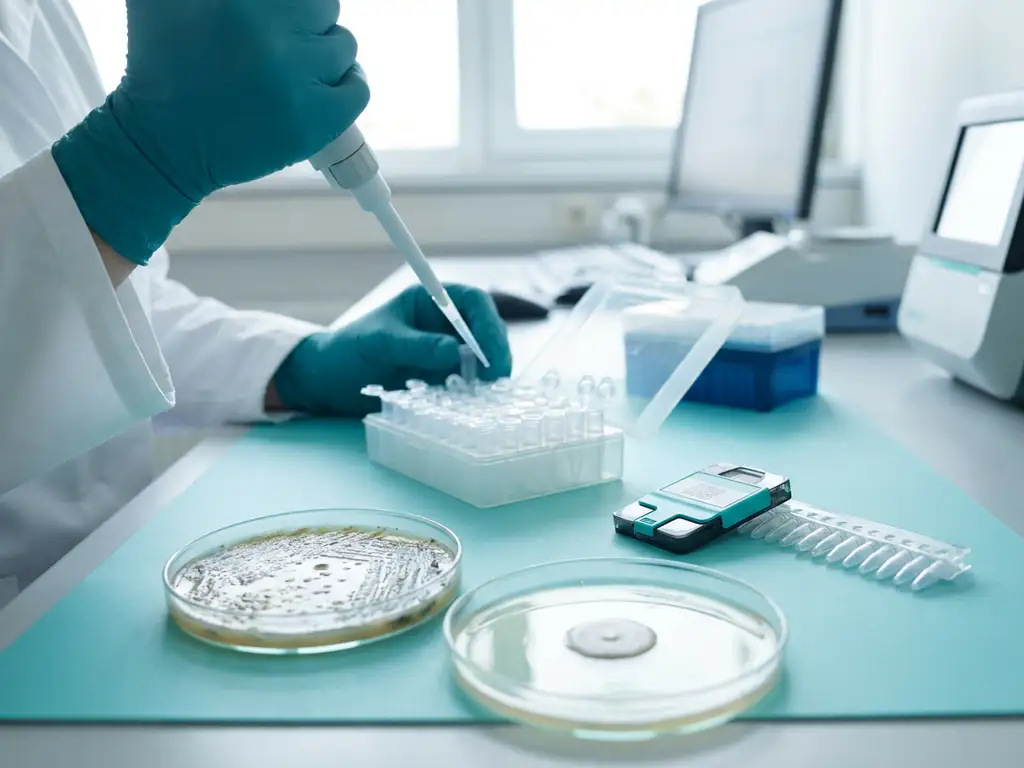
Shotgun metagenomics is a microbiome profiling method that sequences all DNA in a sample, enabling both taxonomic identification and functional metagenomics (genes and pathways). You typically choose it over 16S rRNA sequencing when you need species-level resolution, non-bacterial detection, or mechanistic evidence such as metabolic pathways or antimicrobial resistance genes. Below are the key questions teams ask when selecting the right approach.
What is shotgun metagenomics?
Shotgun metagenomics sequences random fragments of total community DNA from a sample, rather than amplifying a single marker gene. The main outputs are (1) taxonomic profiles, often down to species and sometimes strain, and (2) functional readouts, such as gene families, enzymes, and pathway abundance, supporting functional metagenomics.
Conceptually, it differs from targeted amplicon approaches because it does not rely on PCR primers for a specific locus. That broader capture can reduce marker-specific blind spots and enables analysis beyond bacteria, depending on sequencing depth and reference databases.
How does shotgun metagenomics work from sample to results?
Shotgun metagenomics follows a standard workflow from DNA to annotated taxa and functions. The key is controlling technical variation, because small upstream differences can propagate into large downstream interpretation changes.
- Sample handling: stabilisation, storage, and extraction controls.
- DNA extraction: lysis method selection affects which organisms are represented.
- Library prep: fragment DNA, add adapters, choose insert size and indexing.
- Sequencing: select platform and depth based on the required resolution.
- Quality control: trim adapters, remove low-quality reads and duplicates.
- Host read removal: filter human or animal DNA to improve microbial signal.
- Profiling strategy: map reads to references, and/or assemble contigs for gene calling.
- Taxonomic profiling: estimate relative abundance across taxa.
- Gene and pathway annotation: assign functions, reconstruct pathways, optional resistome or virulome.
Decision points that most affect outcomes are extraction chemistry, sequencing depth, host DNA burden, and whether you prioritise mapping (faster, reference-driven) or assembly (more discovery, more compute).
What is the difference between shotgun metagenomics and 16S sequencing?
The core difference is scope. 16S rRNA sequencing targets a bacterial/archaeal marker gene for cost-effective community snapshots, while shotgun metagenomics sequences total DNA for higher resolution and functional readouts. Shotgun is usually more expensive and analytically demanding, but it supports mechanistic interpretation beyond taxonomy.
| Criterion | 16S rRNA sequencing | Shotgun metagenomics |
|---|---|---|
| Typical resolution | Genus, sometimes species | Species, sometimes strain (context-dependent) |
| Functional insight | Indirect inference only | Direct gene and pathway profiling |
| Organism breadth | Mainly bacteria/archaea | Bacteria, archaea, viruses, fungi (depth-dependent) |
| Bias sources | PCR primers, variable regions | Extraction, host DNA, database bias |
| Cost and compute | Lower | Higher |
| Best use | Screening and community shifts | Mechanism-of-action and functional questions |
When should you use shotgun metagenomics instead of 16S?
Use shotgun metagenomics when your decision depends on species-level resolution or functional evidence, not just broad community shifts. It is often the better fit for B2B R&D when you need mechanistic plausibility for internal go/no-go decisions, IP positioning, or regulatory-facing narratives.
- Species or strain differentiation: when closely related taxa may behave differently.
- Functional pathways: carbohydrate utilisation, bile acid metabolism, SCFA-related genes, and other pathway-level questions.
- Resistome or virulome: detection and tracking of antimicrobial resistance genes or virulence factors.
- Non-bacterial targets: viral and fungal signals, where feasible with depth and databases.
- Mechanistic substantiation: when you must connect microbiome modulation to plausible biochemical outputs.
For low-biomass samples, shotgun can be challenging because contamination and host DNA can dominate, so you may need enhanced controls and deeper sequencing.
What are the main limitations and pitfalls of shotgun metagenomics?
Shotgun metagenomics can answer more questions, but it also introduces more ways to get misleading results. Most pitfalls are manageable with good study design, appropriate controls, and a clear analysis plan aligned to the business question.
- Higher cost: sequencing depth and bioinformatics can raise budgets in euros quickly.
- Computational burden: storage, pipelines, and reproducibility requirements are substantial.
- Host DNA interference: reduces effective microbial reads, especially in host-rich matrices.
- Contamination risk: reagents and lab environment matter, especially at low biomass.
- Reference database bias: unknown organisms may be misclassified or missed.
- Batch effects: extraction kits, operators, and run dates can drive apparent differences.
- Interpretation limits: genes indicate potential, not necessarily expression or activity.
Mitigations include negative controls, consistent protocols, pre-defined endpoints, and pairing taxonomy with complementary readouts (for example metabolomics) when function is central.
How Cryptobiotix helps with shotgun metagenomics vs 16S decisions?
When teams need to choose between shotgun metagenomics and 16S rRNA sequencing, we help align the method to the decision you must make, and to the type of mechanistic evidence you need from preclinical work.
- Study design support to match microbiome profiling endpoints to your R&D stage and target population, see our applications.
- Guidance on integrating sequencing with ex vivo gut simulation using SIFR technology, when you need mechanism-of-action signals under biorelevant conditions.
- Clear documentation of our validation approach and capabilities via scientific evidence, supporting internal and external stakeholders.
If you want to pressure-test your sequencing plan before committing budget, contact us via the contact page to discuss the most decision-relevant microbiome profiling strategy for your programme.