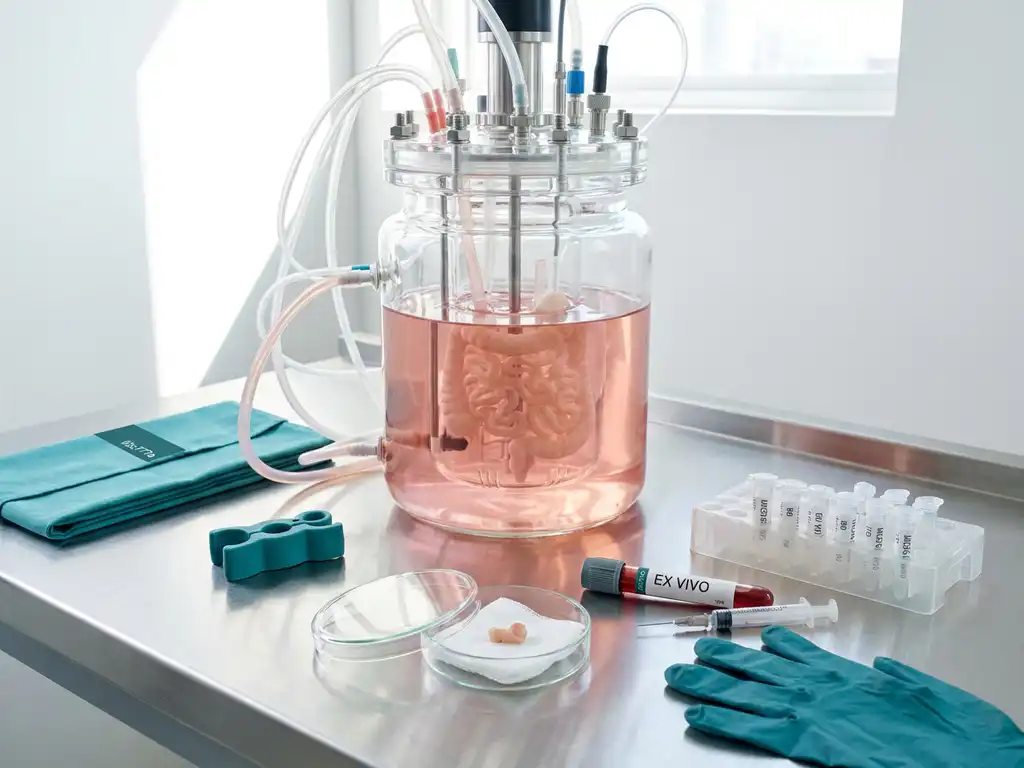
In gut microbiome R&D, in vitro gut testing usually means simplified lab experiments, ex vivo gut models test real donor microbiota outside the body under controlled conditions, and in vivo microbiome studies measure responses in a living organism. The best choice depends on whether you need fast screening, mechanism-of-action evidence, or whole-body outcomes. Below is a practical comparison of realism, speed, cost, and common pitfalls across gut microbiome testing methods.
What do in vitro, ex vivo, and in vivo gut tests mean?
In vitro, ex vivo, and in vivo describe where the biology is tested, from simplified lab systems to whole organisms. In gut research, the key difference is whether you are testing isolated components, a donor-derived microbial ecosystem, or an intact host with systemic physiology. Typical readouts include microbial composition, metabolite profiles, gas production, and host biomarkers (where applicable).
- In vitro: Tests isolated microbes, enzymes, or cell lines in artificial media. Readouts often include growth, survival, single-metabolite production, or barrier markers in cell assays.
- Ex vivo: Tests a complex, donor-derived gut community outside the body (for example, faecal microbiota) under controlled, biorelevant conditions. Readouts include community shifts, short-chain fatty acids, other metabolites, and fermentation gas.
- In vivo: Tests in a living organism (human or animal). Readouts can include stool microbiome, plasma metabolites, immune markers, and clinical endpoints, alongside diet and behaviour confounders.
How do in vitro, ex vivo, and in vivo gut testing compare in realism, speed, and cost?
In vitro is fastest and most controlled, ex vivo balances realism with throughput, and in vivo is most holistic but slowest and most expensive. Budget is driven by duration, analytical depth (for example, sequencing and metabolomics), number of conditions, and operational overheads such as recruitment or animal housing. Ethical review and governance also increase with in vivo complexity.
| Approach | What it captures best | Typical timeline | Cost drivers | Control vs complexity |
|---|---|---|---|---|
| In vitro | Single variables (strain behaviour, enzyme effects, cell responses) | Hours to days | Assays, reagents, analytics | High control, low ecosystem realism |
| Ex vivo | Community fermentation, inter-individual variability, dose response | Days to weeks | Donor handling, bioreactors, multi-omics | Controlled, higher biological complexity |
| In vivo | Whole-body effects, exposure, safety, systemic endpoints | Weeks to months | Recruitment or animal facilities, monitoring, compliance | Highest complexity, lowest experimental control |
When should you choose in vitro vs ex vivo vs in vivo gut testing?
Choose based on the decision you need to make, not on what is most “advanced”. Use in vitro to eliminate weak candidates quickly, ex vivo to generate mechanistic and dose-response evidence in realistic microbial ecosystems, and in vivo when you must measure whole-organism exposure, safety, or clinical outcomes. Many programmes use all three in sequence to reduce risk before major spend.
- Early screening: Use in vitro for stability, basic antimicrobial effects, or first-pass compatibility checks, then move to ex vivo to rank candidates across multiple donors.
- Mechanism of action: Use ex vivo to link ingredient utilisation to community shifts and metabolite changes, ideally across a donor cohort to capture responders and non-responders.
- Dose-response and formulation: Ex vivo is well suited for testing multiple doses and combinations in parallel under consistent conditions.
- Safety and efficacy confirmation: Use in vivo when you need systemic endpoints, tolerability confirmation, or regulatory-grade clinical evidence.
What are the main limitations and pitfalls of each gut testing approach?
Each method can mislead if the model does not match the question. In vitro often over-simplifies, ex vivo can be biased by poor media or inadequate controls, and in vivo can suffer from confounding and translation issues (especially when using non-human models for human outcomes). The most common failure mode is over-interpreting a single readout as “efficacy”.
- In vitro pitfalls: Artificial media effects, missing cross-feeding, and overestimating survival or activity because competition and host constraints are absent. Mitigate with realistic substrates, negative controls, and clear scope statements.
- Ex vivo pitfalls: Donor variability, oxygen exposure during handling, and selection bias if the community drifts away from the starting microbiota. Mitigate with sufficient donor numbers (commonly at least 6 to 8 per cohort), no-substrate controls, and standardised handling.
- In vivo pitfalls: Diet, environment, and compliance confounders in humans, plus limited translation from animal microbiomes to human biology. Mitigate with strong study design, pre-defined endpoints, and aligning the model species and readouts to the intended claim.
How does Cryptobiotix help with the difference between in vitro, ex vivo, and in vivo gut testing?
We help teams choose the right preclinical gut simulation approach, then generate decision-ready evidence using our ex vivo SIFR® platform as a bridge between simplified assays and expensive in vivo work. Learn how it fits across sectors on our applications page, review our validation approach in scientific evidence, and explore the platform details on SIFR® technology.
- High-throughput ex vivo testing across multiple donors to quantify inter-individual variability.
- Mechanism-of-action packages linking microbial composition to functional metabolites and fermentation outputs.
- Study designs that support go, no-go decisions on candidates, doses, and target cohorts before in vivo spend.
- Optional modular workflows spanning digestion, colonic fermentation, and host–microbiome interaction readouts.
If you want to map the most efficient testing pathway for your product and timeline, contact us to discuss your research question.