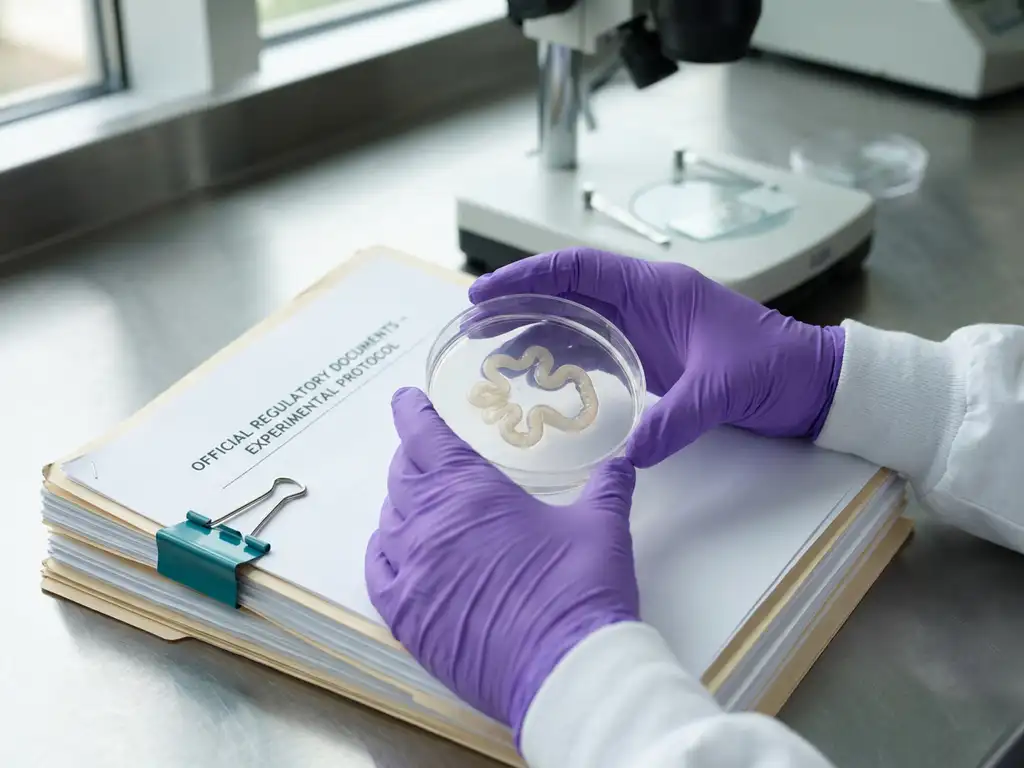
The FDA Modernization Act 2.0 is a US law that updates how the FDA can evaluate drug safety and efficacy by explicitly allowing non-animal testing methods as part of the evidence package. For gut and microbiome research, it signals a clearer regulatory pathway for human-relevant preclinical gut models that generate mechanistic data, explore inter-individual variability, and help teams prioritise candidates before costly clinical trials.
What is the FDA Modernization Act 2.0 in plain terms?
The FDA Modernization Act 2.0 is legislation that amended the US Federal Food, Drug, and Cosmetic Act to modernise preclinical evidence expectations. In plain terms, it tells regulators and sponsors that animal studies are not the only acceptable route for preclinical safety and biological activity evidence.
The intent is not to ban animal testing, but to remove “must use animals” wording and make room for scientifically justified alternatives. For R&D teams, this supports a broader regulatory science toolkit, especially where human biology, such as the gut microbiome, is hard to model in animals.
What does the Act change about animal testing requirements for drugs?
The Act changes the framing from animal testing being a default requirement to animal data being one possible evidence source. It allows sponsors to use fit-for-purpose non-animal data when it is scientifically appropriate for the question being asked.
What it does not do is guarantee FDA acceptance of any specific method, or remove the need for robust safety assessment. Teams still need to justify model choice, show data quality, and align evidence to the intended context of use (for example, early screening vs IND-enabling decisions).
Which non-animal methods does the FDA Modernization Act 2.0 support?
The FDA Modernization Act 2.0 supports the use of multiple non-animal testing methods, as long as they are validated or otherwise justified for the intended decision. The key is demonstrating that the method is reliable, relevant, and interpretable within a defined context of use.
- In vitro assays (cell-based and biochemical), often used for target engagement, toxicity pathways, and barrier function readouts.
- Ex vivo systems using human-derived material, useful for preserving donor-specific biology, including microbiome function.
- Microphysiological systems (for example organ-on-chip) to capture dynamic tissue-level responses.
- In silico approaches (modelling, PBPK, systems biology) to integrate datasets and support dose rationale.
Across all of these, regulators look for clear endpoints, appropriate controls, reproducibility, and a transparent link between the assay output and the claim you are making.
What does FDA Modernization Act 2.0 mean for gut and microbiome research?
For microbiome research, the Act strengthens the case for using human-relevant preclinical gut models to generate mechanistic evidence without relying on animals that often have non-translatable microbiomes and GI physiology. It supports faster, more decision-oriented experiments that focus on microbial metabolism, community shifts, and host-relevant outputs.
Practically, this aligns with common gut R&D needs: screening multiple formulations, understanding responder versus non-responder behaviour across donors, and linking microbial changes to functional readouts (for example, metabolites, gas production as a tolerability proxy, or downstream host-cell responses).
How can teams use non-animal gut models to build stronger regulatory packages?
Teams can use non-animal gut models to strengthen regulatory packages by treating them as structured evidence generators, not exploratory add-ons. The goal is to produce a coherent chain of evidence that connects product, mechanism, and measurable endpoints under controlled conditions.
- Define the regulatory question: safety signal, biological activity, mechanism of action, dose rationale, or cohort differentiation.
- Select the right model: digestion, colonic fermentation, host–microbiome interaction, or an integrated pipeline.
- Pre-specify endpoints and controls: include negative controls, matrix controls, and comparator substances where relevant.
- Design for variability: use multiple human donors to capture inter-individual response patterns.
- Prove data quality: standardised protocols, automation where possible, and clear acceptance criteria.
- Document context of use: what the model can and cannot conclude, and how it informs next decisions.
- Engage early with the FDA: align on how the non-animal testing methods will be interpreted within the overall dossier.
How Cryptobiotix helps with FDA Modernization Act 2.0-ready gut research?
We help teams operationalise FDA Modernization Act 2.0 expectations by generating decision-grade evidence with non-animal, human-relevant preclinical gut models, from rapid screening through deeper mechanistic packages.
- Run studies using our validated SIFR® technology to capture microbiome responses under controlled, biorelevant conditions.
- Support multiple sectors and use cases via our applications focus, including food, biotech, pharma, and animal health.
- Provide clear documentation and scientific rationale aligned with scientific evidence expectations for reproducibility and predictivity.
- Translate outputs into regulator-friendly narratives, linking endpoints to mechanism, dose-response, and inter-individual variability.
If you are planning a non-animal microbiome research programme for a regulatory pathway, contact us to discuss your question, target population, and the evidence package you need.