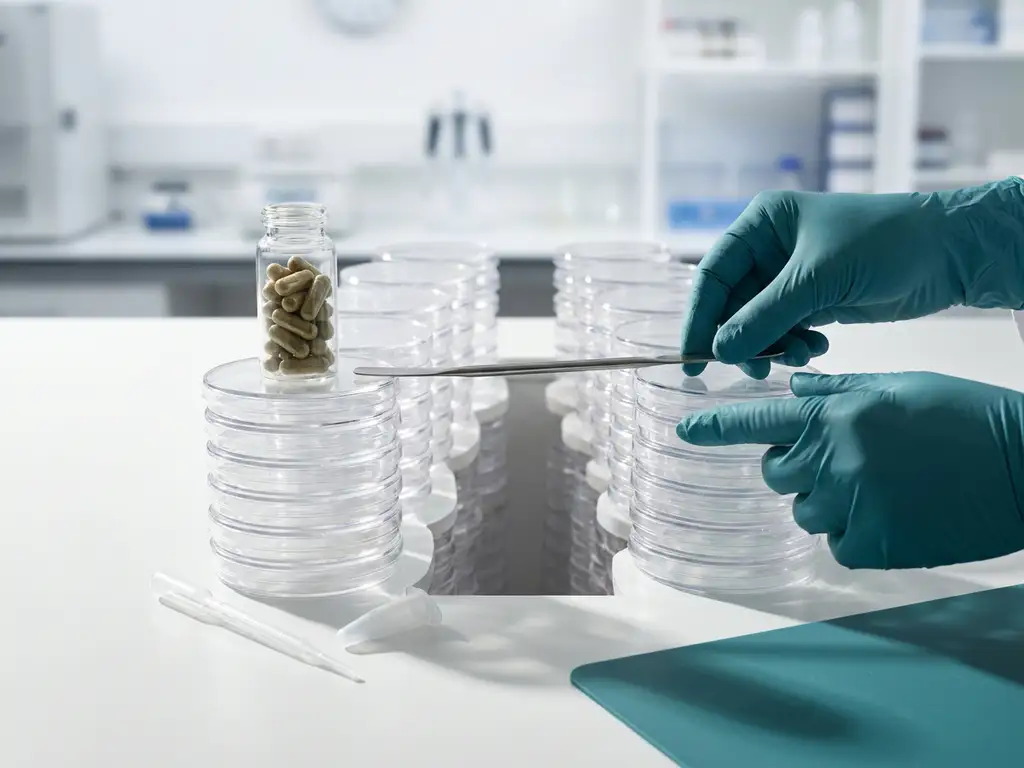
The “valley of death” in microbiome product development is the high-risk gap between early lab signals and reliable clinical or real-world efficacy. Many concepts look promising in simplified assays, then fail when exposed to human variability, realistic matrices, and meaningful endpoints. Closing this gap requires preclinical to clinical translation built on gut microbiome validation, mechanistic clarity, and reproducible effects across multiple donor microbiomes.
What is the “valley of death” in microbiome product development?
In the microbiome context, the valley of death microbiome describes the point where a candidate shows activity in early experiments but cannot demonstrate consistent, clinically relevant effects later. The gap is pronounced because microbiome modulation is indirect, your product changes microbial metabolism first, then host outcomes may accumulate over time.
It is also amplified by the ecosystem nature of the gut, where small shifts in substrates, pH, oxygen exposure, or community structure can change fermentation pathways and metabolite outputs. If a preclinical model introduces bias (for example, by selecting for fast growers or altering the starting community), it can create “effects” that do not exist in humans.
Why do microbiome products fail to translate from lab results to clinical outcomes?
Most translation failures happen because early models do not preserve the original microbiome ecosystem, or they test too few microbiomes to reflect population variability. A strong signal in one donor, one medium, or one format often disappears when you scale to diverse individuals, realistic dosing, and clinically relevant endpoints, increasing microbiome clinical trial risk.
- Model limitations: in vitro bias from adapted communities, non-physiological media, missing controls, or poor reproducibility.
- Inter-individual variability: responder and non-responder dynamics driven by baseline taxonomy and function.
- Formulation and dose effects: matrix interactions, release location, and fermentable load can change outcomes.
- Endpoint mismatch: measuring “nice-to-have” shifts rather than causal metabolites or functional readouts linked to the claim.
- Confounders: diet, antibiotics, concomitant medicines, and habitual fibre intake can mask or mimic effects.
- Mechanistic uncertainty: unclear pathways, cross-feeding, and time dynamics make it hard to choose biomarkers and trial design.
What evidence is needed to cross the valley of death for microbiome claims?
To cross the valley of death, teams need an evidence stack that connects a product to a plausible mechanism and shows it is reproducible across relevant microbiomes. For B2B claims and dossiers, the goal is not just “it changes the microbiome”, it is how it changes microbial function, at what dose, in which populations, and with what translational biomarkers.
| Evidence element | What decision it supports |
|---|---|
| Mode-of-action hypothesis (taxonomy + metabolites) | Claim framing, IP strategy, and endpoint selection |
| Dose–response and formulation sensitivity | Clinical dose justification and product specifications |
| Reproducibility across multiple donor microbiomes | Responder risk management and cohort definition |
| Tolerability and safety-relevant proxies | Feasibility of dosing and risk mitigation plans |
| Biomarker strategy (microbial and host-facing) | Preclinical to clinical translation and trial readouts |
| Alignment with regulatory expectations | Dossier readiness and claim defensibility |
How can teams de-risk microbiome development before expensive clinical trials?
You de-risk microbiome product development by designing preclinical work to answer “go/no-go” questions, not to generate descriptive data. That means starting with a testable mechanism, using a fit-for-purpose model that preserves donor characteristics, and building decision criteria around reproducibility, dose, and biomarkers that can be carried into humans.
- Frame the hypothesis: specify the intended microbial function (for example, SCFA shift, bile acid modulation, indole pathway), not only a taxon change.
- Select the right model: ensure physiological conditions, negative controls, and stability of the baseline community without product.
- Screen smart: compare formulations, doses, and combinations early, then narrow to a small set for deeper mechanistic work.
- Include enough microbiomes: test across a donor panel to quantify variability and identify responder patterns.
- Pre-define success criteria: set thresholds for effect direction, consistency, and tolerability proxies before you see the data.
- Plan translational biomarkers: pick outputs measurable in both preclinical and clinical settings to support continuity.
How Cryptobiotix helps with the valley of death in microbiome product development?
We help teams bridge the valley of death in microbiome product development by generating fast, decision-grade evidence that supports preclinical to clinical translation and reduces microbiome clinical trial risk. Using our validated ex vivo platform, we can test across multiple donor microbiomes and connect composition to function with actionable interpretation.
- Run studies with the SIFR® technology to capture immediate microbial responses that underpin longer-term outcomes.
- Support different sectors and target populations via our applications workflows, including human and animal microbiomes.
- Provide confidence through our scientific evidence approach, focused on predictivity, reproducibility, and biorelevance.
- Help define mechanisms, dose–response, responder profiles, and biomarker strategies suitable for dossiers and trial planning.
If you want to pressure-test your concept before committing €500,000+ to a clinical programme, contact us to discuss your target claim, cohort, and the most efficient study design.