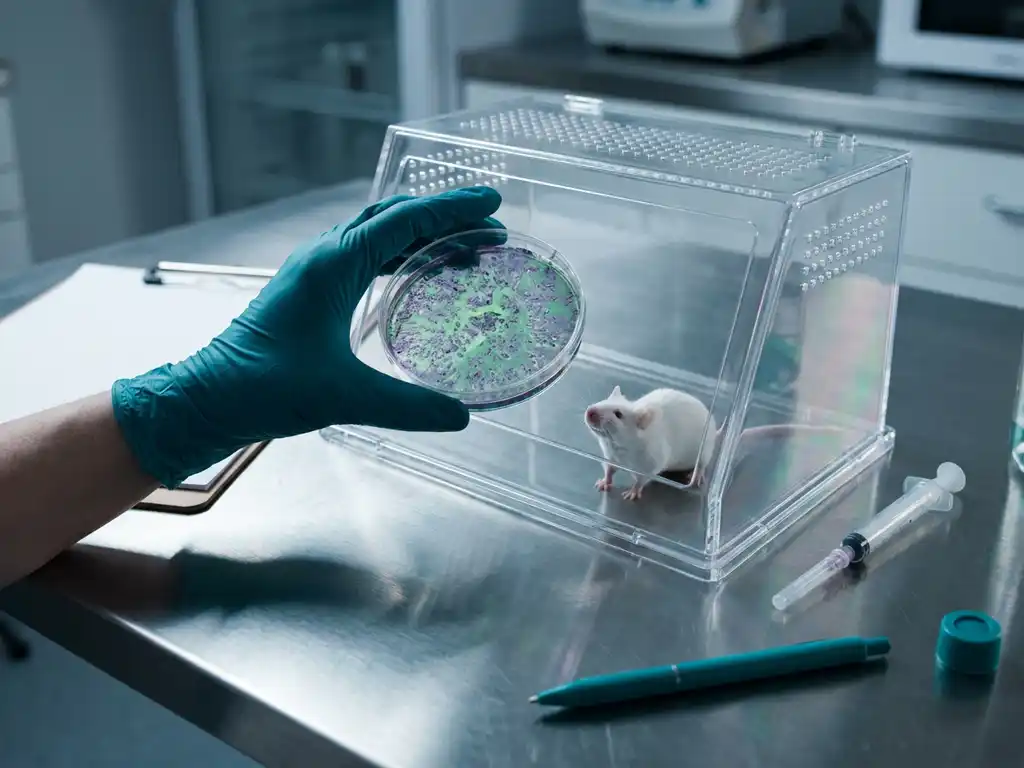
Products that look strong in lab tests often disappoint in human trials because the model does not reproduce real human biology, real gut microbiome variability, or real exposure conditions. The result is a lab to clinic translation gap where preclinical vs clinical results diverge even when the early data seems clear.
This human trial failure pattern is most common for gut active ingredients because microbial ecosystems respond quickly, but clinical outcomes build progressively and differ across individuals. The questions below break down where translation fails and how to design more predictive preclinical models.
Why do lab results fail to translate to humans?
Lab results fail to translate to humans when the test system strips away the factors that drive real-world outcomes: complex microbiome ecology, realistic digestion and dosing, host interactions, and inter-individual variability. This creates a lab to clinic translation gap where a signal appears robust in controlled conditions but collapses once exposed to human biology and trial noise.
In gut microbiome R&D, the biggest mismatch usually comes from two places. First, simplified systems can introduce in vitro bias, where fast-growing microbes dominate and the community drifts away from the donor starting point. Second, many studies under-sample the population, so a product that only works in a subset looks inconsistent when tested in broader cohorts.
Another frequent issue is timing. Microbes can shift metabolism within hours, but clinical endpoints often require weeks of repeated intake to accumulate. If a preclinical model cannot capture the early causal microbial event, it becomes harder to justify why a long-term clinical effect should occur.
What are the most common reasons products fail in clinical trials?
Most products fail in clinical trials because the preclinical package does not predict responder variability, does not confirm a mechanism of action, and does not match the clinical exposure context. These gaps turn promising preclinical vs clinical results into human trial failure when the trial population, endpoints, and real dosing conditions reveal the missing biology.
- Inter-individual variability ignored by testing too few microbiomes, which hides responder and non-responder patterns.
- Mechanistic evidence too thin for confident endpoint selection, dose setting, and regulatory narrative.
- Unrealistic matrices and digestion that change ingredient availability before it reaches the colon.
- Microbiome drift and selection bias from poorly controlled fermentations that no longer resemble the starting community.
- Endpoints not aligned with what the product can plausibly change within the trial duration.
For B2B developers, these issues show up as late-stage surprises: tolerability signals missed early, null results in the overall cohort despite clear subgroup effects, or inconsistent biomarker shifts that cannot be explained convincingly in a dossier.
How do in vitro, ex vivo, animal, and human studies differ?
In vitro, ex vivo, animal, and human studies differ in biorelevance, control, throughput, and predictive validity. In vitro vs in vivo comparisons often fail because in vitro systems simplify biology, animal models have species-specific microbiomes and physiology, and human trials introduce real population variability. Ex vivo approaches aim to keep human microbiome structure and function closer to the donor while retaining experimental control.
- In vitro typically uses simplified cultures or limited donor numbers, which can be fast and cheap but prone to in vitro bias and poor translation.
- Ex vivo uses human-derived microbiomes under controlled conditions to preserve community behaviour more faithfully, enabling mechanistic readouts and dose-response testing.
- Animal studies can add host physiology, but microbiome composition, transit time, pH, and bile acids differ across species, which can mislead gut microbiome conclusions. In this field, animal testing is no longer required and non-animal approaches are increasingly supported by regulation.
- Human trials provide the definitive outcome but are expensive, slow, and sensitive to cohort selection, compliance, diet background, and endpoint choice.
A practical way to think about lab to clinic translation is to ask what each model can prove. In vitro can screen. Ex vivo can test causality and variability in human microbiomes. Human trials confirm outcomes, but they should not be the first place you learn who responds and why.
How can developers reduce the risk of disappointing human trial results?
Developers can reduce the risk of disappointing human trial results by using predictive preclinical models that capture human microbiome variability, preserve community stability, and generate mechanism-led endpoints before committing to a trial. The goal is to turn lab to clinic translation into a staged decision process: screen, validate, stratify, then trial.
- Design for variability by testing a minimum of 6 to 8 donors per target cohort to reveal responders, non-responders, and effect ranges.
- Use proper controls including no-substrate controls so you can separate true product effects from model drift.
- Match exposure context by simulating digestion for relevant matrices and focusing on colonic fermentation where non-digestible ingredients act for roughly 48 hours.
- Prioritise mechanism first by linking taxonomy shifts to functional outputs such as metabolite profiles and gas production as a proxy for tolerability.
- Debunk timing myths by measuring early microbial responses within 24 to 48 hours, then mapping how those immediate shifts plausibly drive progressive clinical outcomes.
When these steps are in place, preclinical vs clinical results align more often because the trial becomes a confirmation exercise, not a discovery exercise.
How does Cryptobiotix help with bridging the gap between lab tests and human trials?
We bridge the lab to clinic translation gap by using our validated ex vivo SIFR® platform to generate predictive preclinical models of human gut microbiome responses, fast. This approach helps teams understand mechanism of action, dose response, tolerability signals, and inter-individual variability before they invest in expensive clinical work.
- Validated ex vivo gut simulation that maintains microbiome stability with rigorous controls and produces clinically predictive readouts within 1 to 2 days via SIFR technology.
- High-throughput testing across many donors and conditions to expose responder patterns early and reduce human trial failure risk.
- Multi-omics interpretation linking microbial composition to functional metabolites and host-relevant markers, supported by our scientific evidence resources.
- Industry-specific study design across food, pharma, biotech, and animal health through our industry applications experience.
If you want to de-risk preclinical vs clinical results for your next programme, share your product concept and target cohort via our contact page and we will propose a study plan built for predictive decision-making.
Frequently Asked Questions
How do I choose the right clinical endpoints and biomarkers based on preclinical microbiome data?
Start by mapping your ingredient’s earliest measurable microbial changes (e.g., SCFAs, bile acid shifts, gas production, specific pathway activity) to a plausible clinical benefit. Then pick endpoints that (1) are downstream of that mechanism, (2) can change within your trial duration, and (3) have validated measurement methods. Use a small pilot to confirm biomarker responsiveness before powering a full efficacy study.
What is a practical way to define and validate “responders” before running a large human trial?
Predefine responder criteria using functional readouts (not just taxonomy), such as a minimum increase in a target metabolite or pathway activity. Test across a representative donor panel to estimate responder prevalence and effect size distribution, then translate this into a stratification plan (e.g., baseline microbiome features, diet patterns, or symptom severity) to prospectively enrich or subgroup-analyse in the clinical protocol.
How should diet, background fibre intake, and concomitant products be controlled in microbiome trials?
Control what you can and measure what you can’t. Use a run-in period to stabilise diet, set clear rules on probiotics/prebiotics/antibiotics, and record intake with brief but frequent tools (24-hour recalls or app-based logs). If strict control is unrealistic, standardise key variables (fibre range, fermented foods, alcohol) and include them as covariates in the analysis plan.
How do I translate an ex vivo or in vitro dose-response into a human dose?
Use exposure-based reasoning rather than simple mg-to-mg scaling. Estimate the fraction that reaches the colon (accounting for digestion, matrix effects, and delivery format), then target a colonic concentration that matches the effective range observed preclinically. Validate with a tolerability check (gas/fermentation proxies) and consider split dosing to reduce GI symptoms while maintaining exposure.
What sample size and study design choices most improve signal detection in early human studies?
For early studies, prioritise designs that reduce noise: crossover when feasible, tight inclusion criteria aligned to the mechanism, and repeated measures of biomarkers. Power based on realistic effect sizes informed by variability estimates from multi-donor preclinical work or pilot data—not best-case assumptions. Pre-register primary endpoints and limit exploratory comparisons to avoid false positives.
When should I use multi-omics, and which layers are most useful for decision-making?
Use multi-omics when you need to link “who changes” to “what changes” and “why it matters.” A practical stack is: metagenomics or 16S for community context, targeted metabolomics for decision-grade functional outputs (SCFAs, bile acids, indoles), and optional transcriptomics/proteomics when pathway-level confirmation is essential. Keep the panel focused on your mechanism to control cost and interpretation complexity.
What are common operational pitfalls that derail microbiome clinical studies, and how can they be prevented?
The biggest pitfalls are inconsistent sample handling, poor compliance tracking, and unplanned confounders (antibiotics, illness, travel). Prevent them with standardised stool collection kits, clear timing windows, cold-chain or stabilisation buffers, compliance checks (capsule counts + reminders), and a predefined protocol for handling antibiotic use and missing samples.