


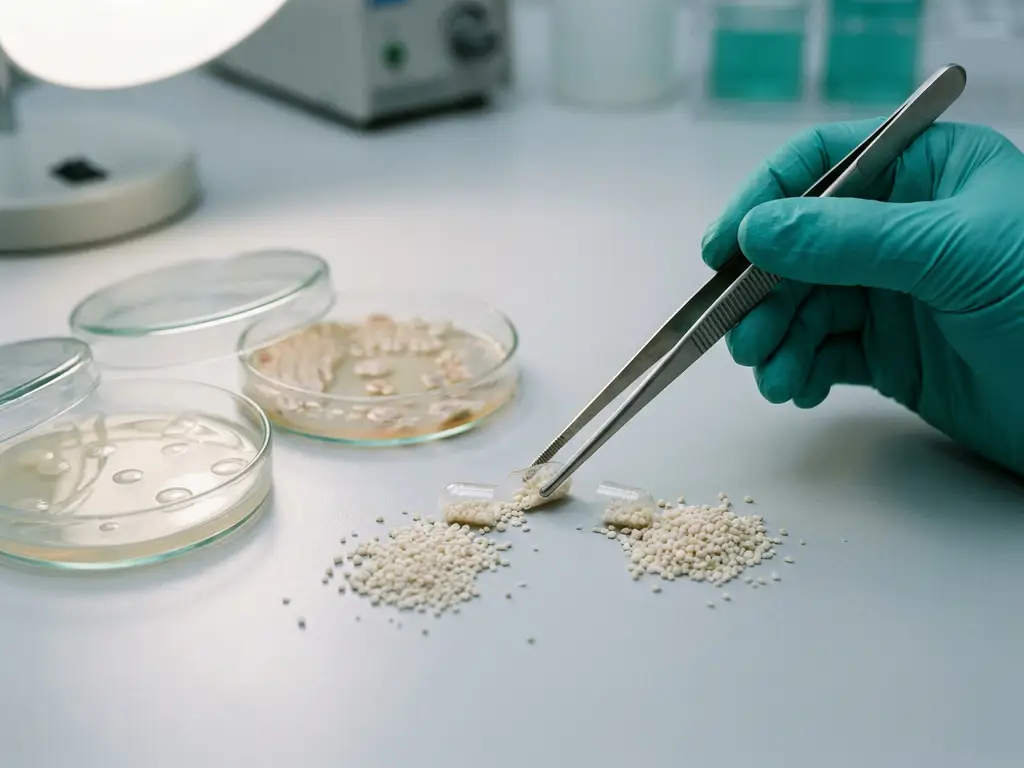
The same probiotic strain can produce different results across population groups because probiotic strain efficacy depends on the starting gut ecosystem, diet, medication exposure, and host biology, which vary by cohort. These factors shift colonisation dynamics, metabolic outputs, and host response, creating clear responder vs non-responder patterns.
In B2B R&D, this is best treated as inter-individual variability rather than product inconsistency. The goal is to identify which populations respond, why they respond, and what formulation or dose best fits the intended cohort.
The questions below break down the main drivers behind gut microbiome differences and what to control in study design to generate population-relevant evidence.
What does it mean when a probiotic strain works differently across populations?
When a probiotic strain works differently across populations, it usually means the strain interacts with different baseline microbiomes and host environments, leading to different functional outputs and clinical endpoints. In practice, the strain may be a strong performer in one cohort and a weak performer in another, creating responder vs non-responder segments rather than a single average effect.
For product developers, this has two implications. First, population-specific probiotics may need population-specific claims, endpoints, or positioning. Second, the right question often shifts from “Does it work?” to “For whom does it work, under which conditions, and via which mechanism?” Mechanistic readouts such as metabolite shifts, substrate utilisation, and community-level changes help explain why outcomes diverge between cohorts.
- Different baseline ecology changes whether the strain can establish activity or gets outcompeted.
- Different diets change available substrates and cross-feeding networks.
- Different host context changes immune signalling and barrier interactions that shape observed outcomes.
Why do baseline gut microbiomes change how a probiotic performs?
Baseline microbiomes change probiotic performance because the strain enters an existing ecosystem with its own nutrient landscape, competitors, and metabolic pathways. These gut microbiome differences determine whether the strain can express its intended function, whether it triggers cross-feeding, and which metabolites rise or fall, driving probiotic strain efficacy up or down.
Two cohorts can receive the same strain yet show different outputs because the strain may rely on specific substrates or partner microbes to generate functional metabolites. If those partners are absent or low abundance, the strain’s effect can flatten. Conversely, a cohort with complementary taxa may amplify the same intervention through cooperative metabolism.
- Competitive exclusion can limit activity if closely related taxa already occupy the niche.
- Substrate availability determines whether the strain can metabolise and persist long enough to matter.
- Network effects mean small baseline differences can cascade into large functional shifts.
How do diet, lifestyle, and medications alter probiotic effects?
Diet, lifestyle, and medications alter probiotic effects by changing gut transit, pH, bile exposure, and the availability of fermentable substrates, which collectively shape strain survival and metabolic output. Antibiotics and other microbiome-active drugs can reset community structure, creating new inter-individual variability and shifting who becomes a responder vs non-responder.
From a development perspective, diet is often the biggest unrecognised confounder. A strain designed to support carbohydrate fermentation may look ineffective in a low-fermentable-intake cohort, not because the strain fails, but because the ecosystem lacks the inputs needed for the desired metabolic pathway.
- Dietary pattern changes substrate pools and cross-feeding, altering functional readouts.
- Medication history can suppress or enrich taxa that interact with the strain.
- Lifestyle factors such as stress and sleep can influence gut motility and host response, affecting endpoints.
Do genetics, age, and immune status explain different probiotic results?
Genetics, age, and immune status can explain different probiotic results because they shape mucosal immunity, barrier function, and inflammatory tone, which influence how microbial signals translate into host outcomes. Even if the microbiome shifts similarly, downstream effects can diverge across cohorts, contributing to apparent differences in probiotic strain efficacy.
Age is especially relevant for cohort selection because microbiomes and host physiology differ across life stages. Infant and elderly populations often show distinct community structures and resilience, which can alter both the magnitude and the direction of response. Immune status also matters because some endpoints depend on host signalling rather than microbial composition alone.
- Host genetics can influence mucin structure, receptor signalling, and metabolite handling.
- Age-related physiology changes bile acids, transit time, and immune responsiveness.
- Immune context affects whether microbial changes translate into measurable host biomarkers.
What study and product factors make results look inconsistent between groups?
Results look inconsistent between groups when study design fails to capture variability or when product parameters differ subtly across trials. Small cohort sizes, inadequate donor diversity, inconsistent matrices, and endpoint mismatches can all mask true effects or exaggerate noise, making responder vs non-responder patterns appear as contradiction rather than biology.
In preclinical and early translational work, the most common issue is under-sampling human variability. If a study uses too few microbiome donors, it can accidentally select a responder-heavy or non-responder-heavy set and produce a misleading average. Product factors also matter: viability, dose form, excipients, and co-administered substrates can change functional output without changing the strain name.
- Insufficient cohort representation limits detection of inter-individual variability.
- Matrix effects can change survival and activity between formulations.
- Endpoint selection can miss the mechanism if it measures the wrong functional readout.
- Control strategy matters, including negative controls and consistent sampling windows.
How does Cryptobiotix help with population-specific probiotic performance?
Cryptobiotix helps teams understand population-specific probiotics by generating fast, mechanistic, cohort-relevant evidence that explains responder vs non-responder outcomes. Using our validated ex vivo gut model technology, we can test the same probiotic strain across multiple donors and cohorts to quantify inter-individual variability and link it to functional outputs.
- Screen strains, doses, and formulations across diverse donor panels to map gut microbiome differences that drive performance
- Measure mechanism-aligned outputs, including microbial composition, metabolite shifts, and tolerability-relevant gas readouts
- Generate evidence packages that support R&D decisions across different industries, from food and nutrition to pharma and animal health
- Share the scientific basis behind our approach via scientific evidence resources to support internal decision-making
If you are developing a probiotic and need to predict cohort performance before committing to expensive trials, contact us via the contact page to discuss your target population, endpoints, and study design.
Frequently Asked Questions
How can we identify likely responders before running a full clinical trial?
Start with a stratification plan: collect baseline stool (microbiome profile), diet pattern, and key medication history, then predefine subgroup analyses. Use a small pilot with mechanistic biomarkers (e.g., targeted metabolites, inflammation or barrier markers) to see which baseline features predict response before scaling to a powered RCT.
What baseline data should we collect to explain responder vs non-responder outcomes?
At minimum: recent antibiotic and microbiome-active drug exposure, habitual diet (especially fibre/fermentable intake), GI symptom baseline, and stool sampling for microbiome and metabolite profiling. Add host context where relevant (age, BMI, immune status markers) so you can separate microbial drivers from host-response drivers.
How long should a probiotic intervention run to detect population-specific effects?
Match duration to the mechanism and endpoint. For functional metabolite shifts, changes can appear within 1–2 weeks; for symptom or immune endpoints, 4–12 weeks is more common. Include multiple sampling timepoints so you can distinguish transient effects from sustained changes and avoid missing early responders.
How do we choose endpoints that won’t miss the mechanism in different cohorts?
Pair clinical outcomes with mechanism-aligned readouts. For example, if the strain is intended to support fermentation, include SCFAs and gas-related tolerability measures; if it targets barrier/immune signalling, include permeability or inflammatory markers. Pre-specify primary vs exploratory endpoints to reduce false negatives from endpoint mismatch.
Can formulation and co-ingredients be used to reduce variability across populations?
Yes. Adjusting dose, delivery format (capsule vs food matrix), and adding a compatible substrate (e.g., specific prebiotic fibres) can improve survival and functional output in cohorts with limited substrates. Validate changes with stability/viability testing and a small mechanistic study before making broad claims.
What are common mistakes when comparing probiotic results across countries or cohorts?
Mixing different diets, sampling protocols, and inclusion/exclusion criteria without harmonisation; ignoring medication exposure; and changing matrices or storage conditions between sites. Use standardised SOPs for product handling and sample collection, and document diet and drug exposure so differences can be modelled rather than treated as noise.
