Researchers have multiple gut model options for studying gastrointestinal function and microbiome interactions. The main categories include in silico computational models, in vitro lab simulations, ex vivo lab simulations, and in vivo animal models. Each approach offers distinct advantages for different research objectives, from mechanistic discovery to clinical translation. Understanding these options helps researchers select the most appropriate model for their specific study requirements and regulatory needs.
What are the main categories of gut models used in research?
Research gut models fall into four primary categories: in vivo animal models, in vitro lab & cell culture systems, ex vivo fermentation models, and in silico computational approaches. Animal models use living organisms to study gut function and complex phenotypes, while in vitro systems recreate basic gut conditions in laboratory settings. Ex vivo models bridge these approaches by using human-derived samples outside the body, and computational models simulate gut processes mathematically.
Each category serves different research purposes and provides unique insights. Computational models enable large-scale screening. Animal models offer whole-system complexity but face translation challenges to human physiology. In vitro systems provide controlled conditions for mechanistic studies but lack biological relevance and translate poorly into clinical outcomes – think “quick & dirty”. In 2021, we introduced a new category of laboratory testing for the gut microbiota: an ex vivo approach that maintains each individual microbiome’s identity, allowing for the generation of predictive insights at preclinical stage.
The choice between these gut models depends on research objectives, timeline constraints, and the specific questions being investigated. Modern research increasingly favours human-relevant approaches that can predict clinical outcomes more accurately than traditional animal testing.
How do laboratory gut models compare to animal testing?
Laboratory gut models offer significant advantages over animal testing, including markedly lower costs, higher-throughput capabilities, and minimisation of ethical concerns. These laboratory-based systems can process tens of conditions simultaneously, while animal studies are limited by housing constraints and ethical considerations. Laboratory approaches also offer the possibility of better standardisation and reproducibility, if done well. In that respect, in vitro gut fermentation studies score poorly in comparison to a truly ex vivo methodology.
However, animal models have historically been considered the gold standard for their biological complexity. The main advantage remains in the direct investigation of complex phenotypes rather than biomarkers. Yet animal microbiomes differ substantially from human microbiomes in taxonomic composition, gut transit times, pH levels, and bile acid profiles amongst others. These fundamental physiological differences lead to difficultly translatable results when studying human gut health applications.
Modern regulatory frameworks increasingly support non-animal approaches. The FDA Modernization Act 2.0 and EU Directive 2010/63/EU actively promote alternatives to animal testing. The 3R principle (Replacement, Reduction, Refinement) further encourages researchers to adopt human-relevant gut models that can better predict clinical outcomes.
What makes ex vivo gut fermentation modelling superior to in vitro gut models?
Ex vivo gut fermentation modelling use unmodified microbiome samples to simulate gut conditions outside the body. A prerequisite for being called ex vivo is that such gut model maintains the original microbial composition and individual donor characteristics throughout the fermentation process. This approach preserves microbiome functionality as if working with a living biopsy.
The key advantage lies in solving the lack of translational power of in vitro systems. Ex vivo gut models demonstrate microbiome effects immediately, within a single administration of an intervention, as they rely on a biorelevant sample of the microbiome. They allow the observation of gut bacteria responding to interventions within hours and days, not weeks. This immediate microbial response represents the foundational event that drives long-term clinical outcomes observed in multi-week human trials.
Unlike traditional fermentation systems that adapt microbiomes over extended periods, ex vivo models preserve the original donor characteristics. This biorelevance enables researchers to capture authentic human microbiome responses and predict how different individuals might react to specific interventions in real-world conditions.
Which gut model should researchers choose for their specific study?
Gut model selection depends on research objectives, budget constraints, timeline requirements, and regulatory needs.
In silico gut modelling requires a lot of data, good quality data, and a very targeted research question. Often relying on functional metagenomic analysis, it aims to map the functional potential of probiotic strains, or for fibres, alternative analyses look for possible metabolic interactions and pathways. This exploratory approach allows the narrowing down of candidates from 1000+ to a more restrictive subset for further analysis.
Hight-throughput ex vivo screening, like the SIFR technology in screening mode, is rapidly evolving to provide an alternative first-pass screening instead of in silico modelling, enabling the targeted analysis of many conditions to further rank candidates and produce a hit list worthy of advanced characterisation.
In the past, after such narrowing, or in case you would have a limited number of products already, in vitro models were providing elementary hypothesis testing in simple conditions. This first evidence that an ingredient may work is however increasingly deemed insufficient for fundraising or patentability, as it does not accurately capture the complexity of the microbial ecosystem, where the outcome may very well be different.
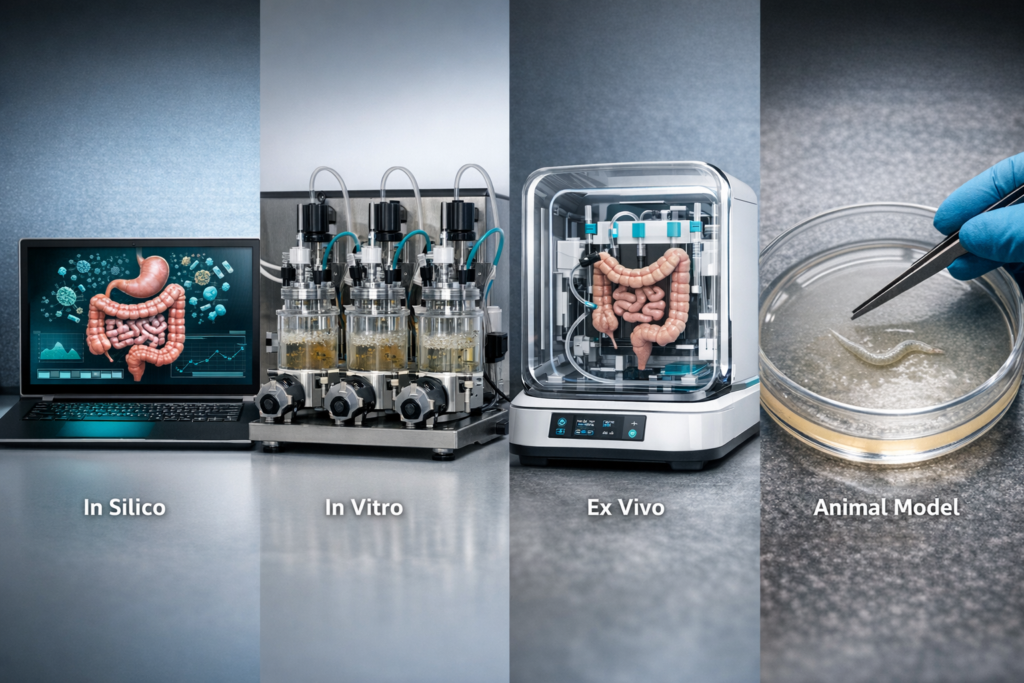
With the superiority of ex vivo gut models, demonstrated by the SIFR technology in prism mode, companies increasingly require biologically and technologically robust data from the get-go. Ingredients are tested not with a single strain, or a reduced biological context, but with a full microbial ecosystem, representative of the intended use case. By considering multiple individual microbiota in parallel and generating predictive data across omics, a single, well-designed preclinical study can generate all the data needed for fundraising, securing IP and de-risking clinical trials.
For mechanistic discovery studies, animal testing has gradually veered towards nematode models like Caenorhabditis elegans to test pure ingredients and strains, but this does not capture the more complex interactions with the microbial ecosystems. Nematode models are an emerging technology, showing some potential in identifying phenotypic effects.
Budgets are varying very much across technology providers and there is no shortcut. Robust scientific evidence has a cost, but erroneous data leading to clinical failure down the line could have catastrophic consequences otherwise. Quick and dirty in vitro findings may help pre-seed, while in silico and animal trials may be out of reach. In the recent years, customisable ex vivo models like the SIFR technology have also proven to accommodate start-up budgets with smart customisations of the experimental parameters. As regulatory submissions increasingly demand mechanistic evidence as well, complementing clinical efficacy demonstration with predictive ex vivo data is a sound path to success.
Timeline requirements also matter: some in vitro and animal models deliver results within a few months to a year. A truly ex vivo approach can deliver results within a few weeks to a few months already. Research complexity should match model sophistication.
How Cryptobiotix advances gut model research with the SIFR® technology
We provide validated ex vivo gut simulations through our proprietary SIFR® technology, which bridges the “Valley of Death” between preclinical and clinical research. Our platform maintains fresh human microbiome samples without adaptation bias, generating clinically predictive data within 24-48 hours that mirrors outcomes observed after weeks of clinical testing.
Designed to replace poorly translatable in vitro models and make large numbers of conditions easy to test in the laboratory, the SIFR technology bridges preclinical needs from early R&D screening needs, all the way to advanced mechanistic analysis considering interindividual variation. One model, fully validated, customised to your specific research needs.
The modular SIFR technology platform offers comprehensive gastrointestinal research capabilities:
- Advanced mechanistic elucidation – combining taxonomy, metabolites and host-microbiome interactions to elucidate structure-function relations
- High throughput – simulating over 1,000 conditions per week in prism mode; up to 10,000 conditions in screening mode
- Population diversity – testing across a minimum of 6–8 donors per cohort for statistical reliability
- Actionable insights – telling you exactly what you need to know, and giving you all the analysed and interpreted data
- IP- & regulatory-grade data – supporting dossier preparation with accurate mechanistic evidence
Our approach has been extensively validated through scientific publications demonstrating correlation with clinical outcomes, for taxonomy, metabolites, and impact on the host. Whether you are preparing regulatory submissions, de-risking clinical trials, or generating mechanistic insights for product development, the SIFR technology provides the predictive accuracy needed for confident decision-making. Contact us to discuss how our validated ex vivo SIFR technology pipeline can accelerate your gut microbiome research.
Frequently Asked Questions
How do I determine the minimum number of donors needed for statistically reliable results in ex vivo gut studies?
For ex vivo gut fermentation studies, we recommend a minimum of 6-8 donors per cohort to achieve statistical reliability and capture inter-individual microbiome variability in a defined population. This sample size accounts for the natural diversity in human gut microbiomes and provides sufficient power to detect meaningful treatment effects. Consider increasing donor numbers to 12-18 for studies investigating subtle effects or when targeting specific populations with expected high variability, depending on the desired statistical granularity.
What are the most common mistakes researchers make when transitioning from animal models to human-relevant gut systems?
The most frequent error is expecting identical experimental conditions and timelines from animal studies to translate directly to human-relevant models. Researchers often underestimate the importance of donor selection criteria and fail to account for interpersonal microbiome diversity. Additionally, many overlook the need for different analytical approaches, as human gut models require more sophisticated multi-omics analysis to properly capture structure-function relations.
How long does it typically take to generate data from different gut model approaches?
Timeline varies significantly by model type: ex vivo gut models produce data within 24-48 hours, in vitro assays typically require 1 week-8 weeks, while animal studies often take 4-12 weeks depending on the endpoint measured. Computational models can generate predictions within hours to days, but require existing datasets for validation.
The simulation itself is not the only contributing aspect for the timeline: donor recruitment, sample analysis, data analysis and interpretation & reporting all impact timeline significantly.
Can ex vivo gut models predict individual patient responses, or do they only show population-level effects?
An ex vivo gut model excels at capturing individual donor variability and can predict personalised responses when samples from specific donor populations are used. By testing interventions across multiple individual donors, researchers can identify responders versus non-responders and correlate responses with baseline microbiome characteristics. This individual-level prediction capability is particularly valuable for precision medicine applications and personalised nutrition research.
What regulatory documentation do I need when using human-relevant gut models for product development?
Regulatory submissions require detailed documentation of model validation, standard operating procedures, and evidence demonstrating clinical relevance of your chosen model. For ex vivo models, include donor consent procedures, sample handling protocols, and validation studies showing correlation with clinical outcomes. The FDA and EMA increasingly demand mechanistic data from human-relevant models, but ensure your documentation clearly links model findings to predicted human health outcomes.
What budget should I allocate for different gut model approaches, and what factors drive cost variations?
Advanced ex vivo testing typically costs 60-80% less than animal studies, with budget ranges from € 500-2,000 per ingredient depending on depth of analysis. For screenings, the cost per ingredient may be significantly lower, but require a large number of conditions, offsetting an overall economy. In vitro systems are particularly volatile and technology-dependent (€3,000-60,000), while animal studies can range from €25,000-150,000+ depending on duration and complexity. Key cost drivers include donor recruitment, multi-omics analysis, regulatory-grade documentation, and the number of test conditions evaluated.