


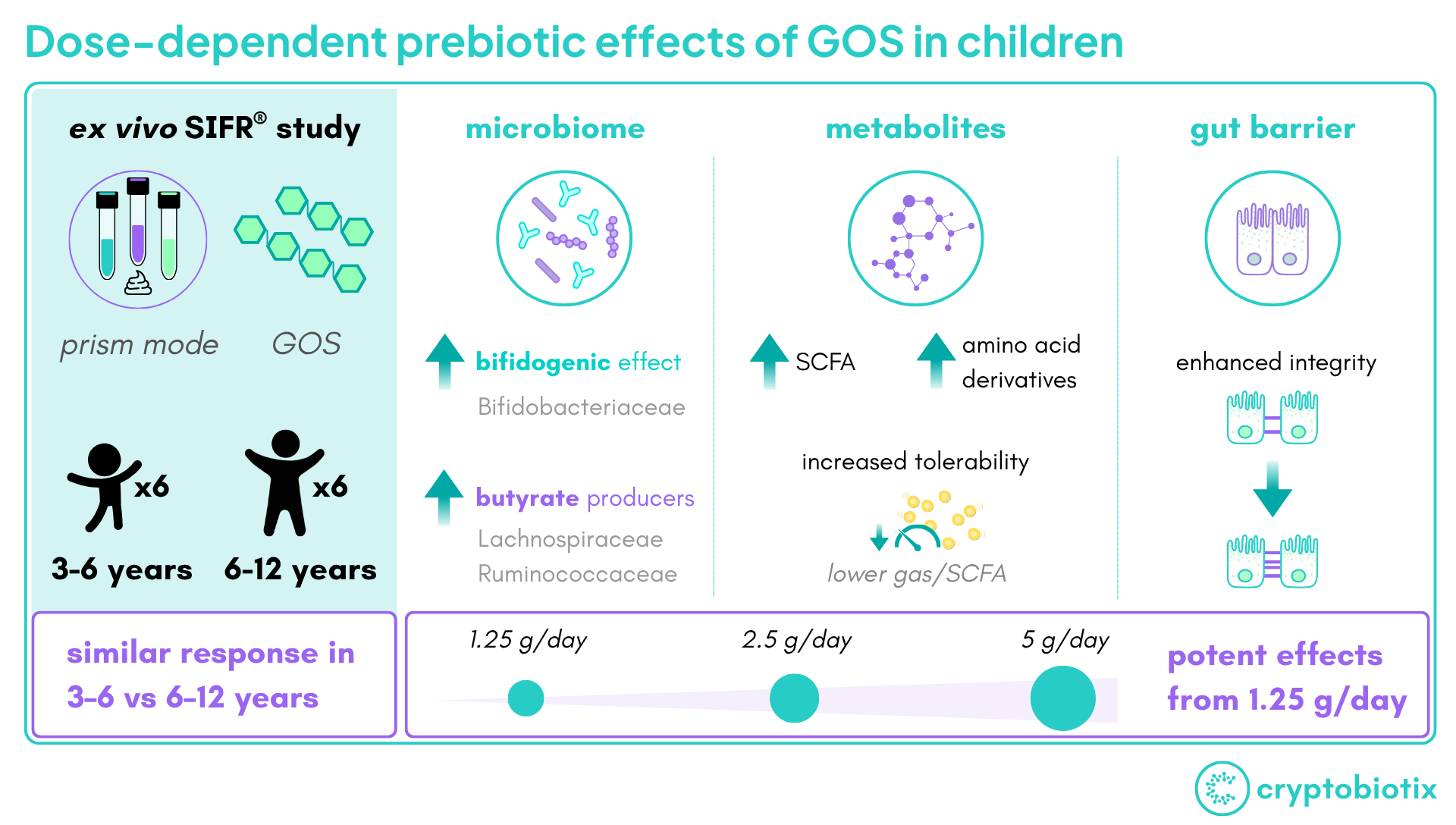
Galactooligosaccharides (GOS) are well-established prebiotic fibres, yet dose-response relationships and functional effects on children’s microbiota remain incompletely characterized. In the present study, Cryptobiotix and FrieslandCampina investigated the impact of three GOS doses (1.25, 2.5, and 5 g/day equivalents) on gut microbiota composition, microbial metabolism and gut barrier function in children aged 3 to 12 years, using the predictive, ex vivo SIFR® technology pipeline.
Using the SIFR® technology, we tested all three GOS doses in younger (3 to 6 years) and older children (6 to 12 years). GOS induced pronounced, dose-dependent bifidogenic effects and significantly increased other beneficial microbial taxa, including butyrate-producing Lachnospiraceae and Ruminococcaceae, in both age groups. These compositional shifts were accompanied by elevated SCFA levels (acetate, propionate, butyrate), with significant effects already observed at the lowest dose (1.25 g/day), while gas formation increased proportionally less, resulting in a lower gas-to-SCFA ratio.
Untargeted metabolomics revealed stimulation of additional health-relevant metabolites, including N-acetylated amino acids, agmatine and polyamines along with tryptophan-derived indoles and p-hydroxyphenyllactic acid, many of which were already significantly increased at lower GOS doses. These metabolites are associated with antioxidant, anti‑inflammatory, antimicrobial, neuroprotective and metabolic effects, as well as support of gut barrier integrity.
GOS shaped the child gut ecosystem in a dose-dependent manner, with significant effects already at 1.25 g/day and highly comparable responses in younger and older children. Beyond its strong bifidogenic effects, GOS stimulated propionogenic and butyrogenic taxa, enhanced the production of health-relevant metabolites and strengthened gut barrier integrity under both normal and inflammatory conditions. For formulators, this gives a clear dose rationale and highlights GOS as a promising nutritional strategy to support child health through modulation of the gut ecosystem, with potential broader influences on immune response, inflammatory regulation and neuroprotection.
Full article: De Beul et al, 2026, Frontiers in Nutrition
Explore other, relevant SIFR studies:
