


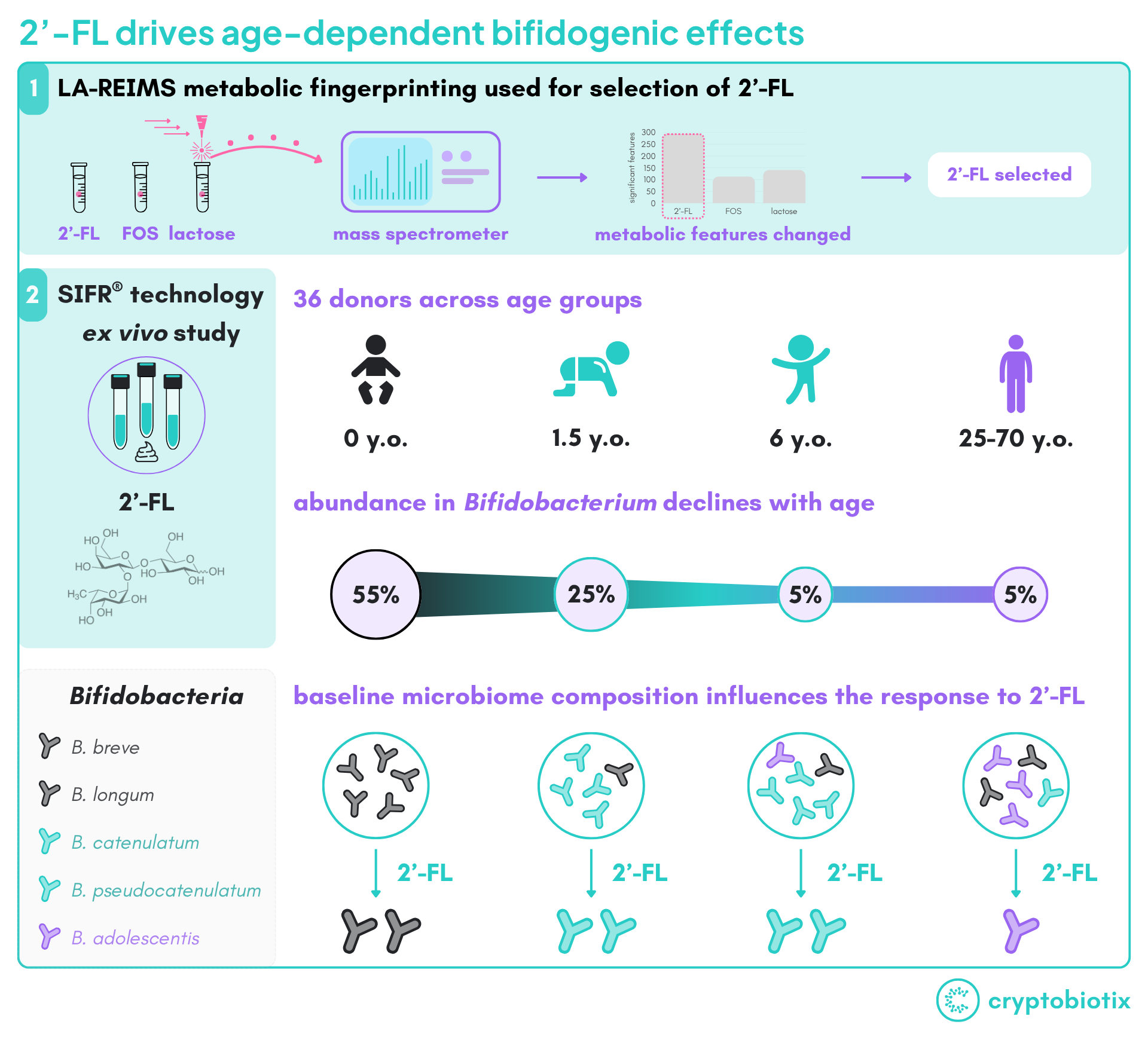
Laser-Assisted Rapid Evaporative Ionization Mass Spectrometry (LA-REIMS) is a novel, automated metabolomic and lipidomics technology, used for rough fingerprinting. The technology bypasses chromatographic separation and vaporises directly the samples using a laser. This results in very fast analysis time, in the 10s of seconds instead of traditional, separation-based metabolomics taking 10s of minutes. Unlike standard metabolomics and lipidomics approaches, LA-REIMS focuses on fingerprinting rather than obtaining molecular resolution. In the present study metabolic fingerprinting identified 2′-FL among three tested ingredients (2′-FL, FOS and lactose) for further in-depth analyses.
The gut microbiome changes substantially throughout life, yet age is rarely considered when evaluating responses to microbiome-targeted nutritional interventions. Researchers from the USDA Agricultural Research Service, Cryptobiotix, Ghent University and Queen’s University Belfast investigated how gut microbiomes from 36 donors across six age groups, spanning infancy to adults up to 70 years old, responded to the human milk oligosaccharide 2′-fucosyllactose (2′-FL), with fructo-oligosaccharides (FOS) and lactose included as comparators.
Using the predictive, ex vivo SIFR® technology pipeline, we observed age-dependent differences in the microbial response to 2′-FL, driven by distinct Bifidobacterium species across life stages. In infants, 2′-FL predominantly stimulated B. breve and B. longum, whereas B. catenulatum and B. pseudocatenulatum were important responders in toddlers and children. In adults, B. adolescentis was a major responder, with its increase reaching statistical significance across all age groups from toddlers onwards.
These compositional differences were accompanied by age-specific metabolic responses, including differences in SCFA production and microbial cross-feeding interactions. While 2′-FL exerted bifidogenic effects across all age groups, the specific microbial species stimulated and their metabolic interactions varied with age.
The findings demonstrate that the same microbiome-targeted ingredient can produce different microbial and metabolic effects depending on the age of the consumer, highlighting age as a key consideration in the development of precision nutrition strategies. By preserving both age-specific microbiome characteristics and interindividual variability, the SIFR® technology provides a powerful approach for identifying age-dependent and individual response patterns, supporting the development of microbiome-targeted nutritional interventions tailored to different life stages.
Full article: Firrman et al, 2025, Nutrients
Explore other, relevant SIFR studies:
