Nicotinamide adenine dinucleotide (NAD(H)) is a vitamin B3-derived redox cofactor essential for numerous metabolic reactions and protein modifications. Disturbances in NAD+ homeostasis are linked to multiple health conditions, which is why dietary precursors such as nicotinamide riboside (NR), nicotinamide mononucleotide (NMN) and nicotinamide (Nam) are widely studied as ways to restore NAD+ levels.
However, NR and NMN exhibit low oral bioavailability and are poorly absorbed intact in the gastrointestinal tract, leaving their mode of action unresolved given how little of the parent compound reaches systemic circulation.
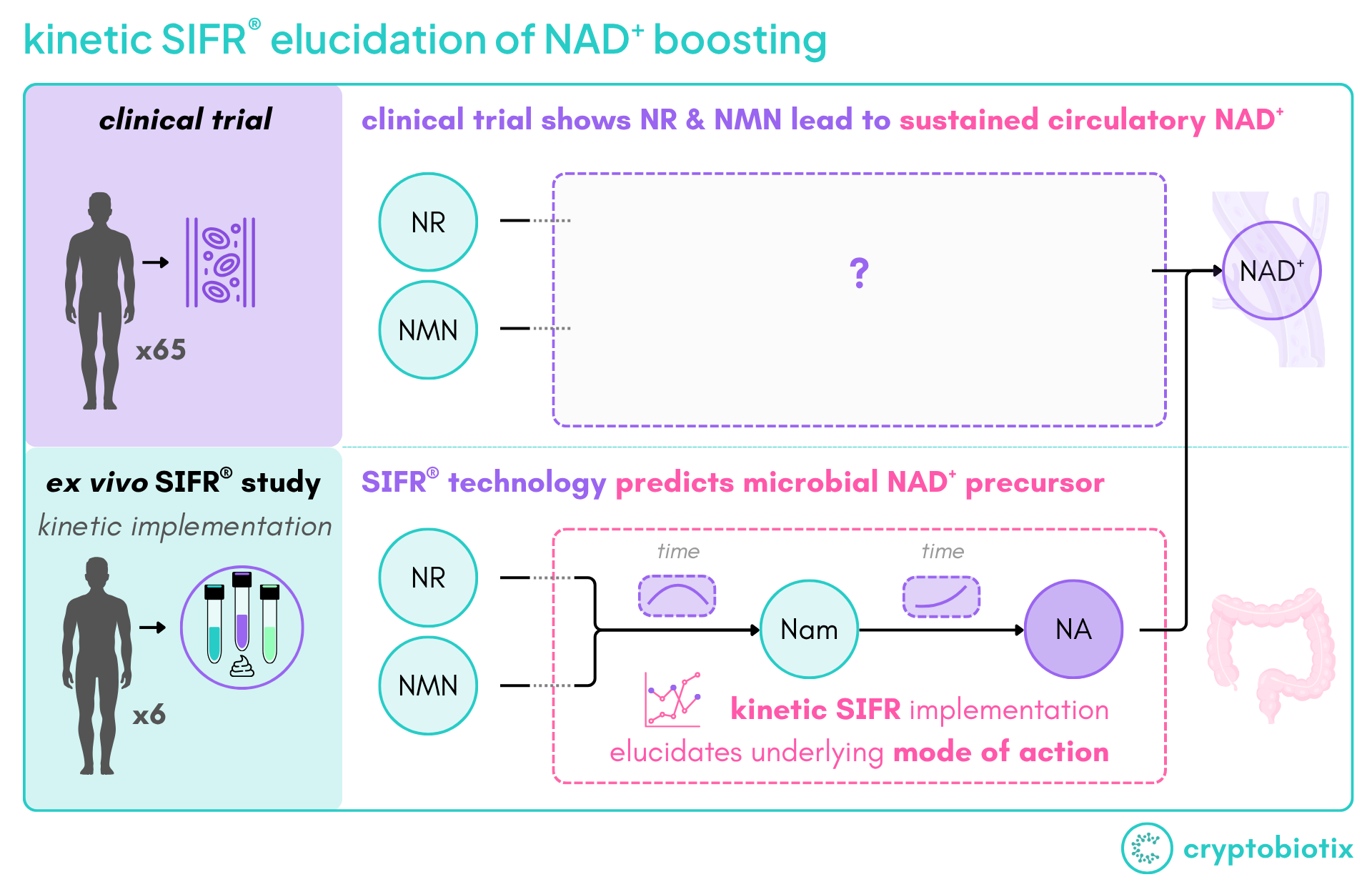
To investigate this gap, Nestlé Research and Nestlé Health Science led a randomized, placebo-controlled clinical trial comparing NR (1 g/day), NMN (1 g/day), Nam (0.5 g/day) against placebo in 65 healthy adults over 14 days, measuring how each precursor affects circulatory NAD+.
Alongside the clinical trial, researchers turned to Cryptobiotix’s predictive, ex vivo SIFR® technology pipeline, a gut fermentation model that simulates the human intestinal environment outside the body, tracing exactly what happens to NR and NMN once they reach the gut, something a clinical blood test alone can’t capture.
For the clinical results, 14 days of NR and NMN supplementation nearly doubled whole-blood NAD+ concentrations, with increases of 49.4 µM and 43.1µM versus placebo, respectively, while Nam did not significantly increase NAD+ compared with placebo.
Using the predictive, ex vivo SIFR® technology pipeline, time-resolved fermentation showed that NR was rapidly converted by human gut microbiota into nicotinic acid (NA), while increasing acetate, propionate, total short-chain fatty acids and bacterial growth. These metabolic effects were consistent across healthy adults, healthy older individuals and people with Crohn’s disease, with NA accumulating across all three donor populations.
A single-timepoint result from the predictive, ex vivo SIFR® technology pipeline already shows that the gut microbiome changes significantly when exposed to NR and NMN, visible through shifts in composition and metabolites by the end of fermentation.
Sampling across the full fermentation window, rather than one endpoint, reveals the sequence in which the microbiome converts NR from nicotinamide through to NA, with short-lived peaks of NMN, nicotinic acid riboside (NAR) and nicotinic acid mononucleotide (NAMN) along the way. This shows which compound feeds which microbial activity, and when. It also makes it possible to distinguish a real mechanistic pathway from a coincidental association, since intermediates can be watched building up and being consumed over time rather than compared only at a start and end point.
Full article: Christen et al, 2026, Nature Metabolism
Explore other, relevant SIFR® studies: